What Is the Panamanian Closing Process? A Buyer's Guide
What Is the Panamanian Closing Process? A Buyer’s Guide
If you’re considering a real estate transaction in Panama, understanding what is Panamanian closing process will save you from costly surprises. Most foreign buyers assume closing works like it does back home: sign a contract, wire funds, get the keys. Panama’s process is more structured than that, with specific legal stages, government filings, tax obligations, and banking hurdles that can stretch your timeline well beyond what you expect. This guide breaks it all down, step by step, so you know exactly what you’re walking into.
Table of Contents
- Key takeaways
- What is Panamanian closing process, step by step
- Legal and tax considerations you cannot ignore
- Practical challenges that slow down closing
- Closing costs in Panama: what to budget
- My honest take on Panama’s closing process
- How Panamainvestors helps you close with confidence
- FAQ
Key takeaways
| Point | Details |
|---|---|
| Multi-stage process | Panama closing involves five distinct stages from offer to Public Registry registration. |
| Timeline varies widely | Closings typically take 30 to 90 days depending on transaction complexity. |
| Budget 2% to 5% in costs | Closing costs cover transfer tax, notary, registration, and attorney fees on top of purchase price. |
| Attorney is non-negotiable | A qualified Panamanian attorney protects you from title defects and registration rejection. |
| Banking is the biggest delay | AML checks on fund sources can add weeks to your closing timeline if you’re not prepared. |
What is Panamanian closing process, step by step
The Panamanian real estate closing process is not a single event. It is a sequence of legally required stages, each building on the last. Skip one, and you risk losing your deposit, having your title rejected, or paying taxes incorrectly. Here is how it unfolds.
Stage 1: the Promise to Purchase agreement
Once you and the seller agree on terms, the first formal document is the Promesa de Compraventa, or Promise to Purchase. This is a binding contract that locks in the price, payment schedule, and conditions. You typically pay a deposit of 10% at this stage. The agreement gives both parties time to complete due diligence before signing the final deed. Think of this as Panama’s equivalent of going under contract.
Stage 2: due diligence
Due diligence in Panama is serious business. Your attorney checks the property’s title at the Public Registry, confirms there are no liens, mortgages, encumbrances, or unpaid property taxes, and verifies that the seller actually has the legal authority to sell. If the property is held through a Panamanian corporation, your attorney will also review the corporate books. This stage is where problems surface. A clean due diligence report is your green light to proceed.
Stage 3: signing the Escritura Pública
This is the moment most people picture when they think of “closing.” The final Purchase and Sale Contract is called the Escritura Pública, and it must be signed before an official Panamanian Notary Public. The notary verifies the identity of both parties, confirms the documents are legally valid, and certifies the deed for filing. No notary, no legal transfer. It is that simple.
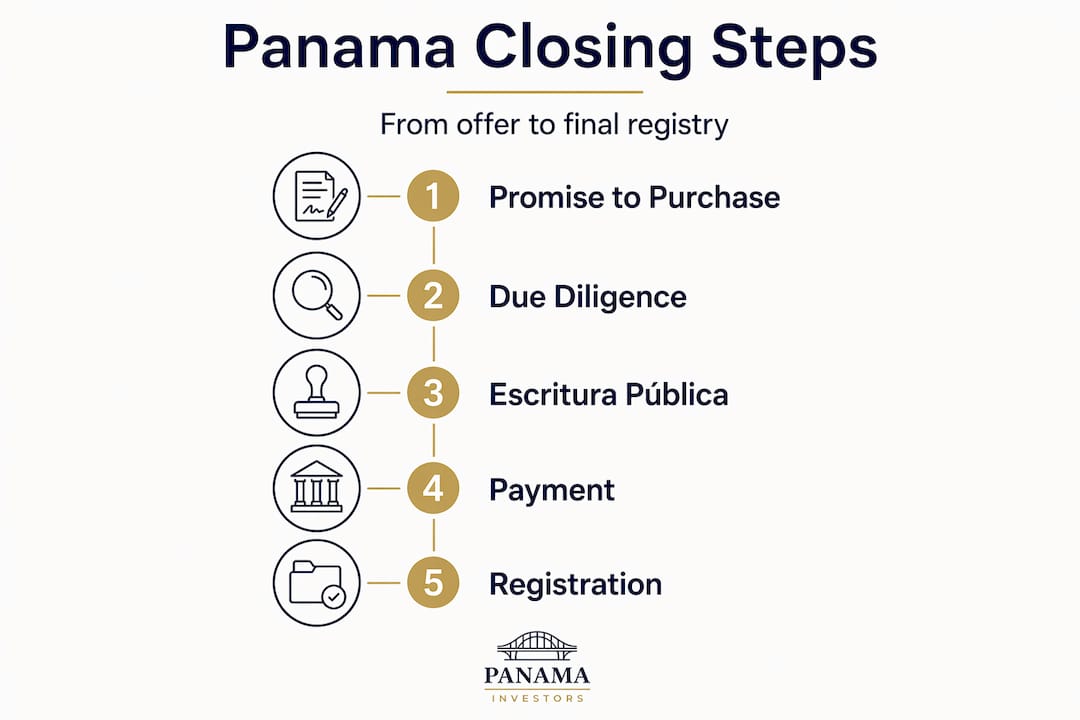
Stage 4: payment
Panama favors escrow accounts or bank-certified funds for the balance payment at closing. Escrow protects both the buyer and seller by holding funds until all conditions are met and the deed is ready for registration. Cash transactions or unverified wire transfers are a red flag to local attorneys and banks alike. Using escrow is not just smart. It is the industry standard for any professionally managed transaction.

Stage 5: registration at the Public Registry
After signing, your attorney submits the deed to Panama’s Public Registry, the Registro Público. This is the official step that records you as the legal owner. Registration typically takes a few days up to two weeks after submission. Until registration is complete, the sale is not legally final. You should receive a certified copy of the registered title once the process is done.
Pro Tip: Request a pre-registration search at the Public Registry right before closing day to catch any last-minute liens or encumbrances filed between your initial due diligence and your signing date.
For a full breakdown of how this fits into the broader purchase journey, the step-by-step buying guide from Panamainvestors covers the process in practical detail.
Legal and tax considerations you cannot ignore
The legal framework around Panamanian real estate closing has a few moving parts that regularly catch foreign buyers off guard. Understanding them early protects your investment.
- Transfer tax: Panama levies a 2% property transfer tax based on the higher of the registered value or the sale price. This tax is paid at closing and is typically the seller’s responsibility, though it is always worth clarifying in your purchase agreement.
- Capital gains tax: Sellers pay a 3% capital gains tax on the gain from the sale. Buyers should confirm the seller has settled this obligation, since unpaid taxes can complicate registration.
- Notary fees: The Notary Public charges fees based on the transaction value. These are standardized by law and not subject to negotiation.
- Role of your attorney: Legal representation is non-negotiable for smooth title transfer and regulatory compliance. Your attorney coordinates with the Dirección General de Ingresos (DGI) and the Public Registry to prevent filing errors that result in rejection.
- Corporate share transfers: Some transactions involve buying the shares of a Panamanian corporation that holds the property rather than buying the property directly. This alternative structure triggers a 5% tax instead of the standard 2% transfer tax, and carries its own due diligence requirements. It can be faster in some cases, but it also means you inherit any corporate liabilities.
Pro Tip: If you are buying through a corporate share transfer, always have your attorney conduct a full review of the corporation’s legal and financial history, not just the property title.
The most common reason for registration rejection is document errors or missing coordination between your attorney, the DGI, and the Public Registry. Engaging experienced legal counsel from the start prevents this. Panama’s legal system requires precision, and the consequences of getting it wrong can add weeks and fees to your transaction.
Practical challenges that slow down closing
Knowing the steps is one thing. Understanding the real-world friction points is what actually prepares you for what to expect in Panama closing.
Banking is where most deals hit a wall
The single biggest delay in Panamanian real estate closings is banking. Opening a local bank account can add 2 to 4 weeks to your closing timeline due to Panama’s strict anti-money-laundering checks. Banks require extensive source-of-funds documentation, including bank statements, tax returns, proof of income, and sometimes a reference letter from your home bank. International buyers who show up to closing without a local account already in place are the ones scrambling.
Start your banking process the moment you sign the Promise to Purchase. Do not wait until due diligence is done.
Remote signing and document logistics
Foreign buyers can hold titled property in their own names, but managing documents from abroad adds complexity. Some buyers use a Power of Attorney to authorize a local representative to sign on their behalf, which requires notarization and apostille certification in their home country. Build two to four extra weeks into your timeline if you plan to close remotely.
Timeline comparison by transaction type
| Transaction type | Typical timeline | Key variables |
|---|---|---|
| Straightforward titled property | 4 to 6 weeks | Clean title, buyer has local bank account |
| Property with encumbrances to clear | 8 to 12 weeks | Seller needs time to discharge liens |
| Corporate share transfer | 6 to 10 weeks | Corporate due diligence and tax structuring |
| Remote buyer with no local bank | 10 to 14 weeks | Banking setup and document apostille time |
Panama’s closing process typically spans 30 to 90 days from accepted offer to registered title. Plan for the longer end if you are an international buyer without an existing Panamanian banking relationship.
Closing costs in Panama: what to budget
Closing costs in Panama are real and they add up. Total buyer closing costs range from 2% to 5% of the purchase price. On a $200,000 property, that means $4,000 to $10,000 on top of your purchase price before you receive a single key.
Here is a typical breakdown:
- Transfer tax: 2% of the higher of the cadastral value or sale price (seller pays, but confirm in contract)
- Public Registry fees: Approximately 0.1% to 0.3% of the property value
- Notary fees: Usually $300 to $800 depending on transaction value
- Attorney fees: Typically 1% to 2% of the purchase price
- Escrow fees: Usually a flat fee of $500 to $1,500 depending on the escrow provider
The buyer almost always covers attorney fees, registration fees, and escrow costs. Transfer tax is legally the seller’s obligation, but deals sometimes split costs differently. Get this in writing in your Promise to Purchase so there are no arguments at the table.
There are additional costs in complex transactions. Corporate share transfers require corporate legal review, which adds attorney fees. Properties with tax exemptions under Panama’s Exoneración program may have different tax treatments that require specialist advice.
My honest take on Panama’s closing process
I’ve sat through enough of these closings to tell you that the biggest misconceptions buyers arrive with are about speed and simplicity. People hear Panama is a buyer-friendly market, which it is, and then assume that means everything moves fast and loose. It doesn’t.
In my experience, the buyers who have the smoothest closings are the ones who start their banking early, hire their attorney before they even identify a property, and accept that two months is a normal timeline, not a failure. The ones who struggle are the ones who wait, assume their U.S. or European banking relationships will transfer seamlessly, or try to manage the process without a Panamanian attorney on the ground.
I’ve watched deals fall apart over banking delays that had nothing to do with the property itself. The buyer’s funds were legitimate, the title was clean, the seller was cooperative, but the bank’s compliance process took nine weeks. That’s not a worst-case scenario. That’s just Panama.
What I find most buyers don’t realize is that local attorneys often have relationships with specific notaries and registry officials that genuinely speed things up. Choosing an attorney who works in Panama City real estate transactions every week is not the same as hiring someone who does it occasionally. The network matters as much as the legal knowledge.
My advice: treat closing not as the finish line but as a process you manage from the moment you make an offer. Early preparation, patient expectations, and the right local team make all the difference.
— Roie
How Panamainvestors helps you close with confidence
Navigating the Panamanian closing process without experienced local support is the fastest route to delays, unexpected costs, and avoidable legal problems.

Panamainvestors, led by Luca Piva with over 12 years of on-the-ground experience, guides buyers through every stage of the Panama property purchase process, from identifying the right property to completing Public Registry registration. The team understands how to coordinate attorneys, notaries, and banks to keep your timeline on track, and they know which pitfalls tend to cost buyers the most. Whether you are buying a residential condo in Panama City or a commercial asset, getting the right advisory support at the start of the process protects your investment at every step. Book a strategy call to discuss your specific situation and get a clear picture of what your closing will involve.
FAQ
How long does the Panamanian closing process take?
The Panamanian real estate closing process typically takes 30 to 90 days from accepted offer to registered title. Straightforward transactions with a clean title and an established local bank account can close in four to six weeks, while complex deals or remote buyers may take three months or more.
What are the main closing costs in Panama?
Total closing costs in Panama typically range from 2% to 5% of the purchase price, covering the 2% property transfer tax, Public Registry fees, notary fees, and attorney fees. On a $200,000 property, budget between $4,000 and $10,000 in additional costs.
Do foreign buyers need a local attorney to close in Panama?
Yes. A qualified Panamanian attorney is required to coordinate with the DGI and the Public Registry to prevent errors that lead to registration rejection. Legal representation is not optional for a secure, legally valid property transfer.
What is the Escritura Pública in a Panama closing?
The Escritura Pública is the final Purchase and Sale Contract signed before an official Panamanian Notary Public. It is the binding legal document that authorizes the transfer of property title and must be filed with the Public Registry to complete the sale.
Why does banking delay real estate closings in Panama?
Panama’s banks conduct strict anti-money-laundering checks on all incoming funds, requiring buyers to provide detailed source-of-funds documentation. Opening a new local bank account can add two to four weeks to the closing timeline, making it one of the most common delays in Panamanian real estate transactions.
