Panama property registry explained: secure your real estate investment
Panama property registry explained: secure your real estate investment
- Panama Investors
- 5 days ago
- 10 min read
Fewer than one in five properties in Panama are formally titled, according to World Bank data. If you’re used to buying real estate in the United States or Europe, where title searches are routine and ownership records are mostly complete, that number should stop you cold. Panama’s property registry system works differently from what most international buyers expect, and the gap between assumption and reality is exactly where costly mistakes happen. This article walks you through how the system works, what the registration process actually involves, where the risks hide, and why the ongoing modernization push creates a genuine opportunity for investors who pay attention.
Table of Contents
Key Takeaways
Point | Details |
Titled land is rare | Only about one in five Panamanian properties is formally titled, so due diligence is vital. |
Registry process is multifaceted | Registering property involves legal steps, taxes, and registry filings totaling about 2.25% plus taxes. |
Modernization is accelerating | Recent investments are expanding the digital registry, improving security for foreign buyers. |
Expert guidance is crucial | Hiring specialized legal or advisory help can help avoid costly mistakes in Panama’s evolving system. |
Understanding property rights and registration in Panama
To properly navigate this system, you first need to understand exactly what property registration means in the Panamanian context.
Panama operates two distinct categories of land ownership, and the difference between them is not minor. Titled property refers to land that is formally recorded in the Public Registry (Registro Público), Panama’s centralized government database of legal ownership. When you hold a title registered there, your ownership is legally recognized, publicly documented, and defensible in court. You can use titled property as collateral for a mortgage, transfer it cleanly to heirs, or sell it to a foreign buyer with full legal confidence.
Right-of-possession (ROP) property, on the other hand, is land that someone occupies and uses without a formal registered title. These are not squatters in the conventional sense. In many cases, families have lived on ROP land for generations, and Panamanian law does recognize certain possession rights. But those rights are informal, harder to enforce, and far more vulnerable to disputes.
The numbers make the problem clear. Only 19% of Panamanian properties are formally titled, leaving the vast majority outside the protection of the formal property registry. That means if you’re browsing listings without professional guidance, a significant portion of what you’re looking at may carry legal risk that isn’t obvious at first glance.
Here’s a quick comparison of the two property types:
Feature | Titled property | Right-of-possession (ROP) |
Recorded in public registry | Yes | No |
Usable as loan collateral | Yes | Rarely |
Foreign buyer eligibility | Full rights | Limited and complex |
Legal dispute resolution | Clearer | Ambiguous |
Appreciation potential | Higher | Lower |
Path to formal title | Already titled | Titling process required |
The risks of buying ROP property without expert guidance go beyond just paperwork. You could face competing claims from family members of previous occupants, government reclamation of land in certain zones, or complete inability to resell to a buyer who needs financing. Our guide to buying real estate in Panama covers this distinction in depth, because it’s one of the first things every investor must understand before making an offer.
Important: Even in Panama City’s urban core, some properties carry murky title histories. Always confirm registry status before signing anything.
Panama’s government has acknowledged these gaps for years, and recent moves toward digital modernization signal genuine change. But the current state of the system still demands that you do your homework before committing capital.
How the property registration process works
With a clear understanding of why property registration matters, let’s look at the exact process international buyers must navigate in Panama.
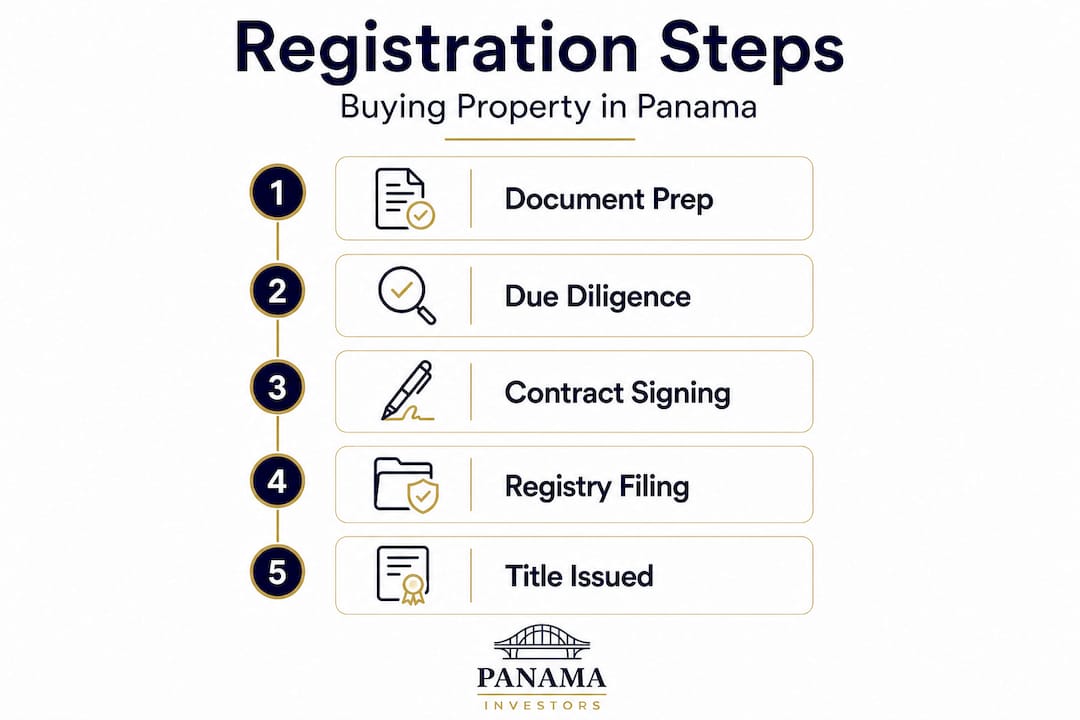
Registering a property in Panama is not a single transaction. It is a sequence of coordinated steps involving multiple government offices, legal professionals, and formal documentation. The full process typically takes about 45 days and costs approximately 2.25% of the property value plus applicable taxes and professional fees. Here’s how it unfolds:
Obtain a non-encumbrance certificate. Your attorney requests this document from the Public Registry to confirm that the property has no outstanding liens, mortgages, or legal encumbrances. This step protects you from inheriting someone else’s debt.
Obtain a cadastral certificate. The National Cadastre (Catastro Nacional) issues this certificate confirming the property’s official boundaries, location, and registered area. It must match the deed to avoid problems at the registry.
Draft the purchase-sale agreement. A licensed Panamanian attorney prepares the legal transfer agreement, incorporating the verified cadastral and registry data. This document becomes the backbone of the entire transaction.
Pay transfer taxes. Panama requires payment of a 2% transfer tax on the higher of the sale price or the registered value before the registry will accept the new deed.
Notarize the agreement. A Notario Público (notary public) authenticates the signatures and verifies the parties’ identities. Foreign buyers often need apostilled documents from their home country at this stage, which is where timelines can stretch if you’re not prepared.
File with the Public Registry. The notarized deed is submitted to the Registro Público for inscription. This is the moment legal ownership officially transfers. The registry assigns a finca (property number) that becomes the permanent identifier for the property.
Update the cadastral record. After registry inscription, the new ownership data must be reflected in the Catastro Nacional to keep both systems synchronized.
Pro Tip: Start gathering your apostilled identification documents and proof of funds well before you make an offer. Foreign buyers who arrive unprepared at step 5 are the ones who blow past the 45-day average.
Here’s a comparison of what happens when buyers skip steps versus following the complete process:
Scenario | Risk level | Common consequence |
Full process completed correctly | Low | Clean title, financing available |
Non-encumbrance check skipped | High | Inherited liens discovered post-purchase |
Cadastral mismatch ignored | Medium | Boundary disputes, resale complications |
Registry filing delayed | Medium | Window for competing claims to emerge |
Taxes underpaid or omitted | High | Registry blocks transfer, legal exposure |
Read our detailed walkthrough of buying property in Panama steps and make sure you also review the legal protections for buyers that Panama’s framework provides once registration is complete.
Challenges and opportunities in Panama’s property registry system
Now that you know what’s involved in registering property, it’s important to recognize both the limitations and the incentives in Panama’s evolving system.
The coverage gaps are real and significant. Only 36% of Panamanian territory is covered by the modern cadastre, meaning the majority of the country’s landmass exists in a legal gray area where boundaries are imprecise and ownership records are incomplete or outdated. For investors, this creates both a risk to avoid and an opportunity to understand.
Here’s what that means in practice:
Urban and resort areas tend to have higher rates of titled, cadastrally registered property, making them safer for foreign buyers
Rural and indigenous territories carry the highest rates of informal possession, with complex overlapping claims
Coastal and riverfront land often involves additional legal layers, including maritime zone regulations that restrict private development within 200 meters of the high-tide line
Pre-construction condominiums in registered developments are typically already titled or go through an expedited registration process tied to the developer’s permits
The good news is that significant change is underway. A World Bank $60 million project launched in 2026 is designed to modernize Panama’s digital cadastre, expand formal coverage, accelerate the titling of currently informal land, and improve access to credit for property owners. The initiative is expected to create roughly 1,200 jobs while building the infrastructure that makes Panama’s property market more transparent and reliable.
What this means for investors: Those who buy correctly titled property now, in areas earmarked for cadastral expansion, are positioning themselves ahead of a wave of formalization. As more land gains formal status, property values in those corridors are likely to rise, financing becomes more accessible, and the buyer pool deepens. It’s a straightforward thesis: buy into a system before it becomes more efficient, and the efficiency gains flow into your returns.
The international buying guide covers how to screen for these opportunities, and if you want to understand the tax side of the equation, the breakdown of tax benefits of Panama investment is worth reading before you structure your purchase.
Tips for international investors navigating the Panama registry
To bring these issues home, here are actionable recommendations specific to international buyers pursuing real estate in Panama.
Verify title status before every other step. This sounds obvious, but many buyers get emotionally attached to a property based on photos or a site visit before anyone has pulled the registry record. Title verification takes a few hours and costs very little. Make it the first check, not the last.
Always hire a licensed Panamanian attorney. Most experienced buyers use lawyers for due diligence and documentation because the cost of a registration error almost always exceeds the cost of proper legal representation. A good real estate attorney will run the non-encumbrance check, verify cadastral alignment, flag red flags in the seller’s ownership history, and manage the registry filing timeline.
Here are the key due diligence items every international buyer should confirm:
Finca number verified in the Registro Público and matching the deed
No outstanding mortgages, liens, or judicial embargoes on the property
Cadastral data matches the physical boundaries and legal description
Seller has clear chain of title with no unresolved inheritance issues
All transfer taxes are current and no penalties are outstanding
Zoning permits your intended use of the property
HOA or condo fees are current if the property is part of a development
Pro Tip: Ask your attorney to obtain a full ownership history (tracto registral) going back at least 20 years. This reveals if the property changed hands rapidly, which can signal a dispute or forced sale you don’t want to inherit.
Reminder: Escrow accounts are not universally standard in Panama, but using one protects your deposit if the seller fails to deliver clean title before closing.
If you’re an American citizen evaluating your options, the dedicated guide for American investors addresses specific treaty considerations and common documentation challenges. And for protecting your deposit through the transaction, read up on using escrow in Panama before you transfer any funds.
Why smart investors look beyond the paperwork
With strategies in hand, let’s step back and consider how smart investors should really view Panama’s evolving property system.
Most of the conversation about Panama’s property registry focuses on compliance: get the title, check the finca number, pay the transfer tax, file the deed. That’s necessary, but treating the registry as a finish line misses the larger picture. The real opportunity for sophisticated investors is in monitoring the trajectory of the system itself.
Panama’s registry modernization is not a one-time event. It’s an ongoing reform cycle, and every phase of that cycle creates investment windows. When cadastral coverage expands into a region, the formerly informal land in that zone doesn’t just gain a document. It gains access to financing, becomes transferable to foreign buyers, and enters the market as investable real estate for the first time. Values in these areas don’t move slowly.
Here’s the insight most expats miss: the weaknesses in Panama’s registry system are precisely what keep prices in certain segments below their real potential. A titled beachfront property in a zone where only 20% of comparable land is titled commands a premium today, but that premium will compress once modernization brings the surrounding parcels into the formal system. The early buyer captures the spread.
The inverse is also true. Investors who buy ROP or poorly documented property hoping to title it later are betting on a process that can take years, involve surveys and legal proceedings, and ultimately fail if competing claims emerge. The discount on that type of property is a discount for a reason.
Our view is simple: buy with clean title, in areas where cadastral modernization is coming, with proper legal representation, using a dollarized transaction structure. Follow the Panama real estate guide to understand which market segments fit that profile today. Panama is not a country where you take shortcuts on documentation and hope for the best. It’s a country where the investors who understand the rules, and watch how those rules are changing, consistently outperform those who don’t.
Explore your Panama investment opportunities
If you’re considering a move or investment in Panama, dedicated advisory support can give you the edge needed in this dynamic environment.
Understanding Panama’s property registry is one thing. Applying that knowledge to an actual transaction, in the right neighborhood, with the right legal team, at the right price, is where most international buyers need a trusted partner.

At Panama Investors, Luca Piva and the advisory team bring over 12 years of on-the-ground experience navigating Panama’s registry system, identifying correctly titled properties across every major market segment, and guiding international buyers through the full process from due diligence to closing. Whether you’re looking at a Casco Viejo apartment, a beachfront lot, or a rental-income condo, the team knows which listings have clean title and which to avoid. Contact our experts to schedule a strategy call and move from research to a confident, well-protected investment decision.
Frequently asked questions
What is a property registry and how does it protect my investment in Panama?
A property registry in Panama is a government database recording legal ownership of titled land, which provides legal security and clear proof of ownership to buyers. Given that only 19% of Panamanian properties are formally titled, registry verification is the single most important step before any purchase.
How long does it take to register a property in Panama?
On average, registering a titled property in Panama takes around 45 days, including due diligence, tax payments, notarization, and public registry filing. Delays typically happen when foreign buyers are missing apostilled documents or when cadastral data doesn’t match the deed.
Are there titled and untitled properties in Panama?
Yes, Panama has both titled properties recorded in the public registry and untitled right-of-possession properties, which involve more risk and less legal security. Foreign buyers are strongly advised to pursue only titled property, since ROP land offers limited resale options and cannot typically be used as mortgage collateral.
What costs should I expect when registering property in Panama?
Expect to pay about 2.25% of the property value plus transfer taxes and attorney fees for the full registration process. Budgeting 3% to 4% of the purchase price for total closing costs gives you a reasonable buffer for all registration-related expenses.
Will property registry reforms affect investment potential in Panama?
Modernization projects, particularly the World Bank’s $60 million initiative to expand digital cadastral coverage, are expected to increase property security and investment value as more land becomes formally titled. Investors who hold correctly titled property in areas targeted for expansion stand to benefit most as surrounding land enters the formal market.
Recommended
