
International property buying in Panama: a complete guide
International property buying in Panama: a complete guide
- Panama Investors
- Apr 22
- 8 min read
Panama’s real estate market looks straightforward on paper: foreigners have the same property rights as citizens, the economy runs on U.S. dollars, and Panama’s Friendly Nations Visa lowers the investment threshold to USD 200,000 for eligible nationalities. That combination is rare anywhere in Latin America. But scratch the surface and you’ll find a market where non-titled land, border zone restrictions, and slow court enforcement can turn a promising deal into a costly lesson. This guide cuts through the noise to give you a clear, honest picture of what international property buying in Panama actually involves, and how to approach it with the right strategy.
Table of Contents
Key Takeaways
Point | Details |
Visa-enabled investment | Eligible buyers can access Panama residency with a USD 200,000 property purchase. |
Legal risk awareness | Untitled land and slow enforcement pose real challenges for foreign buyers. |
Step-by-step process | Following a proven buying roadmap greatly reduces risk and maximizes opportunity. |
Expert support advantage | Trusted advisors and legal counsel help avoid costly mistakes and accelerate results. |
What is international property buying?
International property buying refers to the process of purchasing real estate in a country where you are not a citizen or permanent resident. Investors do it for many reasons: portfolio diversification, currency hedging, rental income, or securing a residency pathway in a favorable country. For wealthy expatriates and global investors, it is one of the most powerful tools for building long-term wealth outside their home markets.
Panama has become one of the most sought-after Panama investment destination options in the region. Its dollarized economy eliminates currency risk, its location as a global logistics hub creates consistent demand for real estate, and its legal framework formally grants foreigners equal property rights. These are real and meaningful advantages that justify serious attention from international buyers.
But the market has layers that most online guides skip. The most important distinction to understand before you buy anything in Panama is the difference between two types of land ownership:
Titled property (Registro Público): Registered with the Public Registry, fully transferable, and eligible for mortgage financing. This is the safest form of ownership.
Derecho posesorio (right of possession): Informal possession without formal title, common in rural and coastal areas. These properties cannot be mortgaged through standard lenders and carry significant legal risk.
Concession land: Property near coastlines or rivers may be under government concession rather than private title, requiring additional legal scrutiny.
Restricted zones: Within 10 kilometers of international borders, foreigners are legally prohibited from owning titled property.
As one key consideration for buyers: international buyers face both legal and ownership risks from non-titled derecho posesorio land and geographic restrictions that can invalidate a purchase entirely.
Understanding these distinctions is not optional. It is the foundation of any smart purchase decision in this market.
Why Panama is attractive for international property buyers
Panama’s appeal goes well beyond warm weather and ocean views. It is the only country in Latin America with a fully dollarized economy, which means your investment holds its value without exposure to currency devaluation risk. Property values in key markets like Panama City, Coronado, and Bocas del Toro have shown consistent appreciation over the past decade.

The Friendly Nations Visa eligibility program lowers the investment threshold significantly, offering easier residency routes for nationals from over 50 qualifying countries. For investors from the U.S., Canada, EU nations, and other eligible countries, a USD 200,000 purchase in titled real estate can trigger a permanent residency application. That residency comes with real benefits: no global income tax, access to Panama’s healthcare system, and the ability to live and work in one of Central America’s most developed economies.
Here is how Panama compares to two other popular Latin American markets:
Factor | Panama | Colombia | Costa Rica |
Currency | USD (dollarized) | Colombian Peso | Costa Rican Colón |
Residency via real estate | USD 200,000 | USD 175,000 | USD 150,000 |
Foreign ownership rights | Equal to citizens | Equal to citizens | Equal to citizens |
Property tax incentives | Strong (exoneración) | Moderate | Moderate |
Rule of law ranking | 73/143 | Lower | Higher |
Market liquidity | High in urban areas | High in Bogotá | Moderate |
Beyond residency, there are several strong reasons international buyers choose Panama:
No capital gains tax on primary residence sales in many cases
Property tax exoneration on new constructions for up to 20 years
Strategic time zone aligned with U.S. East Coast business hours
Modern infrastructure including a metro system, major international airport, and extensive fiber internet coverage
For a deeper look at what makes this country compelling, the advantages of Panama page covers the full picture from a local advisory perspective.
Navigating Panama’s legal and financial landscape
Panama’s legal framework is investor-friendly in theory. In practice, enforcement is inconsistent. Panama ranks 73rd out of 143 countries in rule of law, meaning court enforcement of property disputes can be slow and unpredictable. That ranking matters because it tells you that legal protections exist but may not save you quickly if something goes wrong.
Here is a direct comparison of the key risks depending on property type:
Risk category | Titled property | Derecho posesorio |
Legal ownership clarity | High | Low |
Mortgage eligibility | Yes | No |
Residency visa eligible | Yes | No |
Court enforcement risk | Medium | High |
Resale liquidity | High | Low |
The most common and costly mistakes international buyers make in Panama:
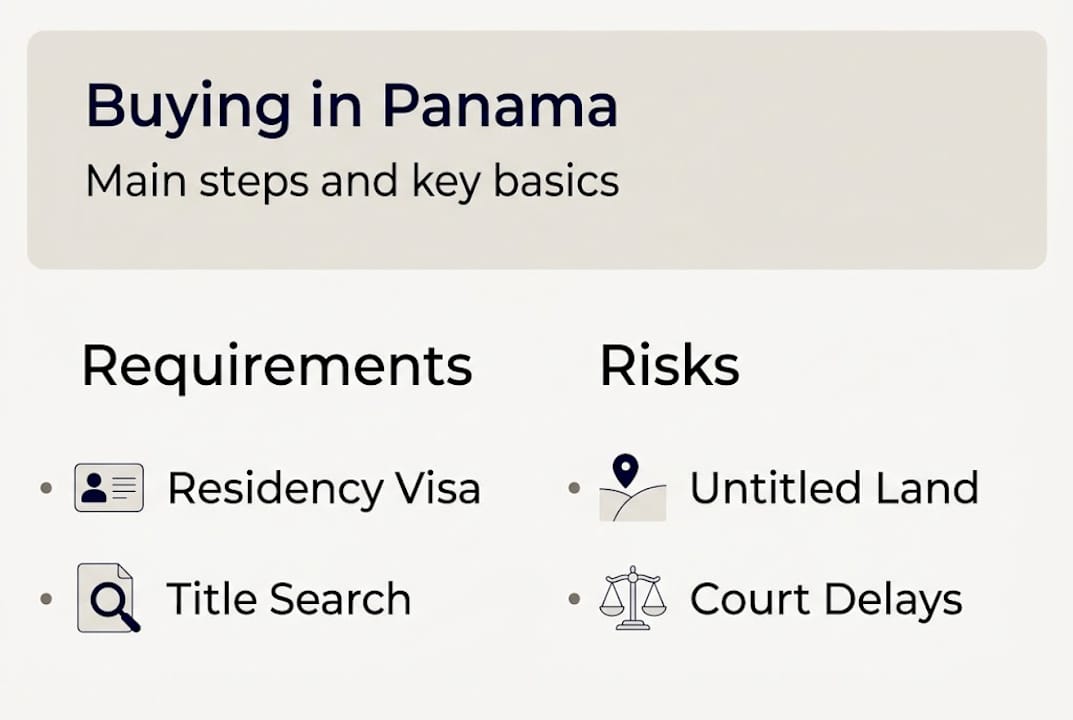
Purchasing derecho posesorio land without understanding it cannot support a residency application or standard financing.
Buying within 10 kilometers of an international border without checking foreign ownership restrictions.
Skipping an independent title search at the Public Registry and relying only on the seller’s representations.
Using a lawyer recommended by the seller’s agent rather than hiring independent legal counsel in Panama.
Ignoring encumbrances (liens, mortgages, or easements) registered against the property.
Not verifying that construction permits match what is actually built on the property.
Pro Tip: Before signing any purchase agreement, run an independent title search (Certificado de Registro) through Panama’s Public Registry. This document costs less than USD 10 and reveals liens, ownership history, and encumbrances. There is no excuse for skipping it.
For investors who want a full breakdown of the buying process, the buying real estate guide covers every stage from first contact to closing. And if you are weighing Panama against neighboring markets, a direct Panama vs Costa Rica comparison helps clarify where your capital works hardest.
Step-by-step guide to international property buying in Panama
Once you understand Panama’s legal landscape, the actual buying process becomes much more manageable. Here is how to approach it systematically.
Define your objective. Are you buying for residency, rental yield, capital appreciation, or personal use? Your goal determines which neighborhoods, property types, and price ranges make sense. A beachfront lot in Pedasi serves a different purpose than a turnkey condo in Panama City’s Punta Pacifica.
Research the market. Study pricing trends, vacancy rates, and rental demand in your target area. The investment insights section is a strong starting point for understanding current market dynamics.
Engage a qualified local advisor. Not all real estate agents in Panama are licensed or experienced with international clients. Work with someone who understands both the local market and the legal requirements for foreign buyers.
Verify legal title. Confirm the property has full Registro Público title before proceeding. Ask for the folio real number and verify it independently. Due diligence is vital because slow court enforcement means you may have limited recourse if title problems surface after purchase.
Check for zone restrictions. Confirm the property is not in a border zone and that any coastal properties comply with maritime zone regulations.
Conduct full due diligence. Review permits, zoning compliance, outstanding utility bills, HOA fees, and any litigation history tied to the property.
Make a formal offer with a Promise to Purchase agreement. This legally binding contract (Promesa de Compraventa) outlines price, terms, and closing conditions. Hire your own attorney to draft or review it.
Close through a notary. Panama property transfers are executed by a notary public and registered at the Public Registry. Budget for closing costs of roughly 2 to 4 percent of the purchase price.
Tie in your residency application. If you qualify for the Friendly Nations Visa, initiate the process immediately after closing. Review the full buying property step-by-step process and explore the tax benefits in Panama to optimize your financial structure.
Pro Tip: Always confirm in writing whether a property qualifies for Panama’s property tax exoneration (exoneración). New constructions valued under a specific threshold qualify for up to 20 years of exemption. This can save thousands annually and dramatically improves rental yield projections.
Key items to double-check before closing:
Registered owner matches the seller’s identity documents
No active mortgage or lien on the title
Construction matches the approved building permit
HOA is financially solvent if applicable
The uncomfortable truth about buying property as a foreigner in Panama
After working with international buyers across many market cycles, one pattern stands out: most mistakes are not made out of ignorance but out of overconfidence. Buyers who have purchased property in Europe or North America assume that Panama’s investor-friendly reputation means the process is equally smooth. It rarely is.
The risks are real and specific. Non-titled derecho posesorio properties and slow court enforcement are not edge cases. They appear in attractive coastal listings, in deals introduced by well-meaning friends, and in transactions where everyone involved seems credible. The legal system will not protect you quickly if something goes wrong, and disputes can drag on for years.
What experienced buyers know is that local relationships matter more than the legal framework on paper. A trusted advisor who knows which notaries are reliable, which neighborhoods have unresolved title disputes, and which sellers are motivated will save you far more money than any discount you negotiate. The foreign investor advice that actually works in Panama is rooted in ground-level knowledge, not just legal checklists.
The uncomfortable truth is simple: Panama rewards prepared, advised buyers and punishes those who rush.
How Panama Investors can help you buy property safely and profitably
Navigating Panama’s real estate market alone is possible, but it is also where avoidable mistakes happen most often. Panama Investors offers direct advisory services built specifically for international buyers who want to move efficiently without cutting corners.

Luca Piva brings over 12 years of on-the-ground experience, a vetted network of legal professionals, and access to exclusive listings that never hit public portals. Whether you are targeting a residency pathway, a rental income property, or long-term capital growth, the Panama Investors advisory team structures each search around your specific goals. Ready to take the next step? Schedule a strategy call to discuss your situation directly, or start by exploring why Panama remains one of the most compelling markets for international buyers in 2026.
Frequently asked questions
What is the minimum investment required for residency via property in Panama?
Eligible nationalities can secure residency through the Friendly Nations Visa by investing at least USD 200,000 in titled real estate. The property must carry full Public Registry title to qualify.
Are foreigners allowed to buy property anywhere in Panama?
Most of Panama is open to foreign buyers, but border zone restrictions and non-titled derecho posesorio properties require extra caution and independent legal verification before any purchase.
What legal risks should international property buyers know about in Panama?
The main risks are untitled land, slow court enforcement, and unclear ownership chains. Thorough due diligence and independent legal counsel are essential for every transaction.
What steps should I take before buying property in Panama?
Research the market carefully, verify full legal title through the Public Registry, check zone restrictions, and engage a qualified local advisor before making any offer. Due diligence is non-negotiable given the pace of court enforcement in Panama.
Recommended
