Why Legal Counsel Is Essential for Buying Real Estate in Panama
Why Legal Counsel Is Essential for Buying Real Estate in Panama
- Panama Investors
- Apr 17
- 8 min read
Sophisticated investors lose significant money in Panama real estate every year, not because they lacked capital or ambition, but because they skipped independent legal counsel. The risks for foreign buyers go well beyond paperwork. You are navigating a system built around local customs, Spanish-language contracts, and property types that carry very different legal protections. All experts unanimously recommend hiring an independent lawyer, separate from your agent or seller, to avoid conflicts of interest. This guide explains why legal representation is non-negotiable, what your lawyer should actually do, how to choose one wisely, and what special risks high-net-worth and expatriate buyers must address before signing anything.
Table of Contents
Key Takeaways
Point | Details |
Hire independent counsel | An unbiased lawyer is essential for safeguarding international investments in Panama real estate. |
Verify credentials early | Check for legal certification, international experience, and independence before engaging representation. |
Legal counsel manages risks | Your lawyer handles due diligence, compliance, and title verification to protect you from scams or costly mistakes. |
Plan for tax and visa outcomes | A skilled lawyer will ensure your property deal optimizes tax benefits and meets residency goals. |
Why legal representation is indispensable for international buyers
Panama’s property system was not designed with foreign investors in mind. Title registries, land classifications, and contract norms all follow local conventions that can blindside even experienced international buyers. The gap between what a deal looks like on the surface and what it actually is legally can be enormous, and that gap costs money.
Foreign buyers face a unique set of compounding risks:
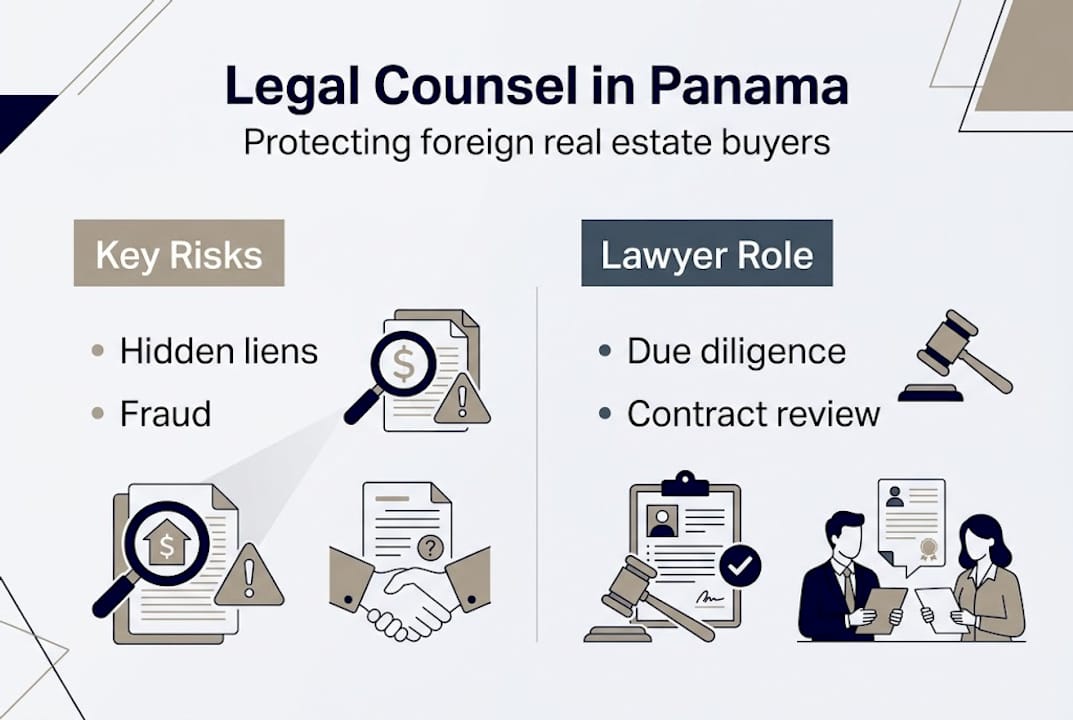
Conflict of interest: Agents and sellers sometimes refer lawyers who serve their interests, not yours.
Title fraud: Fraudulent or encumbered titles are more common in tourist and coastal zones where foreign demand is highest.
Rights of Possession (ROP) land: ROP is not titled property. It carries no formal ownership rights and is far harder to protect legally. Foreigners face higher fraud risks on ROP land than locals, who often understand the informal norms around it.
Tax exposure: Transfer taxes, capital gains obligations, and annual property taxes all apply differently depending on deal structure and your residency status.
Anti-money laundering (AML) compliance: Panama’s banking and legal system applies strict AML checks to large transactions, and non-compliance can freeze or void deals.
Visa and immigration alignment: How you structure a purchase directly affects your eligibility for residency programs.
“No reputable source suggests skipping a lawyer. While locals may sometimes proceed without full due diligence, foreigners face significantly higher risks, including scams and legal complications that can be very difficult to reverse.”
The Panama property buying guide lays out these risks in full detail. And if you are still weighing whether Panama is the right market, why Panama attracts investors covers the fundamentals that make this country compelling despite its complexity.
Pro Tip: Never accept a lawyer referral from your real estate agent without independently verifying that lawyer’s credentials and client history. The referral may be genuine, but the conflict of interest is real regardless of intent.
Now that the stakes are clear, let’s break down precisely what roles a qualified Panama real estate lawyer plays in safeguarding your interests.
Core responsibilities of legal counsel in Panama property deals
A trustworthy Panama real estate lawyer is not just a document reviewer. They are your strategic partner across every stage of the transaction. Here is what that looks like in practice:
Title investigation: Your lawyer searches the Public Registry to confirm the seller holds clean, unencumbered title. This includes checking for liens, mortgages, easements, and any legal disputes attached to the property.
Tax verification: Outstanding property taxes must be confirmed as paid. Unpaid taxes transfer with the property in Panama, meaning you inherit the seller’s debt if this step is skipped.
Contract drafting and negotiation: Your lawyer drafts or reviews the promise-to-purchase agreement and the final deed. They negotiate terms that protect your deposit, define contingencies, and set clear timelines.
Escrow management: Funds should be held in a neutral escrow account, not transferred directly to the seller. Your lawyer structures this to protect your capital until all conditions are met.
AML and compliance review: Due diligence, AML compliance, and visa alignment all fall within your legal advisor’s scope for international transactions.
Final registration: The lawyer files the transfer deed with the Public Registry and ensures the property is correctly registered in your name or your chosen legal entity.
Stage | Lawyer’s role | Risk without counsel |
Pre-purchase | Title search, tax check | Hidden liens, unpaid taxes |
Negotiation | Contract drafting | Unfavorable terms, lost deposit |
Closing | Escrow, deed transfer | Fraud, fund mismanagement |
Post-closing | Registry filing | Incomplete ownership transfer |
Understanding how your purchase interacts with Panama’s tax system is critical. The Panama real estate tax guide breaks down the specific obligations and exemptions available to foreign buyers. If residency is part of your strategy, your lawyer should also be familiar with the residency through real estate pathways available in Panama.
Pro Tip: Ask your lawyer to provide a written due diligence report before you sign anything. A verbal assurance is not a legal protection.
With the breadth of responsibilities established, how do you select legal representation you can absolutely trust, especially as a foreign client?
How to choose the right legal representative in Panama
Choosing a lawyer in Panama is not the same as choosing one at home. The local bar is large, the quality varies significantly, and the conflicts of interest that affect agents also affect legal professionals. Your selection process needs to be deliberate.
Start with these non-negotiable criteria:
Bar membership: Confirm the lawyer is registered with the Colegio Nacional de Abogados de Panamá. This is the baseline credential.
International client experience: A lawyer who regularly works with foreign buyers understands the specific compliance, tax, and visa issues you face. Ask for references from past international clients.
Clear fee structure: Your lawyer should provide a written fee agreement upfront. Vague or verbal fee arrangements are a red flag.
Absolute independence: All experts recommend hiring a lawyer who has no financial relationship with your agent, developer, or seller.
Factor | Green flag | Red flag |
Referral source | Independent research, peer network | Referred by your agent or seller |
Fee structure | Written, itemized agreement | Verbal or percentage-only fee |
Client history | International buyer references | Only local transaction experience |
Independence | No overlap with deal parties | Shared office or business with agent |
Before you engage anyone, ask these direct questions: Have you represented foreign buyers in transactions similar to mine? Can you provide written references? Do you have any existing relationship with the agent or developer in this deal? What is your exact fee for full transaction representation?
The answers reveal a lot. Evasion or vague responses are themselves useful information. For a broader view of what a well-structured purchase looks like, the investor’s buying guide is a strong resource. You can also explore Panama real estate insights for current market context that helps you evaluate deals more critically.
Pro Tip: Run a quick search of the lawyer’s name in Panama’s court records system (Sistema de Gestión Judicial). Active disciplinary cases or frequent litigation involving their own clients is a warning sign.
Securing the right legal specialist is only half the equation. Let’s address special nuances and risks that matter most to high-net-worth and expatriate buyers.
Special considerations for high-net-worth and expatriate investors
If you are purchasing a high-value property, the stakes and the scrutiny are both higher. Panama’s financial system applies enhanced due diligence to large transactions, and the legal complexity multiplies when cross-border wealth, heirs, and immigration goals enter the picture.
Here is what high-net-worth and expatriate buyers must specifically address:
Enhanced AML obligations: Transactions above certain thresholds trigger mandatory source-of-funds documentation. Your lawyer must prepare this correctly to avoid delays or deal cancellations.
Global tax implications: Buying property in Panama may trigger reporting obligations in your home country. Tax optimization and AML compliance are essential for high-net-worth transactions, and your legal team should coordinate with your international tax advisor.
Ownership structure: Many HNW buyers hold property through a Panamanian corporation (Sociedad Anónima) or foundation for asset protection and estate planning purposes. Your lawyer structures this entity correctly from the start.
Visa strategy: The minimum investment thresholds for Panama’s residency programs are specific. A lawyer familiar with immigration law ensures your purchase qualifies and is structured to support your visa application.
Succession and inheritance: Panama’s inheritance laws differ significantly from most Western countries. Without proper legal structuring, your heirs may face costly and time-consuming legal proceedings.
Panama remains one of the most strategically positioned markets in Latin America. Panama’s investment advantages are real, but they are best captured by buyers who approach the market with the right legal infrastructure in place. The Panama Investors resource provides ongoing guidance tailored to exactly this type of buyer.
Having addressed the major process steps and pitfalls, let’s step back for a perspective that most guides miss, especially for international clients.
Our take: Why shortcuts hurt even savvy foreign investors
We have seen it more than once. A seasoned investor, someone who has closed deals in multiple countries, decides that Panama is simple enough to navigate without dedicated legal counsel. They rely on the developer’s lawyer, skip the independent title search, and move fast because the deal looks clean. Then something surfaces: an unresolved lien, a tax debt, a boundary dispute. By that point, the deposit is gone and the legal path forward is expensive and uncertain.
The myth that locals skip lawyers so foreigners can too is genuinely dangerous. Locals operate within a web of relationships, local knowledge, and informal protections that foreigners simply do not have access to. The Latin American investment comparison shows that Panama offers real advantages, but those advantages only materialize when you protect them with proper legal structure. Independent legal counsel is not a formality. It is the single most effective risk management tool available to you in this market.
Connect with trusted experts for turnkey Panama real estate success
Navigating Panama’s real estate market as a foreign investor is far more manageable when you have the right team behind you. At Panama Investors, we connect international buyers with pre-vetted legal partners who specialize in foreign transactions, from title searches to residency structuring.

Luca Piva and the Panama Investors team have spent over 12 years building a network of independent legal professionals, trusted agents, and market specialists who work exclusively in your interest. Whether you are exploring why Panama is the right fit or ready to move forward on a specific property, the best next step is a direct conversation. Book your strategy call and get clarity on your legal and investment options before you commit to anything.
Frequently asked questions
Can I buy property in Panama without a lawyer?
While legally possible, all experts warn that foreign buyers face major risks without independent legal counsel, including title fraud, hidden debts, and contract terms that favor the seller.
Do lawyers in Panama help with residency and visas through investment?
Yes. Skilled lawyers can structure your property purchase to support residency applications, and visa alignment is a standard part of legal advisory services for foreign buyers in Panama.
What’s the biggest mistake foreign buyers make?
Relying on the seller’s or agent’s lawyer instead of hiring independent representation is the most costly error, as conflicts of interest are common when legal counsel is tied to the other side of the deal.
How do lawyers protect investors from Panama property scams?
Lawyers conduct title searches, verify registry records, uncover liens, and draft contracts with protections built in. Due diligence shortcuts create the highest fraud risk, particularly on ROP land in coastal and rural areas.
What should I look for when hiring a Panama real estate lawyer?
Seek confirmed bar membership, direct experience with international clients, a written fee agreement, and absolute independence from all other parties involved in your transaction.
Recommended
