Securing Panama property: how escrow protects overseas buyers
Securing Panama property: how escrow protects overseas buyers
- Panama Investors
- Apr 28
- 9 min read
Losing tens of thousands of dollars to a fraudulent property deal in a foreign country is not a hypothetical risk. It happens, and it happens to sophisticated buyers who simply didn’t have the right protections in place. Panama attracts thousands of international investors every year because of its dollarized economy, favorable tax laws, and strong rental yields. But buying property in an unfamiliar legal system without a safety net is genuinely dangerous. Escrow is that safety net. Understanding how it works, what it covers, and how to use it correctly is the difference between a smooth transaction and a costly legal nightmare.
Table of Contents
What is escrow and why is it crucial in Panama property transactions?
The escrow process: Step-by-step for Panama property purchases
Legal requirements and regulatory considerations for escrow in Panama
Buyer and seller protections: How escrow builds trust in Panama real estate
Why most international buyers underestimate escrow’s value in Panama
Key Takeaways
Point | Details |
Escrow ensures security | Using escrow for Panama property protects both buyer and seller from fraud and disputes. |
Step-by-step process | Following the escrow process gives international buyers clarity and reduces risk during transactions. |
Legal and practical essentials | Understanding local regulations is essential—never skip due diligence or reliable professional advice. |
Trustworthy partners matter | Select only licensed, experienced escrow agents to secure your overseas investment. |
What is escrow and why is it crucial in Panama property transactions?
Escrow is a financial arrangement where a neutral third party holds funds and documents on behalf of a buyer and seller until specific conditions in the purchase contract have been met. In a property context, the escrow agent acts as a trusted intermediary who releases funds only when both parties have fulfilled their agreed obligations. This means neither side can access the money until the deal closes correctly.
In Panama, escrow agents are typically law firms, licensed financial entities, or specialized escrow companies. They are not just middlemen handling cash. They verify documentation, confirm title status, and ensure that conditions like inspections, permits, and legal clearances are satisfied before any money changes hands. The foreign property guide outlines how this structure applies specifically to international buyers navigating Panama’s real estate market.
Why does escrow matter so much in Panama specifically? Panama has a well-established legal system based on civil law traditions, but the local property market includes both formal and informal transactions. Foreign investors are particularly vulnerable to risks that locals might recognize and avoid instinctively.
The most common risks without escrow include:
Title defects: Properties with unresolved liens, back taxes, or contested ownership claims.
Misappropriated deposits: Sellers or agents who collect earnest money and then become unreachable.
Fraudulent sellers: Individuals posing as property owners without actual legal standing to sell.
Construction delays: Pre-construction purchases where funds are released before the project is delivered as promised.
Undisclosed encumbrances: Debt or legal claims attached to the property that the seller never disclosed.
Each of these risks becomes dramatically harder to exploit when a professional escrow agent is in the middle of the transaction. As the escrow process guide explains, using escrow is one of the most effective steps in a sound Panama property purchase strategy.
“The single most important thing an international buyer can do to protect their investment is ensure that their funds are held by a licensed, independent escrow provider until every contractual condition is satisfied.”
For international investors, escrow also provides a transparent paper trail. Every document transfer and fund movement is recorded, which matters enormously if a dispute arises after closing.
Pro Tip: Before agreeing to any escrow arrangement, request proof of the provider’s license, professional indemnity insurance, and references from past international clients. A legitimate escrow company will provide these without hesitation.
The escrow process: Step-by-step for Panama property purchases
With escrow’s purpose and protections clear, here’s exactly how the escrow process unfolds in a typical Panama property deal. Each stage has a specific function, and understanding them helps you move through a transaction with confidence rather than confusion.
Offer acceptance and contract signing. The buyer and seller agree on price and terms and sign a purchase agreement, called a promesa de compra-venta in Panama. This legally binding contract outlines the conditions that must be met before funds are released. Your lawyer should review this document before you sign anything.
Opening the escrow account. Once the contract is signed, both parties open an escrow account with a mutually agreed-upon escrow provider. The buyer submits identity documents, proof of funds, and compliance paperwork. The escrow agent begins their own verification process.
Deposit of earnest money. The buyer transfers the agreed deposit, typically 10% of the purchase price, into the escrow account. This amount is held securely and cannot be accessed by the seller until conditions are met. This protects you if the deal falls through due to the seller’s failure.
Due diligence period. This is the most critical stage. The escrow agent works alongside your lawyer to verify the property’s title at the Public Registry of Panama, confirm no outstanding taxes or mortgages, review building permits, and check that the property matches its legal description. The property purchase steps process also includes confirming zone classifications and any applicable restrictions.
Condition satisfaction and final payment. Once all due diligence conditions are cleared, the buyer transfers the remaining purchase balance into escrow. The seller delivers all required documents, including the signed public deed for registration.
Closing and fund release. After the public deed is registered at the Public Registry in the buyer’s name, the escrow agent releases the purchase funds to the seller. Ownership has officially changed hands and both parties have received exactly what they were promised.
For American buyers specifically, the American buyers guide covers additional nuances related to US tax reporting and foreign account disclosures that intersect with the escrow process.
The international buying guide also notes how coordinating with local banks matters, especially for wire transfers from foreign accounts, which can trigger additional compliance checks.
Here’s a direct comparison to help you evaluate your options:
Factor | Escrow payment | Direct payment to seller |
Funds security | Held by neutral party | Immediately accessible by seller |
Title verification | Completed before release | Not guaranteed |
Fraud risk | Very low | High |
Fund recovery if deal fails | Contractually protected | Difficult or impossible |
Transparency | Full documentation trail | Minimal |
Cost | Escrow fee (typically 0.5–1%) | None upfront |
Legal standing in dispute | Strong | Weak |
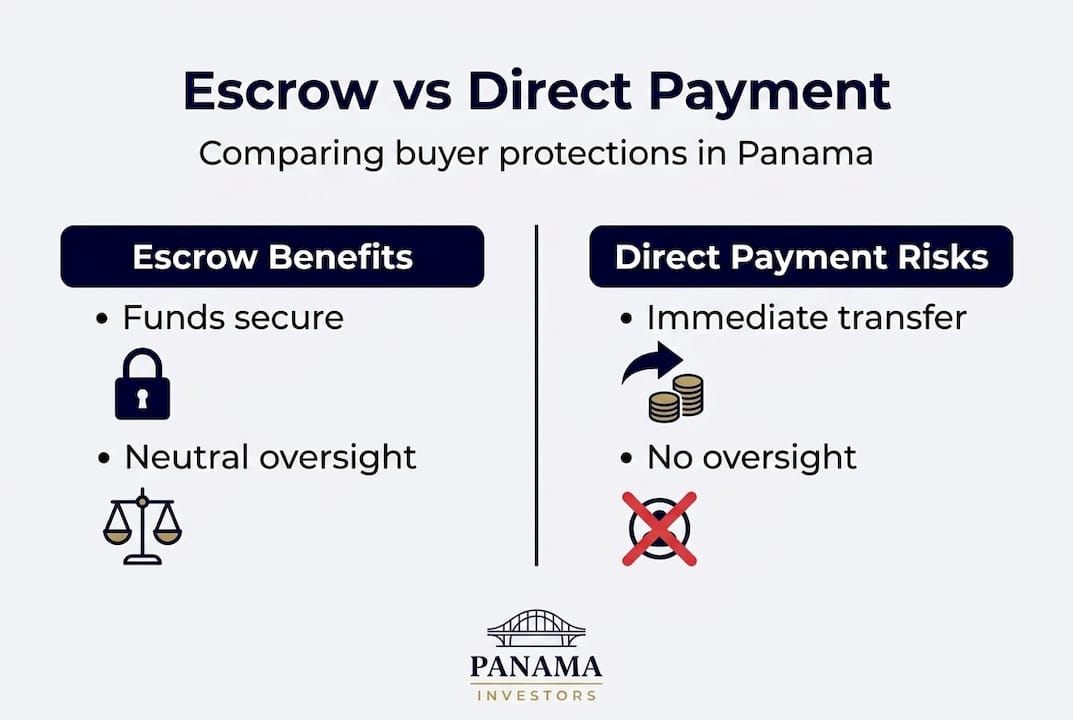
The escrow fee is a minor cost relative to the protection it provides. Most experienced investors view it as the cheapest insurance policy they’ll ever buy on a six-figure transaction.
Legal requirements and regulatory considerations for escrow in Panama
Understanding the steps, it’s vital to know what Panama law requires and where international buyers need extra caution.
In Panama, escrow accounts for real estate must be managed by entities authorized under Panamanian law. Qualified escrow agents include licensed law firms, trust companies regulated by the Superintendence of Banks of Panama, and authorized escrow specialists. An informal arrangement with an individual, even a friend or relative of the seller, does not constitute legal escrow and offers no real protection.
Tax considerations for foreign investors in Panama intersect with escrow requirements because the closing process involves transfer taxes and capital gains declarations that must be handled correctly before final deed registration.
Here’s a summary of the key legal rules governing escrow in Panama:
Rule or requirement | Details |
Authorized escrow agents | Must be licensed by Panamanian regulatory authority |
Currency | All escrow accounts operate in USD (Panama’s currency) |
KYC documentation | Passport, proof of address, source of funds required |
Anti-money laundering compliance | Mandatory for all parties; escrow agent must report suspicious activity |
Escrow agreement | Must be written, signed, and reference the underlying sales contract |
Fund segregation | Escrow funds must be held in dedicated accounts, separate from agent’s own funds |
Common mistakes international buyers make in this area include:
Treating informal deposit arrangements as escrow. A handshake deal or an unsigned letter from a seller is not escrow. Period.
Not verifying the escrow agent’s authorization. Some unscrupulous operators present themselves as escrow providers without the required licensing.
Skipping KYC documentation. Incomplete documentation stalls the process and can trigger regulatory flags that delay or cancel your transaction.
Assuming foreign escrow standards apply. Panama’s system has its own rules. What’s standard in the US or Europe may not transfer directly.
Working with legal counsel for Panama property purchases is not optional when navigating these requirements. A qualified local attorney will review the escrow agreement, verify the agent’s credentials, and ensure that every regulatory box is checked before your money moves.
The KYC process deserves specific attention. Panama has strengthened its anti-money laundering framework significantly over the past decade. Buyers must document the legitimate source of their purchase funds, especially when transferring large sums internationally. This is not bureaucratic inconvenience. It is what keeps the market clean and protects property values across the board.
Buyer and seller protections: How escrow builds trust in Panama real estate
Grasping the legal side, let’s make clear what stands to be gained or lost for both buyers and sellers when escrow is or isn’t used.
For buyers, the central protection is that your money cannot be released to a seller who has not delivered what was promised. If the title comes back with an encumbrance, if the construction isn’t completed to specification, or if the seller can’t produce clear ownership documentation, the funds stay in escrow until the issue is resolved or the deal is unwound. This is not a theoretical benefit. Real transactions fall apart at these moments, and escrow is what prevents financial loss when they do.
For sellers, escrow provides assurance that the buyer is genuinely funded and committed. A seller who accepts an escrow-backed offer knows the funds exist and have been verified. This matters in competitive markets where sellers sometimes lose time to unqualified buyers who never had real purchasing capacity.
Key protections escrow provides for buyers:
Clean title guarantee: Funds release only after title is confirmed as free and clear.
Protection from seller default: If the seller walks away, your deposit is contractually returnable.
Construction milestone verification: For pre-construction deals, funds can be released in stages as building milestones are verified.
Independent intermediary: No single party can unilaterally access funds.
Consider this scenario. A buyer from Canada wires a $50,000 deposit directly to a seller in Panama without using escrow, because the seller claimed it was faster. The seller disappears. The buyer has no recourse through the escrow mechanism because there was none. Recovery depends entirely on expensive litigation in a foreign legal system. Compare that to the escrow scenario, where the same $50,000 sits in a segregated account managed by a licensed provider until a valid deed is delivered.
Pro Tip: Use only established escrow companies that specialize in Panama property law. Ask your real estate advisor or attorney for referrals, and verify that the provider has handled transactions at your investment level before.
The passive income potential from Panama real estate is real, but only accessible to buyers who complete clean, properly structured transactions. Escrow is what makes clean transactions possible.
Why most international buyers underestimate escrow’s value in Panama
After working with international buyers across more than a decade of Panama real estate transactions, the pattern is consistent. Buyers arrive with strong financial instincts, solid business backgrounds, and a tendency to view escrow as a formality rather than a foundation. They calculate the escrow fee against the deal size and conclude it’s optional overhead. That calculation is wrong.
The real cost of skipping escrow is not the fee itself. It’s the legal battle you’re fighting in a foreign country, in Spanish, against a party who may have disappeared entirely. We’ve seen deals derailed by undisclosed debts attached to properties that looked perfect on the surface. In every case where escrow was in place, the buyer lost nothing but time. In the cases where it wasn’t, the losses were severe.
The most secure international buyers we work with share one trait. They treat every protection mechanism, including escrow, as non-negotiable regardless of how trustworthy a seller seems. Trust is personal. Escrow is structural. You need both, but only one of them will hold up in court. Explore the international buying insights to understand how buyers who get this right approach the full process from the start.
Take the next step: Secure your Panama property investment
Panama’s real estate market offers genuine, documented returns for international buyers who approach it with the right structure in place. The knowledge you now have about escrow is the foundation of that structure.

At Panama Investors, we guide international buyers through every stage of a secure Panama property purchase, from identifying the right property to coordinating escrow, legal review, and closing. Luca Piva and the team have over 12 years of on-the-ground experience connecting buyers with trusted providers and verified listings. If you want to understand more about why Panama continues to attract serious investors, or you’re ready to move forward, speak with a Panama expert and get your questions answered directly.
Frequently asked questions
Is escrow mandatory for all property purchases in Panama?
Escrow is not legally mandatory for all Panama property transactions but is strongly recommended for security and peace of mind, particularly for international buyers unfamiliar with local processes.
Can foreigners open an escrow account in Panama?
Yes, international buyers can open escrow accounts in Panama through licensed providers who guide them through KYC documentation, identity verification, and proof of funds requirements.
How are escrow funds protected if a Panama property deal falls through?
If contract conditions aren’t met, escrow funds are typically returned to the buyer, minus any contractually agreed penalties or third-party expenses incurred during due diligence.
What documents are required to set up escrow for Panama real estate?
Buyers must provide a valid passport, proof of residential address, source of funds documentation, and a signed sales contract to satisfy Panama’s compliance requirements for escrow account setup.
Recommended
