
Legal protections for property buyers in Panama
Legal protections for property buyers in Panama
- Panama Investors
- May 4
- 9 min read

Many international investors assume that buying property in a Central American country means accepting weak legal protections and crossing their fingers. Panama tells a very different story. The country has a surprisingly robust legal framework built on civil law traditions, statutory warranties enforced by national agencies, and formal dispute resolution channels that have recovered over $202 million for property buyers between 2020 and 2026. If you’re an expatriate or high-net-worth individual looking to invest here, understanding how these protections actually work is the single most important step before you sign anything.
Table of Contents
Understanding legal protections for property buyers in Panama
Essential strategies and safeguards for HNWI and expatriate buyers
Common pitfalls and mistakes in Panama real estate purchases
A fresh perspective: What most investors overlook in Panama’s legal protections
Take the next step: Secure your investment with expert guidance
Key Takeaways
Point | Details |
Statutory warranties | Panama law provides strong warranty periods for new construction—10 years for structure, 1 year for finishes. |
Effective dispute resolution | ACODECO resolves most property complaints efficiently with a high rate of favorable outcomes for buyers. |
Due diligence is crucial | Verifying permits, contracts, and developer credentials is essential to avoid costly mistakes. |
Privacy via corporations | Using SA corporations enables privacy and easier estate management for high-value real estate purchases. |
Common pitfalls | Abusive clauses and ignoring legal processes are the top causes of buyer regret in Panama property deals. |
Understanding legal protections for property buyers in Panama
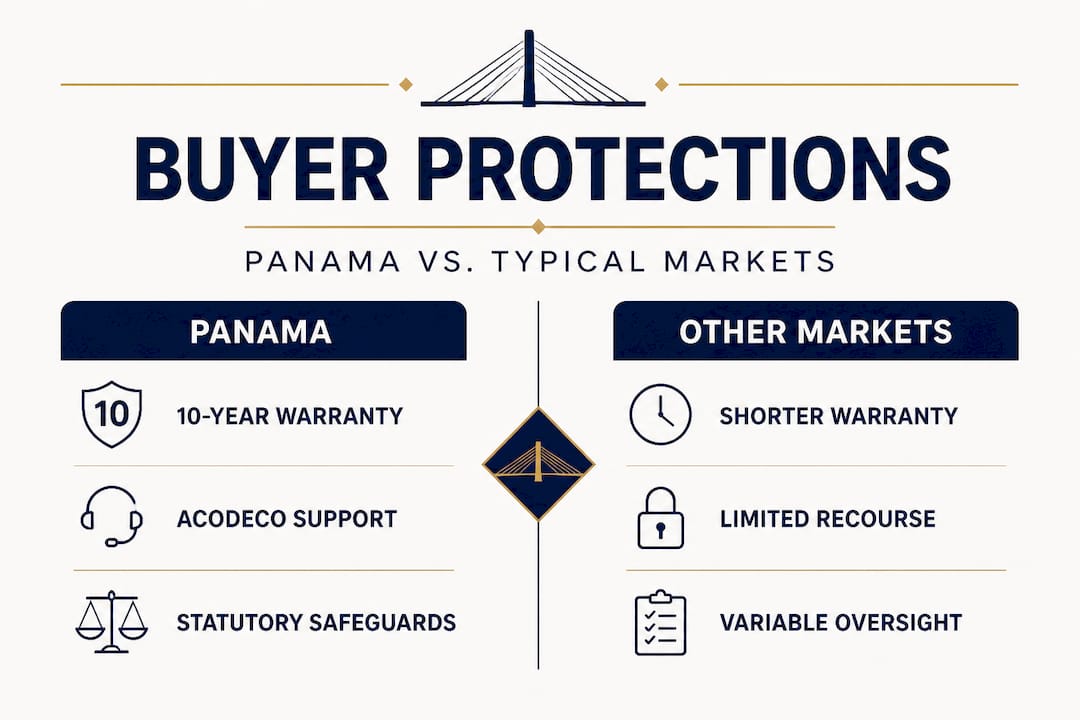
Panama’s legal infrastructure for real estate buyers is more structured than most foreign investors expect. The foundation sits in the Civil Code, which establishes clear liability rules for developers, contractors, and sellers. For anyone purchasing new construction, knowing these rules is not optional. It’s your baseline protection before any contract negotiation even begins.
Here’s what the law actually guarantees:
Structural defects: 10-year liability period under Civil Code Article 1343, running from the delivery date of the property.
Finishes and installations: A 1-year warranty covers cosmetic defects, flooring, fixtures, paint, and non-structural elements.
Developer accountability: Developers cannot contractually waive these statutory warranties. Any clause attempting to eliminate these protections is legally void.
Completion guarantees: Pre-construction buyers should verify that developers have obtained all required construction permits and that the project carries a formal completion guarantee.
“Panama’s Civil Code Art. 1343 holds developers liable for structural defects for a full decade from delivery. This is comparable to protections offered in France, Spain, and other civil law countries, yet many international buyers are unaware it exists.”
These warranty periods matter enormously when you’re buying into a new development. A structural defect discovered in year seven is still actionable under Panamanian law. That is leverage most buyers in other markets simply do not have.
For pre-construction purchases specifically, due diligence needs to go further. You should confirm that the developer holds all environmental and municipal permits, that the project is registered under a horizontal regime (explained in detail below), and that your purchase agreement includes specific delivery timelines with financial penalties for delays. Panama’s foreign investor guide covers this extensively for buyers entering the market for the first time.
Contract clauses are where many buyers lose ground without realizing it. Developers often include provisions that limit refund rights, shift liability for delays to external factors, or impose arbitration terms that disadvantage buyers. This is why engaging qualified legal counsel in Panama before signing any pre-construction agreement is non-negotiable, not a formality.
Dispute resolution channels and enforcing buyer rights
Knowing your legal protections on paper is one thing. Knowing how to actually enforce them when something goes wrong is another. Panama offers buyers two primary pathways: administrative complaints through ACODECO, and direct civil litigation through the courts.

ACODECO (the Autoridad de Protección al Consumidor y Defensa de la Competencia) is Panama’s consumer protection authority. It handles real estate complaints involving defects, delivery delays, abusive contract clauses, and refund disputes. The process is free for complainants and typically faster than civil court proceedings.
Here’s a side-by-side comparison to help you understand which route fits your situation:
Factor | ACODECO | Civil court |
Cost to buyer | Free | Attorney fees + court costs |
Speed | Weeks to months | Months to years |
Monetary limit | Up to ~$5,000 to $10,000 | Unlimited |
Types of disputes | Defects, delays, refunds, abusive clauses | Complex cases, large claims |
Legal representation required | Optional | Strongly recommended |
Outcome enforceability | Administrative order | Court judgment |
The data on ACODECO’s effectiveness is striking. Between 2020 and March 2026, 3,276 real estate complaints were filed with ACODECO totaling $202 million in claimed amounts, with 73% resolved favorably for buyers. The largest category involved abusive contract clauses, accounting for $119 million of that total. Refund disputes made up a significant secondary category.
Separately, ACODECO resolved 2,386 real estate cases worth $142 million between 2020 and 2026, underscoring the volume and value of disputes being processed through administrative channels every year.
What does this mean practically? If a developer refuses to honor a warranty claim or delays your delivery without compensation, ACODECO is your fastest first move. It costs you nothing, and the 73% resolution rate shows it works. For larger disputes involving significant property values or complex legal arguments, civil litigation handled by experienced Panamanian attorneys provides stronger enforcement mechanisms and uncapped recovery.
Working with a knowledgeable buyer’s agent in Panama who understands both channels gives you a meaningful advantage. They can flag contractual red flags before a dispute arises, and help you document issues correctly if you need to file a claim.
Essential strategies and safeguards for HNWI and expatriate buyers
Legal protections are your floor, not your ceiling. High-net-worth and expatriate buyers can build significantly stronger layers of protection through strategic structuring and rigorous pre-purchase due diligence. Here’s what that looks like in practice.
Step-by-step pre-construction due diligence:
Verify that the developer holds all required construction and environmental permits from the relevant Panamanian authorities.
Confirm the project is registered under a horizontal property regime (Propiedad Horizontal), which gives each unit a separate legal title and protects your ownership independently of other buyers.
Review the developer’s track record, including completed projects, litigation history, and financial standing.
Confirm the existence of a formal project completion guarantee, either through a performance bond or a third-party escrow arrangement.
Have a qualified Panamanian attorney review every clause in the purchase agreement before signing, including delivery timelines, penalty provisions, and warranty terms.
Use escrow protection for buyers to hold your funds in a neutral account until milestones are met rather than paying directly to the developer.
For buyers with significant assets, corporate structuring adds another protective layer. Using an SA corporation (Sociedad Anónima) to hold Panamanian real estate provides three distinct advantages. First, it protects your personal privacy since corporate ownership is not directly linked to your individual name in the property registry. Second, it simplifies estate planning because shares in a Panamanian SA can be transferred without going through the local probate process. Third, it creates a liability buffer between your personal assets and any property-related disputes.
Pro Tip: When setting up a Panamanian SA to hold property, structure the share ownership so that bearer shares (if still applicable under current regulations) are replaced with registered shares held by a trust or foundation for maximum estate planning efficiency. Discuss this architecture with your attorney before the purchase, not after.
Panama’s legal environment also rewards buyers who take the time to understand the horizontal property regime. This framework, which governs most condominium and multi-unit developments, specifies ownership rights, common area responsibilities, and condominium association governance. A property without proper horizontal regime registration can create serious title complications. Validating this registration is a non-negotiable step in any pre-closing checklist.
The advantages of Panama as an investment destination, including its dollarized economy and favorable tax environment, become fully accessible only when you combine market opportunity with structured legal preparation. The step-by-step property buying process maps out each phase from search to closing so that nothing falls through the cracks.
Common pitfalls and mistakes in Panama real estate purchases
Even buyers with sophisticated legal teams in their home countries make avoidable mistakes when purchasing property in Panama. The legal environment is different here, and assumptions imported from other markets create real vulnerability.
The most common mistakes include:
Signing contracts with abusive clauses without review. The $119 million in ACODECO claims related to abusive clauses tells a clear story. Developers include provisions that limit their liability, restrict your refund rights, and impose unfavorable dispute resolution terms. If you sign without having an attorney review these clauses, you waive leverage you would otherwise have.
Relying on verbal assurances from developers or sales agents. In Panama, what matters legally is what’s written in the purchase contract and registered in the Public Registry. Verbal promises about amenities, delivery dates, or finishes carry no legal weight.
Skipping developer due diligence. Not every developer in Panama has a clean track record. Some projects have stalled due to permit issues, financing gaps, or mismanagement. A quick check of completed projects and ACODECO complaint history for a specific developer can reveal serious red flags.
Failing to validate warranty terms in writing. Some purchase agreements attempt to shorten the statutory warranty periods or add conditions that make claims difficult to pursue. Since these clauses are void under Panamanian law, buyers need their attorney to identify and strike them before signing.
Purchasing without a horizontal regime check. If your unit doesn’t have a clean independent title under the horizontal regime, reselling or mortgaging the property later becomes significantly harder.
3,276 ACODECO complaints totaling $202 million in disputes between 2020 and 2026 represent real buyers who faced real problems. Many of those problems were preventable.
Pro Tip: Before committing to any developer, ask for references from buyers of previously completed projects. Contact those buyers directly. Ask whether the delivered property matched what was promised in the contract, whether any defects were repaired under warranty, and whether the developer was responsive when issues arose. This informal due diligence often reveals more than any document check.
Reviewing your contracts through the lens of Panama’s international buying guide gives you a clear framework for what to look for and what to push back on before you commit any capital.
A fresh perspective: What most investors overlook in Panama’s legal protections
After working with international buyers across more than a decade in this market, one pattern stands out consistently. Buyers spend enormous energy comparing property prices and rental yields, and almost no energy understanding the legal architecture that either protects or exposes their investment.
Panama’s legal protections are genuinely strong, but they are not self-activating. A 10-year structural warranty means nothing if your contract includes a clause that channels all disputes to an arbitration process controlled by the developer’s own designated body. ACODECO’s 73% resolution rate is impressive, but it doesn’t help buyers who never filed a complaint because they didn’t know they had standing.
The uncomfortable truth is this: Panama’s legal system rewards prepared buyers and exposes unprepared ones. The statutory protections exist. The dispute resolution channels work. But exercising them requires documentation, correctly structured contracts, and professionals who know the local system from the inside.
Here’s the contrarian insight that most articles miss entirely. The biggest legal risk for high-net-worth buyers in Panama is not that the law is weak. It’s that buyers with significant resources assume their resources alone protect them, and skip the foundational preparation that actually creates legal leverage. A buyer who purchases a $2 million condo without a properly reviewed contract has weaker real protections than a buyer who purchases a $200,000 apartment with a validated horizontal regime title, an escrow arrangement, and legal counsel who reviewed every clause.
This is why the value of qualified legal counsel advice is not a line-item expense to minimize. It is the mechanism that converts Panama’s legal protections from theoretical rights into enforceable ones. The market here rewards sophisticated preparation, and the data from ACODECO proves that buyers who structure their purchases correctly rarely end up in disputes at all.
Take the next step: Secure your investment with expert guidance
Navigating Panama’s legal landscape on your own is possible, but it’s slow and exposes you to risks that experienced professionals routinely prevent. Whether you’re evaluating pre-construction developments, validating a developer’s track record, or structuring a corporate purchase for privacy and estate planning, having the right team behind you changes the outcome.

At Panama Investors, Luca Piva and his team combine over 12 years of on-the-ground experience with deep local legal networks to guide buyers through every phase of the purchase process. From initial property selection and developer vetting to contract review coordination and closing, the advisory process is designed to make sure your legal protections are fully activated before you commit a single dollar. Ready to move forward with confidence? Contact Panama Investors to schedule your strategy call and get expert eyes on your investment plans.
Frequently asked questions
What warranty protections exist for new property buyers in Panama?
Panama law grants a 10-year warranty for structural defects and a 1-year warranty for finishes on new constructions, both running from the delivery date. Developers cannot legally waive these protections in a purchase contract.
How effective is ACODECO in resolving property disputes?
ACODECO resolved 73% of complaints favorably across 3,276 real estate cases filed between 2020 and 2026. The process is free for buyers and covers defects, delays, and refund disputes efficiently.
What are the main risks for international buyers in Panama?
Abusive contract clauses, insufficient developer due diligence, and failure to validate horizontal regime registration are the top risks. Over $119 million in ACODECO claims alone involved abusive clause disputes, most of which were preventable.
Should high-net-worth buyers use corporate structures for privacy?
Yes. Purchasing through a Panamanian SA corporation protects ownership privacy, simplifies estate planning by avoiding local probate, and creates a legal buffer between personal assets and property-related liabilities.
Recommended
