
What Is Pre-Construction Property? Your 2026 Guide
What Is Pre-Construction Property? Your 2026 Guide
Pre-construction property is defined as real estate purchased before construction is complete, often before a single foundation is poured. Buyers commit at today’s pricing, then wait for delivery while the market moves around them. This model covers condos, townhouses, and detached homes across markets from Toronto to Panama City. The appeal is real: locked-in pricing, customization options, and the chance to build equity before you ever hold a key. The risks are equally real. This pre-construction property guide covers the full picture so you can decide with clear eyes.
What is pre-construction property and how does the process work?
Buying a pre-construction home follows a specific sequence that differs sharply from purchasing a resale property. You sign a purchase agreement, pay a deposit, then wait for the developer to build. The timeline from signing to move-in can stretch from several months to two years or more, depending on project scale and external factors like weather and labor availability.
The deposit structure
Deposits on pre-construction typically total 20% of the purchase price, paid in increments over 12–24 months. A common schedule starts with $5,000 at signing, followed by additional installments tied to construction milestones. This staged approach eases cash flow pressure compared to a single lump-sum payment. Still, you are committing significant capital to a property that does not yet exist.
The cooling-off period and contract review
Most jurisdictions build in a 10-day cooling-off period after signing, during which you can walk away without penalty. Use every one of those days. Hire a real estate lawyer to review the purchase agreement before that window closes. Contracts often contain adjustment clauses, delay language, and escalation provisions that can cost you thousands if you miss them.
Mortgage and financing timing
Your mortgage approval happens at closing, not at signing. That gap matters. If interest rates rise or your financial situation changes during construction, your borrowing power at closing may differ from what you expected. Get pre-approved, but also model scenarios where rates move against you.
Pro Tip: Ask the developer whether the contract is assignable. An assignable contract lets you sell your purchase agreement to another buyer before closing, which is a critical exit option if your circumstances change.
Here is the typical buying sequence in order:
- Research developers and projects in your target market.
- Sign the purchase agreement and pay the initial deposit.
- Hire a real estate lawyer to review the contract during the cooling-off period.
- Make incremental deposit payments per the agreed schedule.
- Secure mortgage financing as the completion date approaches.
- Conduct a pre-delivery inspection to document any deficiencies.
- Close the transaction and take ownership.
What are the main benefits and risks of pre-construction properties?
Pre-construction offers genuine advantages, but the risks are specific and often underestimated by first-time buyers. Understanding both sides is the foundation of a sound decision.
Benefits worth knowing
Early-bird pricing and equity growth represent the clearest financial upside. Developers price units below anticipated market value at launch to attract buyers and secure financing. If the market appreciates during construction, you gain equity before you even move in.

Customization options are another real advantage. Pre-construction buyers can often choose finishes, layout configurations, and upgrade packages that simply do not exist in resale homes. For buyers who want a modern, energy-efficient home built to their taste, this is a meaningful benefit. You can explore how personalization options work in practice before committing to an upgrade package.
New builds also carry lower maintenance costs in the early years and typically come with builder warranties covering structural defects, mechanical systems, and finishes.
Risks that catch buyers off guard
- Construction delays: Timelines vary widely from several months to 1–2 years beyond the projected completion date. Every delay extends the period your capital is tied up without generating returns.
- Appraisal shortfalls: Lenders may reduce your mortgage if the appraised value at closing falls below the contract price. You would need to cover the gap in cash.
- Interim occupancy fees: In condo developments, occupancy fees act as rent paid to the developer after you move in but before legal ownership transfers. These payments do not reduce your mortgage principal.
- Hidden contract clauses: Adjustment clauses and delay language can trigger unexpected charges or extend your timeline without recourse.
- Market risk: If property values fall during construction, you may close on a unit worth less than you paid.
“Hidden costs such as occupancy fees and adjustment clauses can erode expected savings. Full budgeting including these factors is essential for buyers.” — Top Benefits of Buying a Pre-Construction Home
Pro Tip: Build a cash reserve equal to at least 5% of the purchase price beyond your deposit. Appraisal shortfalls and closing adjustments arrive fast, and buyers who are not liquid face serious pressure.
Pre-construction vs. move-in ready homes: Which is right for you?
The choice between pre-construction and a move-in ready home comes down to three factors: your timeline, your risk tolerance, and your financial flexibility. Neither option is universally better.
Move-in ready homes offer certainty. You see exactly what you are buying, you can move within weeks of closing, and your financing is based on a known appraised value. In competitive markets with low inventory, however, move-in ready homes often trigger bidding wars that push prices well above list. Pre-construction sidesteps that competition by locking in a price before the broader market can bid it up.
Pre-construction suits buyers who have time on their side, want a customized space, and can absorb the uncertainty of a future delivery date. It suits investors who want to capture appreciation during the construction period and potentially assign the contract for a profit before closing.
| Factor | Pre-construction | Move-in ready |
|---|---|---|
| Pricing | Locked at signing; potential upside if market rises | Reflects current market; subject to bidding competition |
| Customization | High: finishes, layouts, upgrades available | Low: you buy what exists |
| Timeline to occupancy | 1–3 years typical | Weeks after closing |
| Financing risk | Mortgage approved at closing; rate and value uncertainty | Financing based on known appraised value |
| Maintenance costs | Low in early years; builder warranty included | Varies by age and condition of property |
| Exit flexibility | Assignable contracts possible; limited before completion | Can resell at any time |
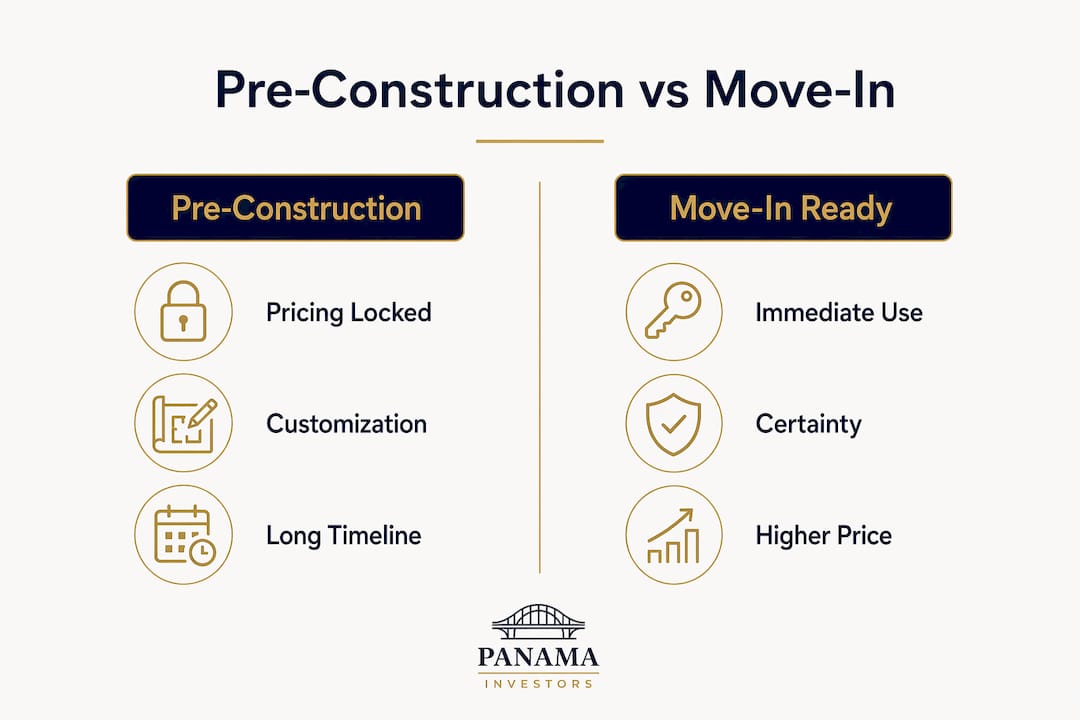
For investors focused on passive income from real estate, the pre-construction model requires patience. Rental income does not start until the unit is delivered and tenanted, which can be two or more years after signing.
How to evaluate pre-construction projects and developers
Due diligence on a developer is as important as due diligence on the property itself. A great location means nothing if the builder runs out of financing or delivers a substandard product.
- Check the builder’s track record. Research completed projects, delivery timelines, and buyer reviews. Developers who have delivered on time and on spec in the past are far more likely to do so again.
- Confirm project financing. Builder reputation and secured financing are the two strongest predictors of project success. Ask directly whether construction financing is in place before you sign.
- Read every contract clause. Thorough contract examination by a real estate lawyer identifies delay clauses and adjustment provisions before they become expensive surprises.
- Assess location and market demand. Evaluate market demand and location rigorously to confirm that your appreciation assumptions are realistic. A unit in a declining neighborhood will not recover its value simply because it is new.
- Understand the cancellation terms. Some contracts allow developers to cancel projects and return deposits without interest. Know your exposure before you commit.
Red flags include developers who cannot confirm financing, projects with no comparable completed developments, and contracts that heavily favor the builder on delay and cancellation terms.
Pro Tip: Search the developer’s name alongside terms like “lawsuit,” “delay,” and “cancellation” before signing anything. Public records and buyer forums surface problems that marketing materials never will. A step-by-step due diligence process applied consistently protects you from the most common pitfalls.
Key takeaways
Pre-construction property rewards buyers who plan carefully, budget honestly, and choose developers with proven track records.
| Point | Details |
|---|---|
| Deposits are staged, not lump sum | Expect 20% total paid in increments over 12–24 months, starting from a small signing amount. |
| Legal review is non-negotiable | Use the cooling-off period to have a lawyer examine every clause before it becomes binding. |
| Hidden costs erode savings | Budget for occupancy fees, adjustment clauses, and potential appraisal shortfalls beyond your deposit. |
| Developer track record is the top risk filter | Confirmed financing and completed projects predict delivery success better than any marketing claim. |
| Pre-construction suits patient, liquid buyers | Investors and buyers with flexible timelines gain the most from locked-in pricing and customization. |
Why I think most buyers underestimate the patience this requires
Most people who ask me about pre-construction are focused on the upside: the lower entry price, the custom finishes, the equity they expect to gain. That optimism is not wrong. The upside is real. What catches people off guard is the psychological weight of waiting two years for a property that exists only on paper.
I have seen buyers sign contracts with genuine excitement, then spend 18 months anxious about delays, rate changes, and developer communications that arrive months apart. The financial math worked out for most of them. The experience was harder than they expected.
My honest view is that pre-construction is best suited to buyers who treat it as a deliberate investment decision, not an emotional one. The investment property success factors that actually drive returns in this model are discipline, liquidity, and developer selection. Customization is a perk. Equity growth is a goal. But the foundation is choosing the right builder in the right market and having enough cash on hand to absorb surprises at closing.
Markets like Panama are particularly interesting for pre-construction right now. The dollarized economy removes currency risk, appreciation has been stable, and entry prices remain accessible compared to North American equivalents. For international buyers, that combination is worth serious attention. The benefits of beachfront property ownership in Panama illustrate why this market draws investors who have already done pre-construction deals elsewhere and want a more favorable risk profile.
The buyers who do best in pre-construction are not the ones who got lucky on timing. They are the ones who read the contract, hired the lawyer, confirmed the financing, and held enough cash to close without stress.
— Roie
How Panamainvestors can support your pre-construction journey
Pre-construction investing in Panama requires local knowledge that most international buyers simply do not have on their own. Panamainvestors, led by licensed agent Luca Piva with over 12 years of on-the-ground experience, gives you direct access to vetted developers, exclusive listings, and the kind of contract-level insight that protects your capital from day one.

Whether you are evaluating your first pre-construction unit or adding to an existing portfolio, the advisory process at Panamainvestors starts with a strategy call that maps your goals to real opportunities in the Panamanian market. Luca’s local network surfaces deals that never reach public listings. If you are ready to move from research to action, book your strategy call and get a clear picture of what pre-construction investing in Panama actually looks like for your situation.
FAQ
What is a pre-construction property in simple terms?
A pre-construction property is a home or condo purchased before it is built. Buyers sign a contract and pay a deposit, then wait for the developer to complete construction before taking ownership.
How much deposit do you need for pre-construction?
Most pre-construction purchases require a total deposit of around 20%, paid in installments over 12–24 months. The first payment is often as low as $5,000 at signing.
What are the biggest risks of buying pre-construction?
The main risks include construction delays, appraisal shortfalls at closing, interim occupancy fees in condo deals, and contract clauses that favor the developer on cancellations and adjustments.
How is pre-construction different from buying a new build?
Pre-construction refers specifically to purchasing before construction begins or during early stages. A new build can also refer to recently completed homes available for immediate purchase. The key difference is timing and the level of customization available to the buyer.
Is pre-construction a good investment in 2026?
Pre-construction can be a strong investment for buyers with flexible timelines and sufficient liquidity. Markets with stable appreciation, low currency risk, and growing demand offer the best conditions for this strategy to pay off.
