
The Role of Consultation in Property Purchase
The Role of Consultation in Property Purchase
Property purchase consultation is a strategic advisory process that aligns your buying objectives with market realities, legal safeguards, and financial logic before you commit a single dollar. Most buyers treat consultation as optional. It is not. The difference between a profitable purchase and a costly mistake often comes down to whether you had an independent expert reviewing your plan before you signed anything. Panamainvestors has seen this play out repeatedly in Panama’s real estate market, where international buyers who skip early guidance routinely overpay, miss title issues, or misread market timing.
What is the role of consultation in property purchase?
Consultation in real estate is the industry’s term for structured pre-purchase advisory. It covers everything from defining your budget and search criteria to analyzing market data, mapping a legal due diligence timeline, and stress-testing your offer strategy before you approach a seller. The Lifetime Client Group describes this as strategic planning from the start, covering price, presentation, and negotiation across a typical three-to-six-month window from search to closing. That window is where most expensive mistakes happen.
The core value of consultation is not just information. It is structure. Buyers who enter the market without a defined strategy tend to make decisions based on emotion, marketing materials, or incomplete data. A consultant replaces that reactive pattern with a deliberate one. You define what you want, what you can afford, what risks you will accept, and what your exit looks like. Everything after that becomes execution rather than improvisation.

For international buyers specifically, the stakes are higher. You are operating in a legal and regulatory environment you do not know, often in a language that is not your first, and without the local network that gives domestic buyers an edge. That is exactly the gap a qualified property consultant fills.
What happens during a property purchase consultation?
A well-run consultation session covers six distinct areas, each of which directly reduces your exposure to risk and wasted time.
- Buyer profile and goal mapping. The consultant establishes your budget range, preferred property type, intended use (primary residence, rental income, or capital appreciation), and timeline. This prevents weeks of searching properties that never matched your actual criteria.
- Market analysis. Current pricing trends, comparable sales, and neighborhood-level data are reviewed. Data-driven analytics help identify overvalued assets and regulatory compliance risks before you fall in love with a listing.
- Timeline mapping. A realistic schedule is built from search through offer, inspection, financing, and closing. Legal experts note that inspection and financing contingencies typically run seven to fourteen days, with closing following thirty to forty-five days after offer acceptance. Knowing this prevents you from making rushed decisions when timelines compress.
- Offer and negotiation strategy. The consultant helps you structure an offer that protects your interests, including contingency clauses, deposit terms, and escalation thresholds.
- Legal and due diligence overview. Title verification, encumbrance checks, and contract review are outlined. This is where a consultant coordinates with a real estate attorney to ensure nothing is missed.
- Emotional bias check. Consultations shift decisions from emotional responses to data-backed ones, flagging overlooked cost factors like service charges and structural sustainability that buyers routinely ignore when excited about a property.
Pro Tip: Schedule your consultation before you start viewing properties, not after. A pre-search strategy session prevents weeks of aimless searching and positions you to negotiate from day one rather than scrambling to catch up.
How consultation mitigates risks in the property buying process
The most expensive property mistakes are not the ones buyers know about. They are the ones no one told them to look for.
- Title and encumbrance issues. Legal experts confirm that title checks and encumbrance assessments before any offer is made prevent financial and legal exposure that can take years and significant legal fees to resolve.
- Hidden costs. A property priced attractively on paper may carry maintenance fees, deferred repairs, or tax liabilities that change the real cost by tens of thousands of dollars. Consultants evaluate ROI systematically, factoring in purchase price, service charges, maintenance, and market liquidity.
- Inspection blind spots. Buyers focused on aesthetics routinely skip or underweight structural and systems evaluations. A consultant prioritizes realistic ROI over showroom design, directing attention to what actually affects long-term value.
- Divided loyalties. Standard agents and solicitors may not act solely in your interest. Independent buyer consultants provide non-commissioned, buyer-first expertise that traditional intermediaries often cannot offer, particularly for international buyers who lack local legal knowledge.
- Skipping due diligence. Relying on broker assurances instead of independent legal due diligence is the single most common path to costly disputes. Proper due diligence includes title searches, risk assessment, and drafting protective contract clauses.
“The most critical consultation moment is before the buyer signs any agreement. That is when term negotiations and contingency planning can prevent costly overruns that become impossible to reverse once ink is on paper.”
For buyers in Panama, understanding legal protections for property buyers is not optional. Panama’s property law has specific provisions that protect buyers, but only if those protections are properly invoked in the contract.
Comparing a property consultant, agent, and attorney: what’s different?
Buyers frequently confuse these three roles, and that confusion leads to gaps in protection. Each professional serves a distinct function.
| Role | Primary focus | Compensation model | Buyer loyalty |
|---|---|---|---|
| Property consultant | Strategic advisory and buyer goal alignment | Fee-based or retainer | Exclusively buyer-focused |
| Real estate agent | Transaction facilitation and listing access | Commission on sale | Often split between buyer and seller |
| Real estate attorney | Legal protection and contract review | Hourly or flat fee | Legally bound to client |
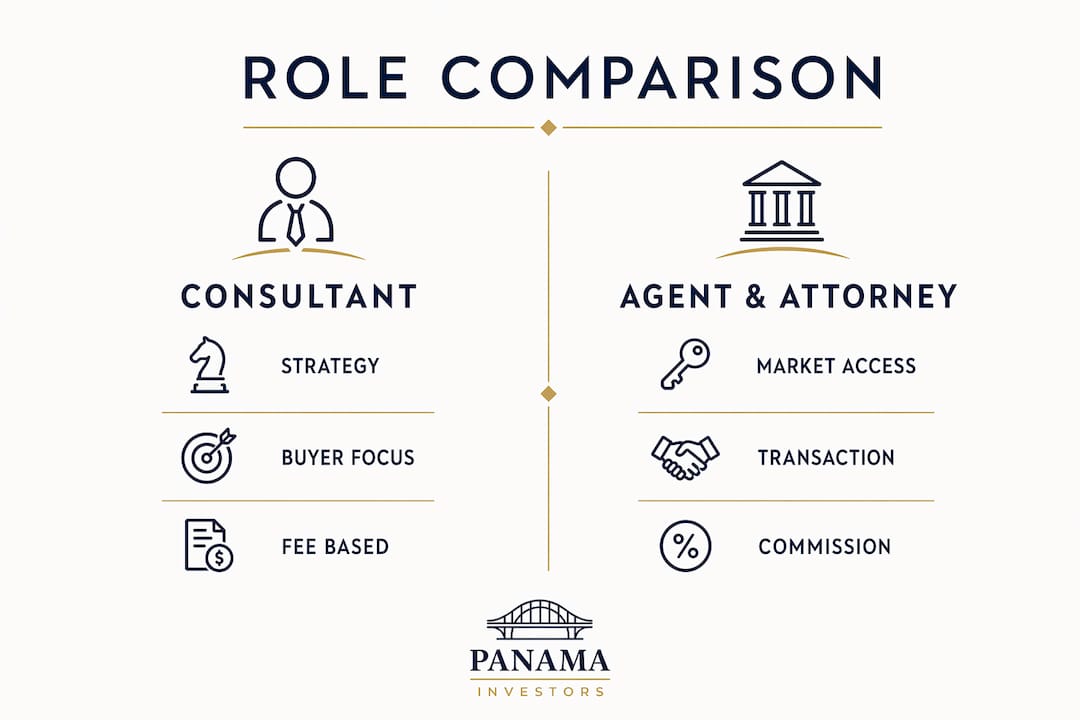
A property consultant’s value is strategic independence. Because consultants are not paid on commission, their advice is not influenced by which property closes fastest or at the highest price. Most buyers do not realize that their agent may not act solely in their interest, particularly in dual-agency situations where one agent represents both sides of a transaction.
An agent’s strength is market access and transaction logistics. They know the listings, they manage showings, and they handle the paperwork mechanics. An attorney’s strength is legal precision. They review contracts, identify problematic clauses, and protect you from commitments that could expose you to litigation. For buyers in Panama, Panamainvestors strongly recommends reading about why legal counsel matters before signing any purchase agreement.
The three roles are not interchangeable. They are complementary. A well-structured purchase uses all three.
Pro Tip: If your agent is also representing the seller, hire an independent consultant immediately. Dual agency is legal in many markets but structurally compromises the advice you receive.
Practical benefits of consultation for first-time and international buyers
First-time buyers and cross-border investors share one critical disadvantage: they do not know what they do not know. Consultation directly addresses that gap.
- Demystifying jargon and process. Terms like escrow, contingency, encumbrance, and title insurance are not intuitive. A consultant translates the process into plain language so you make decisions based on understanding, not assumption.
- Budget and criteria definition. Many buyers enter the market with a vague number in mind and no clear criteria. Consultation forces precision. You leave with a defined price range, a prioritized feature list, and a realistic picture of what that budget actually buys in your target market.
- Multicultural and bilingual coordination. International buyers navigating foreign markets benefit from consultants who understand cross-border issues and can coordinate with bilingual legal and financial professionals. In Panama, this means working with teams fluent in both the language and the local regulatory environment.
- Reduced decision fatigue. Property searches without structure generate an overwhelming volume of options. A consultant filters that volume against your defined criteria, so you evaluate fewer properties with greater confidence.
- Better outcomes on price and terms. Buyers who enter negotiations with a consultant-backed strategy consistently secure better terms than those who negotiate alone. The role of local agents for international investors in Panama illustrates this clearly. Local expertise translates directly into negotiating leverage that outside buyers cannot replicate on their own.
Professional consultation is an upfront cost that delivers security and protects against legal pitfalls that dwarf the advisory fee in magnitude.
Key takeaways
Consultation is the single most effective tool for converting a property purchase from a stressful gamble into a structured, defensible decision.
| Point | Details |
|---|---|
| Consult before you search | A pre-search strategy session prevents weeks of drift and positions you to negotiate from day one. |
| Consultants are not agents | Fee-based consultants provide buyer-exclusive advice that commission-based agents structurally cannot guarantee. |
| Legal due diligence is non-negotiable | Title checks and encumbrance reviews before any offer prevent disputes that can take years to resolve. |
| International buyers need independent representation | Cross-border buyers face divided-loyalty risks that only a buyer-focused consultant can fully address. |
| ROI beats aesthetics | Consultants evaluate service charges, maintenance costs, and market liquidity, not just listing price and design. |
What I have learned after watching buyers skip this step
I have watched buyers at every experience level make the same mistake: they treat consultation as a formality rather than a decision-making tool. They show up to a strategy call with a property already picked out and a price already in their head. At that point, consultation becomes damage control rather than planning.
The buyers who get the best outcomes are the ones who come in with questions, not answers. They want to understand the market before they fall in love with a listing. They want their budget stress-tested before they make an offer. They want someone to tell them what they are missing, not confirm what they already believe.
In Panama specifically, I have seen international buyers overpay by 15 to 20 percent simply because they did not have local market data before entering negotiations. I have also seen buyers walk away from properties that looked perfect on paper but carried title complications that would have taken three years and significant legal costs to resolve. In both cases, a single consultation session would have changed the outcome.
The uncomfortable truth about property buying advice is this: most of the value in consultation comes from what it prevents, not what it produces. You will never know exactly how much a good consultant saved you, because the bad outcome never happened. That invisibility makes it easy to undervalue. Do not make that mistake.
— Roie
Start your property purchase with the right guidance
Panamainvestors offers personalized real estate consultation led by Luca Piva, a licensed Panama real estate agent with over 12 years of local market experience. Every engagement starts with a strategy session that maps your goals, analyzes current market conditions, and identifies the legal and financial steps you need to take before making an offer.

Whether you are a first-time buyer, an international investor, or an expatriate considering Panama as your next home or investment, the process works the same way. You bring your objectives. Luca brings the market knowledge, the local network, and the independent perspective that protects your interests from search to closing. Schedule a strategy call with Panamainvestors today and get the property purchase guidance that turns a complex process into a clear plan.
FAQ
What does a property purchase consultation include?
A property purchase consultation covers buyer goal mapping, market analysis, timeline planning, offer strategy, and a legal due diligence overview. The goal is to align your objectives with market realities before you commit to any property or agreement.
When should I schedule a real estate consultation?
Schedule your consultation before you begin viewing properties. A pre-search strategy session prevents weeks of unproductive searching and gives you a negotiating framework before you approach any seller.
How is a property consultant different from a real estate agent?
A property consultant is fee-based and works exclusively for the buyer, while an agent earns commission on the transaction and may represent both buyer and seller. Independent consultants provide non-commissioned, buyer-first advice that agents in dual-agency situations cannot guarantee.
Do international buyers need a property consultant?
Yes. International buyers face divided-loyalty risks, unfamiliar legal systems, and limited local market data. A consultant who understands cross-border issues provides independent representation that protects buyers from the conflicts of interest that standard agents and solicitors may carry.
What risks does consultation help buyers avoid?
Consultation helps buyers avoid title defects, hidden costs, inspection blind spots, overvalued pricing, and unfavorable contract terms. Legal due diligence conducted through the consultation process includes title searches, risk assessment, and protective clause drafting that prevent future litigation.
