How to Estimate Panama Closing Costs in 2026
How to Estimate Panama Closing Costs in 2026
Closing costs in Panama are the mandatory fees and taxes a buyer pays to legally transfer property ownership, and they typically run 2% to 5% of the purchase price for cash transactions. Knowing how to estimate Panama closing costs before you sign anything is the difference between a smooth purchase and a budget shortfall at the closing table. The main components are transfer tax, legal fees, registration fees, escrow charges, and notary costs. Each has a defined calculation method. This guide breaks every one of them down, shows you how financing changes the math, and flags the legal strategies experienced buyers use to reduce their total bill.
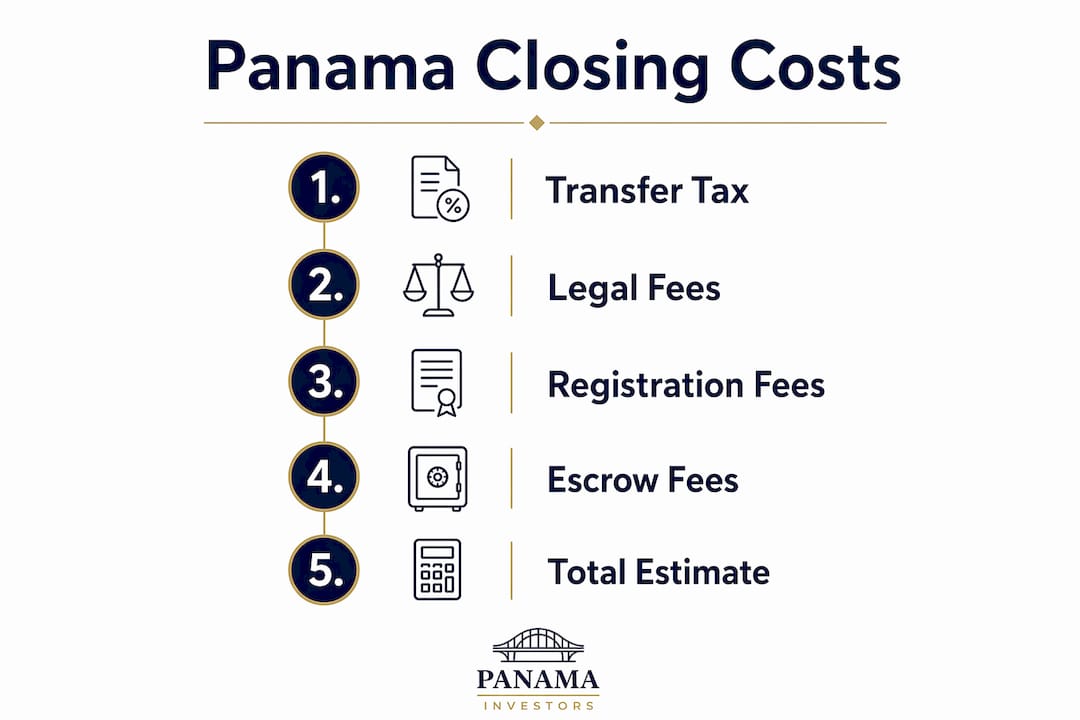
How to estimate Panama closing costs: the full cost breakdown
Panama property transaction fees fall into four main categories. Understanding each one lets you build a reliable budget before you make an offer.
1. Transfer tax
Transfer tax is calculated at 2% on whichever is higher: the agreed sale price or the property’s registered cadastral value. This tax is typically the seller’s responsibility, but it is frequently negotiated into the deal structure. Buyers need to understand it because it directly affects pricing and negotiation leverage. The tax must be paid before closing, so it affects your timeline as well as your budget.
2. Legal fees
Legal fees for real estate transactions in Panama generally run 1% to 1.5% of the purchase price. On a $200,000 property, that means $2,000 to $3,000. These fees cover contract preparation, deed drafting, title review, and closing assistance. Skipping independent legal counsel in Panama is a serious mistake. The legal protections for buyers are strong when you use them, but they require a licensed Panamanian attorney to activate.
3. Registration and notary fees
Registration fees to inscribe the deed run 0.2% to 0.3% of the purchase price, paid by the buyer. On a $400,000 property, that is $800 to $1,200. Notary fees are separate and typically fixed at a few hundred dollars. These costs are non-negotiable because they are set by the Public Registry of Panama.
4. Escrow fees
Escrow fees range from $350 to $1,000 depending on the complexity of the transaction and the escrow agent selected. Escrow is not legally required in Panama, but it is the standard practice for international buyers. It protects your deposit while due diligence is completed. Read more about how escrow protects overseas buyers before you wire any funds.
Sample calculation for a $200,000 cash purchase
| Fee | Rate | Estimated amount |
|---|---|---|
| Transfer tax (if buyer-negotiated) | 2% of sale price | $4,000 |
| Legal fees | 1%–1.5% | $2,000–$3,000 |
| Registration fees | 0.2%–0.3% | $400–$600 |
| Notary fees | Fixed | $200–$400 |
| Escrow fees | Fixed | $350–$1,000 |
| Total estimate | $6,950–$9,000 |
This puts you comfortably within the 2%–5% benchmark for cash buyers. Budget toward the higher end if the transaction involves multiple parties, translations, or additional due diligence reports.
Pro Tip: Always request an itemized fee estimate in writing from your attorney before signing a purchase agreement. Verbal estimates in Panama real estate are not binding.
How do closing costs differ when financing through a mortgage?
Mortgage financing adds a meaningful layer of costs to any Panama property purchase. Mortgage buyers should budget 3% to 7% of the purchase price in total closing costs. That is a significant jump from the 2%–5% range for cash buyers. On a $200,000 property, the difference can reach $4,000 or more.
The additional costs tied to financing include:
- Mortgage registration fee: The bank’s mortgage lien must be registered with the Public Registry. This fee typically runs 0.5% to 1% of the loan amount.
- Bank appraisal fee: Lenders require an independent property appraisal before approving a loan. Expect $300 to $600 for a standard residential property.
- Bank processing and origination fees: These vary by lender but commonly add 1% to 2% of the loan amount.
- Life and property insurance: Panamanian banks require both as a condition of the mortgage. First-year premiums are often paid at closing.
- Additional legal fees: Your attorney will need to review and register the mortgage deed separately from the property deed.
The mortgage term and lender also affect your total. Local Panamanian banks like Banistmo and Banco General have different fee structures than international lenders. For a detailed comparison of your financing options, the mortgage guide for expats from Panamainvestors covers current lender requirements and typical fee ranges.
Pro Tip: Ask your lender for a Good Faith Estimate before committing to a mortgage. Panamanian banks are not legally required to provide one, but reputable lenders will.
What are the typical timelines and payment milestones for Panama closing costs?
Knowing when each fee is due is as important as knowing how much it costs. Panama real estate closings follow a defined sequence, and missing a payment deadline can delay or void the transaction.
| Milestone | Fee due | Typical timing |
|---|---|---|
| Offer accepted | Escrow deposit (10% of price) | Within 5–10 business days |
| Due diligence period | Legal fees (partial or full) | During 30–60 day review period |
| Pre-closing | Transfer tax | Before deed signing |
| Closing day | Registration fees, notary fees, balance of legal fees | At signing |
| Post-closing | Mortgage registration (if financed) | Within 30 days of closing |
The Panamanian closing process typically takes 60 to 90 days from signed offer to registered title. That timeline assumes clean title, no liens, and a cooperative seller. Complications like unresolved cadastral discrepancies or corporate structure reviews can add weeks.
Your attorney and escrow agent set the actual payment deadlines. Confirm every due date in writing before the process begins. Cash flow planning matters here. You may need to have legal fees available weeks before the closing date, not just on the day itself.
How can buyers reduce Panama closing costs legally?
Several legitimate strategies can lower your total Panama real estate expenses. None of them are shortcuts. Each requires professional guidance to execute correctly.
-
Transfer via a Panama S.A. corporation: Transferring an existing corporation that holds the property title can completely avoid the 2% transfer tax. This is a common strategy among experienced buyers. The catch is significant: you must conduct an exhaustive legal audit of the corporation to confirm it carries no hidden debts, tax liabilities, or legal disputes. A clean S.A. transfer saves thousands. A poorly audited one can cost far more.
-
Verify the cadastral value before signing: The Dirección General de Ingresos (DGI) calculates transfer tax on whichever is higher, the sale price or the registered cadastral value. If the cadastral value exceeds your agreed purchase price, you pay tax on the higher number. Verifying this before you sign the purchase agreement prevents a surprise tax bill at closing.
-
Negotiate legal and escrow fees: Attorney fees in Panama are not government-regulated for real estate transactions. Most lawyers will negotiate, especially on higher-value properties. Escrow agents also have some flexibility on fees. Get quotes from at least two providers before committing.
-
Budget a 10% contingency: Even with accurate estimates, unexpected costs appear. Translation fees, additional due diligence reports, and title correction costs are common additions. A 10% buffer on your total closing cost estimate protects your cash position.
-
Understand the capital gains advance: A 3% capital gains advance is withheld on the gross transaction value. This is the seller’s obligation, but it affects pricing negotiations. Sellers who face a higher-than-expected tax burden often adjust their asking price upward to compensate.
Pro Tip: Never rely on the seller’s attorney to protect your interests. Panama law allows one attorney to represent both parties, but your financial exposure is too significant to share legal counsel.
Key takeaways
Accurately estimating Panama closing costs requires calculating transfer tax, legal fees, registration costs, and escrow charges against your purchase price and financing method.
| Point | Details |
|---|---|
| Cash buyer cost range | Budget 2%–5% of the purchase price for all closing fees combined. |
| Mortgage buyer cost range | Financing adds bank fees and insurance, pushing total costs to 3%–7%. |
| Transfer tax calculation | Tax is 2% on the higher of sale price or cadastral value, so verify both before signing. |
| Legal fees | Expect 1%–1.5% of the purchase price; always hire independent counsel. |
| Cost reduction strategy | Transferring a clean Panama S.A. corporation can eliminate the 2% transfer tax entirely. |
What I’ve learned from watching buyers get blindsided at closing
Most buyers I talk to have done their homework on the purchase price. Very few have done it on the closing costs. The gap between what they expect to pay and what they actually pay at the closing table is almost always a legal fee or a cadastral value surprise.
The cadastral issue is the one that catches people off guard most often. You negotiate a price of $180,000, feel good about the deal, and then your attorney tells you the DGI has the property registered at $220,000. Your transfer tax just jumped by $800 without anyone changing the agreed price. That is not a scam. It is just how Panama’s tax system works, and it is entirely avoidable if you check the cadastral value before you sign.
The S.A. corporation strategy is genuinely useful, but I have seen buyers rush it. They hear “avoid the transfer tax” and stop listening after that. The legal audit on the corporation is not optional. It is the entire point. A corporation with an undisclosed creditor or an unpaid tax obligation transfers that liability to you the moment the shares change hands.
My honest advice: plan conservatively, verify every number independently, and use a local attorney you hired yourself, not one recommended by the seller. Panama’s real estate market rewards prepared buyers. The international property buying guide from Panamainvestors is a solid starting point for understanding the full process before you engage any professionals.
— Roie
How Panamainvestors helps you calculate and manage closing costs
Estimating Panama closing costs accurately requires local knowledge that most international buyers simply do not have on their first purchase.

Panamainvestors, led by Luca Piva with over 12 years of on-the-ground Panama real estate experience, gives you direct access to that knowledge. Luca’s team helps buyers calculate realistic closing cost estimates, connect with vetted local attorneys, and avoid the cadastral and corporate transfer pitfalls that catch unprepared buyers. Whether you are purchasing a condo in Panama City or a beachfront property on the Pacific coast, Panamainvestors provides the local network and transaction expertise to protect your investment. Visit the investment opportunities page to start a conversation about your purchase and get a personalized closing cost estimate for your target property.
FAQ
What are closing costs in Panama for a cash buyer?
Cash buyers in Panama typically pay 2%–5% of the purchase price in total closing costs, covering transfer tax, legal fees, registration, notary, and escrow charges.
How do I calculate the transfer tax in Panama?
Transfer tax is 2% of whichever is higher: the agreed sale price or the property’s registered cadastral value. Verify the cadastral value with the DGI before signing any purchase agreement.
Does financing a Panama property increase closing costs?
Yes. Mortgage buyers pay 3%–7% of the purchase price in closing costs due to mortgage registration fees, bank appraisals, origination fees, and required insurance premiums.
Can I avoid the transfer tax when buying property in Panama?
Buyers can avoid the 2% transfer tax by acquiring shares of a Panama S.A. that already holds the property title, but this requires a full legal audit of the corporation to confirm it is free of liabilities.
How long does the Panama closing process take?
The closing process in Panama typically takes 60 to 90 days from a signed offer to a registered title, assuming clean title and no outstanding liens or cadastral discrepancies.
