Why a local agent in Panama unlocks real estate success
Why a local agent in Panama unlocks real estate success
- Panama Investors
- May 1
- 10 min read
Panama’s property market is not what it looks like from the outside. International investors who rely on online listings, expat forums, or even experienced attorneys often walk away having overpaid, wasted months, or worse, fallen into legal traps that could have been avoided. The truth is that Panama operates on relationships, insider knowledge, and access that only a licensed local agent can provide. This article breaks down exactly why local representation is not optional if you want to invest safely and profitably in one of Latin America’s most dynamic real estate markets.
Table of Contents
Key Takeaways
Point | Details |
Panama market is opaque | Panama’s property market lacks transparency and reliable data, making local expertise critical. |
Licensed agents prevent costly mistakes | ACOBIR-certified agents protect against legal and pricing pitfalls for foreign buyers. |
Agents accelerate transactions | Local agents can reduce property sale times from months to weeks by pricing strategically. |
Network access is essential | Trusted local agents grant access to hidden listings and insider negotiation leverage. |
Attorney alone isn’t enough | Market knowledge and networks from agents are vital alongside legal counsel for safe purchases. |
What makes Panama’s real estate market unique
Most international investors arrive expecting a market similar to what they know at home: organized listings, transparent pricing, standardized processes. Panama delivers none of those things. The single biggest structural difference is that
, making it fragmented, opaque, and almost entirely dependent on local networks for accurate data. There is no single database where you can verify a property’s asking price against comparable sales. There is no public record of what properties actually sold for last month.
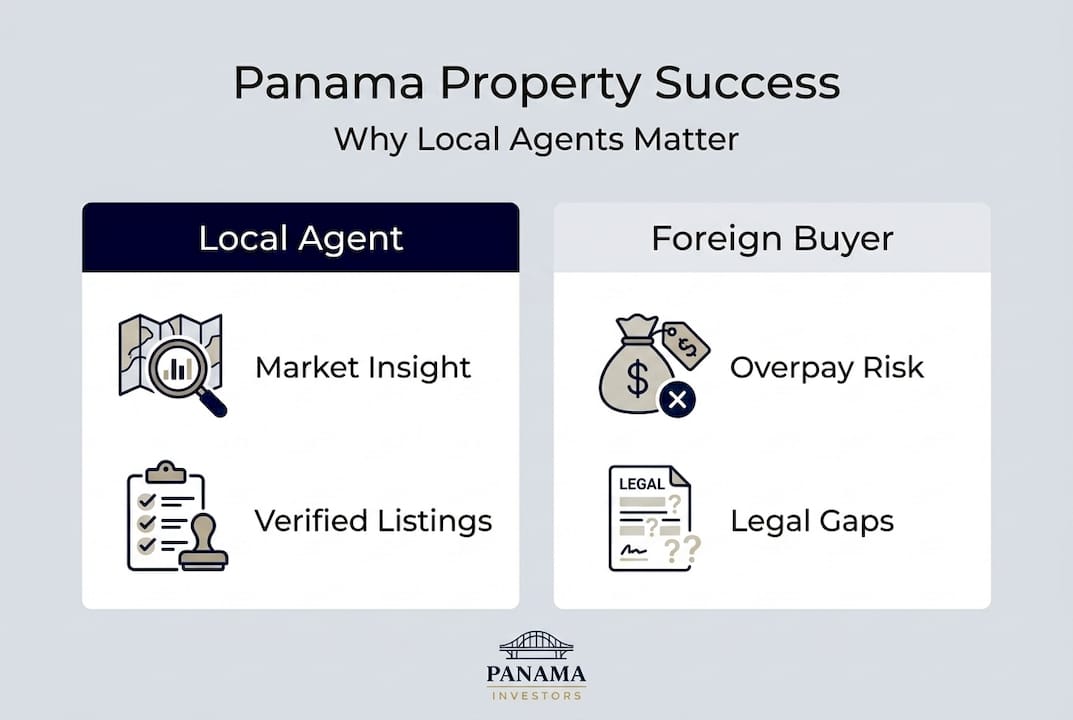
This creates a serious information gap. Sellers routinely list at prices 20 to 30 percent above realistic market value, knowing that uninformed buyers have no way to challenge them. The result? Panama’s average time on market sits at roughly seven months. That is not because demand is low. It is because most listings are overpriced from day one, and sellers wait months before someone without market knowledge walks in and pays the inflated price.
For buying real estate as a foreign investor, this dynamic is especially dangerous. Without a trusted local source of pricing data, you are essentially negotiating blind.
Here is a quick overview of how Panama compares to more regulated markets:
Feature | Panama | Regulated markets (US, EU) |
Centralized MLS | No | Yes |
Public sales data | Limited | Widely available |
Standardized agent licensing | Partial | Mandatory |
Typical time on market | 7 months | 30 to 90 days |
Foreigner buying rights | Equal to nationals | Varies |
The key takeaways for any investor approaching this market:
Listings on property websites are neither complete nor verified
Asking prices rarely reflect true market value
Legal title verification requires hands-on registry access
Negotiation power depends on knowing real comparable data
Scams targeting foreign buyers are documented and ongoing
Panama’s dollarized economy and strong legal framework for foreign ownership are genuine advantages, as explored in this international property buying guide. But those advantages only work in your favor when you have someone on the ground who understands the full picture.
The critical role of licensed local agents
Not every agent operating in Panama is licensed. That distinction matters enormously. A licensed agent in Panama must be registered with the Ministry of Commerce and Industry and, ideally, be a member of ACOBIR, Panama’s national real estate association. Licensed local agents ensure due diligence that includes Public Registry checks, boundary surveys, and coordination with attorneys to protect buyers from overpayment and legal exposure.
ACOBIR membership provides MLS access along with ethical standards and international affiliations that unlicensed agents simply cannot offer. This matters because it means ACOBIR agents can cross-reference listings, share data with colleagues, and operate within an accountability framework. When something goes wrong with an unlicensed agent, you have almost no recourse.
Here is how the two types of agents differ in practice:
Factor | Licensed ACOBIR agent | Unlicensed agent |
Public Registry access | Yes | Limited or none |
Ethical accountability | ACOBIR oversight | None |
MLS data access | Yes | No |
Attorney coordination | Standard practice | Rare |
Recourse if issues arise | Formal complaint process | None |
International recognition | Yes | No |
The process of working with a licensed agent follows a clear structure:
Initial consultation: The agent assesses your budget, goals, and timeline to identify genuinely suitable properties.
Curated listings: Only vetted, registry-verified properties are presented, not everything on a generic website.
Property visits: The agent accompanies you, providing real-time market context and negotiation framing.
Offer and negotiation: The agent uses actual comparable data to anchor your offer at a defensible price.
Due diligence coordination: Public Registry verification, survey review, and attorney handoff happen through the agent’s network.
Closing support: The agent stays involved through the escritura (title deed) process to catch last-minute issues.
Pro Tip: Before signing any agreement with an agent in Panama, ask for their MICI registration number and ACOBIR membership. If they hesitate or cannot produce either, walk away immediately.
This buyer’s agent guide provides more detail on what to expect from the relationship, and the step-by-step buying guide walks you through each phase of the transaction.
“A licensed agent is not a luxury in Panama. They are the mechanism through which a safe, fair, and legally sound transaction actually happens.”
Access, pricing, and negotiation: Why local agents deliver better results
Here is where the financial argument becomes undeniable. Foreigners routinely overpay and face scams when purchasing without a local agent, and realistic pricing from an experienced local cuts the average time on market from seven months down to two to three weeks. That compression is not a minor convenience. It means you close faster, carry less risk, and get a better price because the seller is not anchored to an inflated listing that has sat untouched for half a year.
Consider two scenarios. In the first, a foreign investor finds a property through an online portal, contacts the listing agent directly (who represents the seller), and negotiates without any independent pricing data. They pay the asking price, which is 25 percent above what comparable units have sold for in the past 90 days. In the second scenario, the same investor works with an independent buyer’s agent who pulls actual comparable data from their ACOBIR network, anchors the offer at a realistic price, and closes in three weeks at 12 percent below the original asking price.
The financial difference on a $300,000 property is roughly $37,500. That more than covers any agent commission and then some.
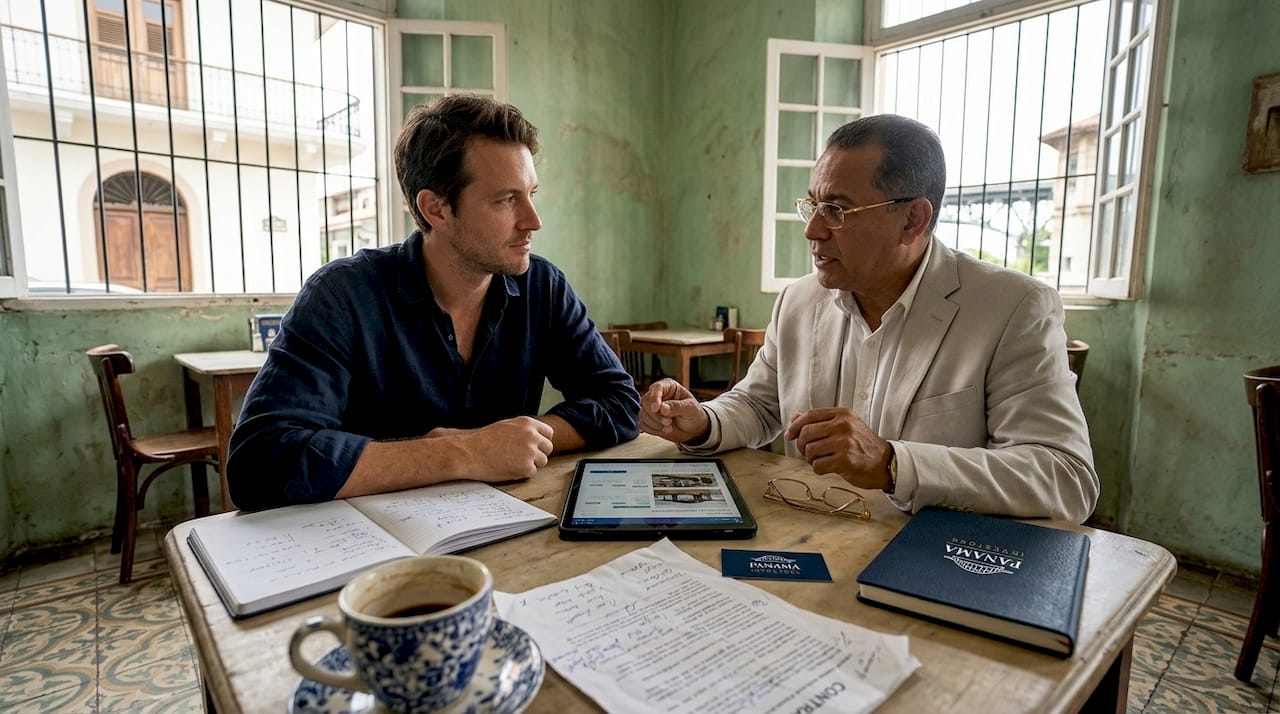
Local agents also provide something no database can: scam prevention. Verified finca numbers (the unique property identifier in Panama’s Public Registry) are the first line of defense against fraudulent listings.
Pro Tip: Always insist that your agent provide the registry-verified finca number before you visit a property. If a listing cannot produce this number upfront, it should not be on your shortlist.
Beyond pricing, access is the other major advantage. Many of the best properties in Panama never appear on public platforms. Sellers with high-value assets often prefer quiet sales handled through trusted agent networks. A foreign investor browsing Encuentra24 or similar portals is looking at a fraction of the actual market.
Key ways a local agent delivers superior outcomes:
Off-market access: Exclusive listings shared only within trusted agent networks
Seller motivation intel: Agents know which sellers are motivated and will negotiate aggressively
Neighborhood pricing history: Real transaction data that online portals do not publish
Legal red flags: Early identification of encumbrances, liens, or title disputes
Currency and transfer guidance: Practical knowledge of how to move funds correctly in Panama’s dollarized system
Working with legal counsel for buying is important, but the agent must come first to ensure the property is worth hiring an attorney for in the first place. And for American buyers specifically, understanding what Americans need to know about the buying process helps set realistic expectations before engaging.
What most investors overlook: Nuances of the Panama market
Most articles on buying property in Panama focus on the legal and financial basics. Fewer discuss the subtler realities that determine whether your investment performs. These nuances are where experienced local agents earn their keep most clearly.
The single most underappreciated factor is agent-attorney coordination. In Panama, the attorney handles the legal transfer and ensures clean title. The agent handles everything upstream: sourcing, pricing, negotiation, and due diligence preparation. When these two professionals work as a team and ideally have an existing relationship, transactions move smoothly. When they do not, deals stall, documents go missing, and buyers get caught in the middle.
ACOBIR-licensed agents are universally preferred for this reason. They operate within a recognized professional framework, which attorneys know and respect. An unlicensed agent asking an attorney to rush a Public Registry check is a very different interaction from a licensed ACOBIR member making the same request.
Here is what a complete, well-coordinated transaction looks like:
Agent sources and vets the property, confirming finca number and initial registry status.
Agent negotiates price and terms using real market data and seller relationship.
Agent coordinates survey with an approved topographer if boundaries need verification.
Attorney reviews title for clean transfer, checks for liens or encumbrances.
Attorney drafts the promise-to-purchase agreement (promesa de compraventa) with deposit terms.
Agent manages seller communication during the due diligence window.
Attorney registers the escritura with the Public Registry to complete the transfer.
This coordination is not accidental. It is the result of agents and attorneys who have worked together on multiple deals and know how to get things done efficiently.
“The Ministry of Commerce and Industry and ACOBIR reinforce the need to work with qualified real estate brokers who provide the market knowledge and ethical standards that protect buyers and sellers alike.”
Foreign investors who skip this process often miss critical nuances: properties with unclear rights of possession (ROP) versus titled land, buildings with pending municipal permits, or condos with HOA debt that transfers to the buyer. None of these are visible on a listing. All of them are visible to an experienced local agent. If you are still building your case for why Panama is worth your attention, the why Panama overview covers the market fundamentals, and understanding Panama real estate tax benefits adds another dimension to the investment case.
The uncomfortable truth about buying property in Panama
After more than 12 years working in this market, here is what we know that most articles will not tell you: online research and a good attorney are not enough. They are not even close to enough.
The conventional wisdom says: do your research, hire a lawyer, and you will be fine. In a transparent market with centralized data and standardized pricing, that advice holds. In Panama, it leaves you exposed at every critical stage of the transaction. Attorneys are essential, but they do not know which seller will accept 15 percent below asking. They do not have the WhatsApp contact of the building manager who can confirm whether a condo has water pressure issues. They do not know which neighborhoods are quietly appreciating and which ones look good in photos but rent poorly.
That information lives in agent networks. Not on websites. Not in legal documents. In relationships built over years of doing deals in the same market.
We have seen sophisticated investors, people who have bought property in multiple countries, arrive in Panama with full confidence and leave having overpaid substantially or, worse, having purchased a property with title complications that took years to resolve. The common thread in almost every difficult case is the absence of a committed, licensed, locally connected agent from the start.
Expat forums are particularly dangerous. They are full of well-meaning advice from people who made decisions based on their single purchase experience. One person’s great deal in Boquete tells you nothing about what a fair price looks like in Casco Viejo today. Relationships and current market intel are what matter. Read the Panama buyer’s agent perspective to understand how proper representation changes the entire investment experience.
Pro Tip: If someone in an expat forum tells you that you do not need an agent in Panama, ask them how many properties they have bought here. One purchase does not make a market expert.
The investors who win in Panama are not necessarily the ones with the most capital. They are the ones who recognized early that local expertise is the real competitive advantage in this market, and they aligned themselves with it before making any commitments.
Connect with expert local agents for your Panama investment
Panama’s real estate market rewards preparation and punishes guesswork. If everything in this article has reinforced one idea, it is that the right local agent is not a cost you add to a transaction. It is the thing that makes the transaction worth doing.

At Panama Investors, Luca Piva and the advisory team have spent over 12 years building the network, market knowledge, and agent relationships that international buyers need to invest safely and profitably. From identifying off-market opportunities to coordinating legal due diligence and negotiating from a position of real data, the process is designed to protect your capital and your time. If you are ready to stop researching and start investing with confidence, book a strategy call with the team today.
Frequently asked questions
Do I need a local agent to buy property in Panama?
Hiring a local agent is strongly recommended because Panama’s market lacks centralized data, making local expertise essential for accurate pricing, access to verified listings, and protection against scams and overpayment.
How do I verify if my agent is licensed in Panama?
Ask for their MICI registration number and confirm ACOBIR membership and ethical standards through the association directly, which also ensures your agent has access to shared listing data and professional accountability.
What are common mistakes foreign buyers make without a local agent?
Without local representation, foreigners routinely overpay and face scams, miss legal complications like rights-of-possession issues, and often purchase based on inflated listing prices with no independent market data to guide them.
Is hiring an attorney enough for property transactions?
Attorneys are essential for the legal transfer, but agents provide market intel and networks that no legal professional can substitute, including pricing intelligence, seller motivation, and off-market access.
How can a local agent speed up property buying in Panama?
By using real comparable data to price offers correctly, agents cut sale time from seven months to as little as two to three weeks, saving investors both time and money on carrying costs and delayed returns.
Recommended
