
What Is Seller Motivation in Panama: 2026 Guide
What Is Seller Motivation in Panama: 2026 Guide
Seller motivation in Panama is defined as the underlying set of financial, legal, and personal pressures that compel property owners to sell at a given price and timeline. In Panama’s 2026 market, these motivations are unusually concentrated around three forces: investor visa deadlines, title status, and the growing share of residency-focused buyers. Understanding seller motivation factors in Panama gives you a direct negotiating edge, because a seller racing against an October 2026 visa threshold behaves very differently from one testing the market with no urgency. Panamainvestors has documented this pattern repeatedly across Panama City, Coronado, and the Azuero Peninsula.
What key factors drive seller motivation in Panama’s 2026 property market?
Seller motivation in Panama’s current market clusters around five identifiable drivers, each with measurable consequences for pricing and negotiation.
-
Investor visa deadlines. Sellers of properties valued between $300,000 and $450,000 face acute urgency to close before the October 2026 investor visa threshold hike. A seller who misses that window loses access to the largest pool of residency-motivated buyers, which directly compresses their exit price.
-
Listing premiums and negotiation room. Panamanian sellers typically list 10% to 20% above their expected final selling price. That built-in cushion signals that most sellers anticipate negotiation, which means a buyer who understands this dynamic can open well below asking without offending the seller.
-
Total selling costs. Seller costs in Panama run between 10.5% and 12% of the sale price, covering agent commissions, transfer taxes, and capital gains obligations. That is a significant financial burden, and sellers who underestimated these costs at listing time often become more flexible once they run the actual numbers.
-
Buyer segmentation. About 25% of buyers are primarily motivated by investor visa and residency criteria rather than pure investment returns. Sellers who recognize this segment actively market their properties as visa-eligible, which changes how they price and present listings.
-
Title and legal complexity. Properties with unresolved title issues or Right of Possession (ROP) status create a specific kind of seller pressure. Sellers holding ROP land often accept lower prices or faster timelines because their buyer pool is structurally smaller.
Pro Tip: Before making an offer, ask your agent how long the property has been listed and whether the seller has already purchased another property. A seller carrying two mortgages is among the most motivated you will encounter in Panama’s market.
How do seller motivations vary across property types and regions?

Motivation does not look the same across Panama’s diverse property categories. The table below captures the most important contrasts.
| Property type / region | Primary seller motivation | Typical negotiation posture |
|---|---|---|
| Pre-construction units (Panama City) | Developer cash flow and unit absorption targets | Limited flexibility on price, more on payment terms |
| Resale condos (Punta Pacifica, San Francisco) | Lifestyle change, relocation, or capital recycling | Moderate flexibility, especially after 90+ days on market |
| Titled beachfront (Coronado, Pedasi) | Retirement exit or estate planning | High flexibility if property has been listed over six months |
| ROP coastal land | Legal complexity and limited buyer pool | Strongest motivation to discount or offer concessions |
| Luxury urban penthouses | Market timing and currency positioning | Low urgency unless carrying costs become a burden |
The pre-construction versus resale divide is particularly sharp. Developers selling pre-construction units in Panama City are motivated by project financing milestones, not personal financial pressure. They rarely discount, but they do negotiate on payment schedules, finish upgrades, or parking allocations. Resale sellers, by contrast, are individuals with personal timelines and emotional stakes in the outcome.
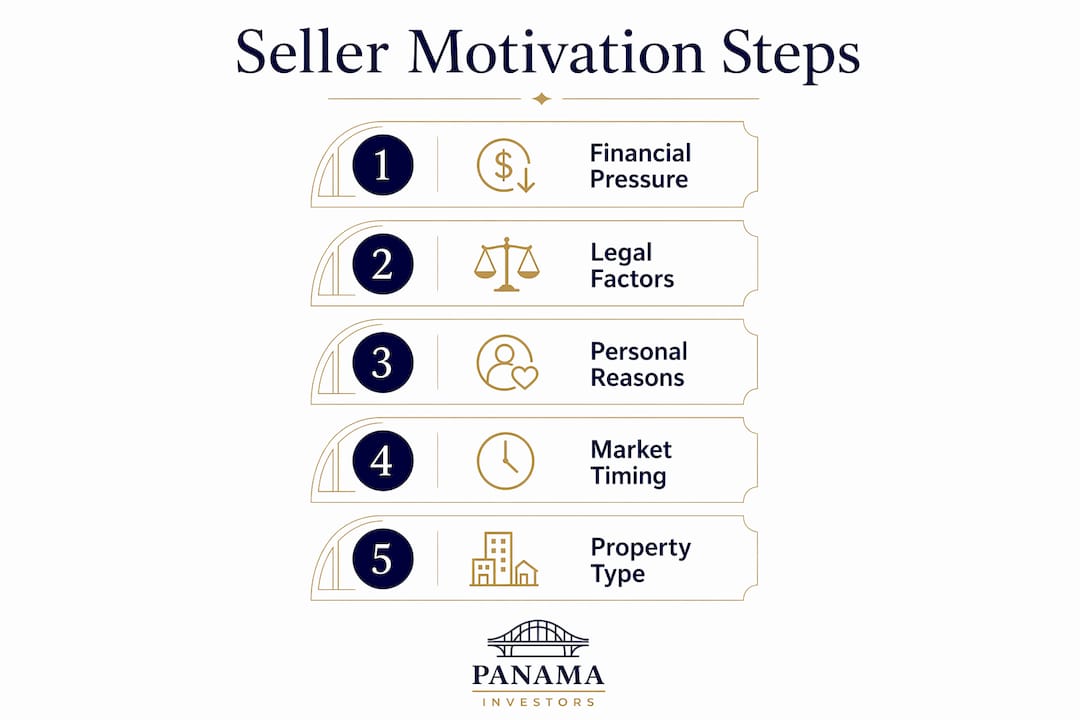
Regional variation matters just as much. Properties with ocean views or direct beach access sell faster and generate higher seller confidence, which reduces motivation to negotiate. A beachfront property in Pedasi with unobstructed Pacific views carries a seller who knows demand is structural. A landlocked lot two kilometers inland in the same town carries a seller who knows they are competing on price alone. Understanding top ROI locations in Panama helps you map which regions produce the most negotiable sellers.
The ROP versus titled land distinction deserves special attention. Sellers of ROP land face greater resale hurdles because many lenders will not finance ROP purchases and many foreign buyers will not accept the legal ambiguity. That structural disadvantage translates directly into seller motivation. If you are comfortable with ROP due diligence, you are often negotiating with the most motivated seller in the market.
What signs and indicators reveal a motivated seller in Panama?
Identifying a motivated seller before you make an offer is a skill that separates experienced Panama investors from first-time buyers. The signals are specific and readable if you know what to look for.
-
Listing language. Terms like “motivated seller” or phrases such as “priced to sell” and “owner financing considered” are direct signals of seller urgency. These are not accidental word choices. They are deliberate invitations to negotiate.
-
Price reduction history. A property that has been reduced twice in six months tells you the seller mispriced initially and is now chasing the market. Each reduction is evidence of increasing motivation. Ask your agent for the full price history before making any offer.
-
Extended time on market. Panama’s active urban market moves listings within 60 to 90 days when priced correctly. A property sitting beyond 120 days is almost always carrying a seller whose expectations have not yet aligned with market reality. That gap is your opportunity.
-
Residency-linked pricing. Properties priced specifically at $300,000 or just above are often positioned to qualify buyers for Panama’s investor visa. A seller who has deliberately priced at that threshold is targeting residency buyers and understands the urgency that visa deadlines create. That seller is motivated to close before the threshold changes.
-
Seller-paid concessions. Offers to cover closing costs, include furnishings, or provide a rent-back period are all signs that the seller values certainty of closing over maximizing net proceeds. These concessions are negotiating currency.
Pro Tip: Request a comparative market analysis from your agent that shows the original listing price, all price reductions, and days on market. In Panama, this data is available through local MLS systems and gives you a factual basis for your opening offer rather than guesswork.
How can investors leverage seller motivation for better decisions in Panama?
Understanding what drives sellers in Panama converts market knowledge into direct financial advantage. Here is how to apply it.
-
Match your offer to the seller’s actual pressure. A seller motivated by the October 2026 visa deadline needs speed and certainty above all else. Offer a faster closing timeline and fewer contingencies rather than a lower price. That trade often produces a better outcome than a pure price negotiation.
-
Target the $300,000 to $450,000 range strategically. This price band concentrates the highest density of motivated sellers in 2026 because it sits at the intersection of visa eligibility and seller urgency. Buyers who understand Panama’s investor visa requirements can use that knowledge to identify sellers who are racing against a regulatory clock.
-
Use title status as a negotiation lever. When a property carries ROP status, the seller’s motivation is structurally higher than the listing price suggests. Buyers who are willing to complete proper due diligence on ROP land can negotiate discounts that titled property buyers rarely access. Panamainvestors recommends always verifying title status before entering any negotiation.
-
Track residency buyer behavior. Residency-focused buyers are less price-sensitive and more deadline-sensitive than traditional investors. Sellers who know this market their properties accordingly, which means you as a traditional investor can sometimes acquire the same property at a better price by moving outside peak residency-buying seasons.
-
Assess carrying costs. A seller who owns a property outright has different motivation than one paying a mortgage, HOA fees, and property taxes on a vacant unit. Ask your agent to find out whether the property is vacant and how long it has been unoccupied. Carrying costs create motivation that does not appear in the listing.
Many buyers purchase years in advance of actual occupancy to lock in prices, which creates an unusual secondary market of sellers who originally bought speculatively and now need to exit before their own financial timelines shift. These sellers are often invisible in standard listing searches but accessible through local agent networks.
Key takeaways
Seller motivation in Panama is most reliably identified through a combination of listing price history, title status, and the seller’s relationship to the October 2026 investor visa threshold.
| Point | Details |
|---|---|
| Visa deadline urgency | Sellers in the $300,000 to $450,000 range face the strongest motivation to close before October 2026. |
| Built-in negotiation room | Listings carry a 10% to 20% premium, so most sellers expect and accept offers below asking price. |
| ROP land as opportunity | Right of Possession sellers face a smaller buyer pool and consistently show stronger motivation to negotiate. |
| Residency buyer effect | The 25% of buyers driven by visa goals push sellers to market properties as visa-eligible, shaping pricing strategy. |
| Carrying costs reveal urgency | Vacant properties with ongoing HOA and mortgage costs signal sellers who prioritize speed over maximum price. |
What I’ve learned watching Panama’s seller market shift in 2026
I have watched Panama’s property market from the inside long enough to say something that most articles will not: the October 2026 visa threshold change is the single most underappreciated factor in seller motivation right now. Most buyers focus on what they want to buy. The investors who consistently get better deals focus on why the seller needs to sell.
The residency buyer segment has genuinely changed seller behavior in ways that are not obvious from listing data alone. Sellers who once priced based on comparable sales now price based on visa eligibility thresholds. That is a structural shift, not a temporary trend. It means a property priced at $310,000 is not priced there by accident. The seller knows exactly what that number unlocks for a residency-motivated buyer.
What I find most interesting is the developer side of this equation. Developers with strong reputations, like those behind established Panama City towers, rarely discount because their buyers trust the brand. But smaller developers or individual sellers in secondary markets are far more exposed to motivation pressure. The gap between those two seller profiles is where the real opportunity lives in 2026.
My advice: do not treat seller motivation as a soft concept. It is a measurable variable with specific indicators. Learn to read those indicators before you make any offer, and you will consistently outperform buyers who focus only on the property itself. For a broader view of how buyer and seller dynamics interact, the buyer’s agent guide from Panamainvestors is worth reading before your first negotiation.
— Roie
Work with Panamainvestors to read seller motivation accurately
Panamainvestors, led by Luca Piva with over 12 years of on-the-ground experience in Panama’s property market, specializes in exactly this kind of seller intelligence. Luca’s local network gives buyers access to off-market listings and direct insight into why each seller is selling, information that never appears in a public listing. Whether you are targeting a residency-eligible property in the $300,000 to $450,000 range or evaluating a beachfront ROP opportunity on the Pacific coast, understanding seller motivation is the difference between overpaying and closing at real value. Start with a strategy call to get a personalized read on current seller dynamics in your target market.
FAQ
What is seller motivation in Panama real estate?
Seller motivation in Panama refers to the financial, legal, and personal pressures that drive a property owner to sell at a specific price and timeline. In 2026, the most common motivators include investor visa deadlines, high carrying costs, and title complications.
How does the investor visa threshold affect seller motivation?
Sellers of properties priced between $300,000 and $450,000 are strongly motivated to close before the October 2026 visa threshold increase, because that price range currently qualifies buyers for Panama’s investor visa. Missing that deadline shrinks their buyer pool significantly.
How can I tell if a Panama seller is motivated?
Look for listing language like “motivated seller,” price reductions within the past 90 days, extended time on market beyond 120 days, and seller-offered concessions such as included furnishings or covered closing costs. These are reliable signals of urgency.
Does property title status affect how motivated a seller is?
Yes. Sellers of Right of Possession land face a structurally smaller buyer pool because many lenders and foreign buyers avoid ROP properties. That limited demand consistently produces stronger seller motivation and greater willingness to negotiate on price or terms.
Are residency-focused buyers changing how sellers price properties in Panama?
Residency-focused buyers, who represent roughly 25% of the market, are less sensitive to price and more sensitive to visa eligibility thresholds. Sellers have responded by pricing specifically at visa-qualifying levels, which has reshaped pricing strategy across Panama’s mid-range property segment.
