
How to get the Panama investor visa: step-by-step guide for 2026
How to get the Panama investor visa: step-by-step guide for 2026
- Panama Investors
- May 2
- 10 min read

Panama sits at a rare intersection that most countries can’t offer: a dollarized economy, a territorial tax system, world-class infrastructure, and a real estate market that actually qualifies you for legal residency. If you’re a global investor tired of navigating complex visa bureaucracies, sky-high tax burdens, and bloated minimum investment requirements, the Panama investor visa deserves serious attention. This guide breaks down every step of the process, from understanding who qualifies to maintaining your status long-term, so you can make a confident, well-informed decision before committing capital.
Table of Contents
Understand the Panama investor visa: What is it and who is it for?
Preparing for your application: Key documents and requirements
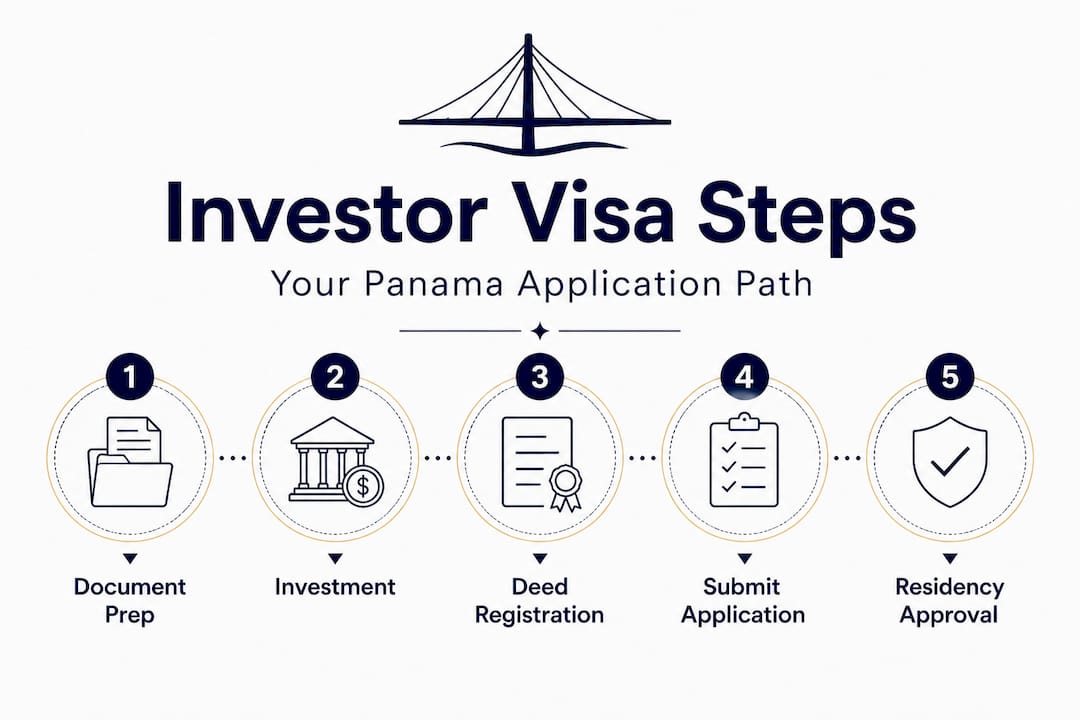
Step-by-step: Making your qualifying investment and submitting your application
Maintaining your investor visa and unlocking citizenship options
The hidden advantages and overlooked risks of Panama’s investor route
Key Takeaways
Point | Details |
Flexible residency | Panama investor visa requires minimal time in the country, appealing to global investors. |
Minimum investment | A $300,000 qualifying real estate purchase is required for eligibility. |
Territorial tax advantage | No local tax is imposed on foreign income with the investor visa. |
Citizenship pathway | Permanent residents can seek citizenship after five years and meeting language requirements. |
Understand the Panama investor visa: What is it and who is it for?
The Panama investor visa is a legal residency pathway specifically designed for foreign nationals who invest a minimum of $300,000 in qualifying Panamanian real estate. Unlike traditional residency programs that demand proof of income or lengthy physical presence, Panama rewards capital commitment with a flexible, privacy-friendly residency status.
What makes this route genuinely different from similar programs across Latin America is the combination of minimal presence requirements and a clean path to permanent residency and eventual citizenship. You don’t have to uproot your life, rent an apartment in Panama City, or spend six months a year there. You simply make a qualifying investment and comply with straightforward annual reporting.
Here’s a quick comparison of investor-oriented residency programs across the region:
Country | Minimum investment | Physical presence required | Citizenship pathway |
Panama | $300,000 (real estate) | 1 day every 2 years | Yes, after 5 years PR |
Costa Rica | $150,000 (various) | 1 day per year | Yes, after 7 years |
Colombia | ~$88,000 (approx.) | 6+ months per year | Yes, after 5 years |
Mexico | ~$200,000 (approx.) | 6 months per year | Yes, after 5 years |
Panama’s investor visa stands out because the minimal visit requirement of just one day every two years is virtually unmatched. You hold the investment for five years, submit annual proof to the Ministry of Commerce and Industries (MICI), and you’re on track for permanent residency and eventually citizenship.
Who qualifies? In terms of nationality, the investor visa is open to most nationalities, though applicants from certain high-risk countries may face additional scrutiny. The real filter is financial: you need to demonstrate a qualifying real estate investment of $300,000 or more, free of mortgage encumbrance or with at least $300,000 in unencumbered equity.
Key eligibility points at a glance:
Clean criminal record and valid passport
Real estate investment of at least $300,000 in Panama
Investment must be registered in your name or through a qualifying corporate structure
Annual MICI certificate to confirm ongoing investment status
No minimum income requirement beyond the investment itself
Panama’s territorial tax system is an enormous draw for international investors. Foreign income is simply not taxed in Panama, regardless of how much time you spend there. For entrepreneurs, investors, and remote professionals earning abroad, this is a structural advantage that compounds significantly over time.
Pro Tip: The investor visa is especially well suited for people managing income streams across multiple countries. Because Panama only taxes income earned within its borders, you can hold residency status without restructuring your global financial life.
Preparing for your application: Key documents and requirements
Getting the paperwork right before you start saves weeks of delays and avoids costly errors. Panama’s immigration system is functional, but it rewards preparation. Arriving at the process with incomplete documentation is the single most common reason applications stall.

Here’s a data overview of the key documents and their purpose:
Document | Purpose | Who issues it |
Valid passport (notarized copy) | Identity verification | Your home country |
Police clearance certificate | Criminal background check | Your home country and Interpol |
Real estate title or public deed | Proof of qualifying investment | Panama Public Registry |
MICI annual certificate | Confirms active investor status | Ministry of Commerce and Industries |
Health certificate | Medical fitness confirmation | Licensed Panamanian doctor |
Investment proof (bank statement) | Shows funds were transferred legally | Your bank |
One of the most important things to understand is the MICI annual certificate requirement. Annual MICI proof is not just a one-time hurdle; it’s an ongoing obligation that confirms your investment is still active and in good standing. Missing this renewal can jeopardize your residency status.
Here’s a step-by-step preparation sequence most investors follow:
Select and purchase qualifying real estate above the $300,000 threshold, ensuring the property is free of liens or that your equity meets the requirement. Review the real estate buying guide for a full breakdown of the acquisition process.
Register the property in your name or through a Panamanian corporation (Sociedad Anónima), which offers additional privacy and estate planning benefits.
Obtain your authenticated police clearance from your home country and have it apostilled or legalized for use in Panama.
Gather notarized passport copies and have all documents translated into Spanish by a certified translator if they are in another language.
Consult with a licensed Panamanian immigration attorney who can review your documents for completeness and flag potential issues before submission.
Secure health clearance from a licensed doctor in Panama, which is typically done during an in-country visit.
For those new to property acquisition in Panama, reviewing the property buying steps is a strong starting point before you begin gathering documents.
Regarding investment structure, you have two main options. You can hold the property directly in your personal name, which is simpler but offers less privacy. Alternatively, you can hold it through a Panamanian corporation, which adds a layer of asset protection and simplifies future transfers. Both structures qualify for the investor visa, but the corporate route is often preferred by investors with multiple assets.
Pro Tip: Work with a local real estate advisor who has direct relationships with immigration attorneys. The coordination between the property transaction and the visa paperwork is where delays most often happen, and a connected local advisor can keep both processes moving in parallel.
Step-by-step: Making your qualifying investment and submitting your application
With your documents organized and your investment identified, the process becomes linear. Here’s how experienced investors move through it efficiently.
Sign a promise-to-purchase agreement (promesa de compraventa) with the seller, typically accompanied by a deposit of 10% of the purchase price. This locks in the property while the full transaction is prepared.
Complete title due diligence through the Panama Public Registry to confirm the property is free of liens, mortgages, or encumbrances that would reduce your qualifying equity below $300,000.
Execute the public deed before a Panamanian notary, which is the formal legal transfer of ownership. The deed is then registered with the Public Registry.
Obtain the MICI certificate confirming your investment is registered and recognized for investor visa purposes.
Submit your immigration application to Panama’s National Immigration Service (Servicio Nacional de Migración), including all required documents, the MICI certificate, and payment of applicable government fees.
Receive your temporary residency card, which is typically issued within 30 to 90 days of a complete application submission.
Renew and maintain your status annually through MICI reporting, then apply for permanent residency after the required holding period.
Important: Panama’s investor visa requires you to hold your investment for five years. The minimal presence obligation of just one day every two years is one of the most investor-friendly policies in the hemisphere, but it does not mean you can neglect MICI compliance or let your investment structure lapse.
American investors considering property in Panama will find the US investor property guide helpful for understanding additional considerations around FATCA reporting and foreign property disclosure. Those interested in using the property as a vacation retreat can review the vacation home steps to understand how lifestyle use and investment status can work together.
The most common mistake at this stage is rushing the deed registration without confirming MICI recognition. The property purchase alone does not automatically generate a MICI certificate. Your attorney must actively file for this certification, and the timeline can add several weeks if not managed proactively.
Pro Tip: Request a certified copy of your public deed immediately after registration. This document becomes the backbone of multiple future filings, from MICI renewals to banking, and having certified copies on hand saves you repeated trips to the Public Registry.
Maintaining your investor visa and unlocking citizenship options
Getting the visa is step one. Keeping it and building toward citizenship is where the real long-term value is created.
Your ongoing compliance obligations as an investor visa holder are genuinely manageable:
Annual MICI certificate renewal: File proof each year that your qualifying investment remains active and in good standing.
Physical presence minimum: Visit Panama at least one day every two years. This is not a burden for most global investors.
Investment holding period: Maintain your $300,000 qualifying investment without liquidating or encumbering it below the threshold for at least five years.
Valid police clearance: Keep your criminal record documentation current, as renewals may require updated clearance letters.
Immigration status fees: Pay applicable renewal fees to the National Immigration Service on schedule.
After five years of maintaining permanent residency, you become eligible to apply for Panamanian citizenship. The citizenship pathway requires passing a basic Spanish language test and taking an oath that technically includes renouncing prior citizenship. However, this renunciation oath is widely reported as not enforced for nationals of the United States, Canada, and most EU member states. In practice, many investors hold both their original citizenship and Panamanian citizenship without issue.
Panama’s territorial tax benefit is worth emphasizing here. The tax advantages are not just theoretical. If you earn rental income from property in another country, manage a business incorporated elsewhere, or receive investment returns from international portfolios, none of that income is subject to Panamanian taxation. You only pay tax in Panama on income sourced within the country.
For those thinking about diversifying across the region, reviewing the international property guide provides useful context for how Panama stacks up within a broader Latin American investment portfolio.
Pro Tip: Most US, Canadian, and EU applicants find the renunciation requirement largely symbolic in practice. Consult a dual citizenship attorney before assuming this applies to your specific nationality, but statistically, the enforcement gap works heavily in favor of investors from these regions.
The hidden advantages and overlooked risks of Panama’s investor route
Most guides stop at the compliance checklist. That’s where the real insight begins.
The privacy dimension of Panama’s investor visa is underappreciated. Panama does not participate in certain global information exchange frameworks in the same way that higher-profile jurisdictions do, which gives investors a degree of financial privacy that is increasingly rare. Combined with minimal physical presence requirements, this makes Panama structurally attractive for people managing global wealth who want legal residency without bureaucratic overreach into their financial affairs.
That said, there are genuine risks that don’t get enough attention. Property overvaluation is real in popular areas like Punta Pacífica and Coronado. Some developers price units specifically targeting visa-seeking buyers, which means paying a premium for the address rather than the underlying asset quality. The investment has to make sense as real estate first, before it can serve as a visa vehicle.
Unvetted advisors are another persistent problem. Panama’s real estate market attracts opportunists who market themselves as visa specialists without holding the proper credentials, local relationships, or legal knowledge. An error in document sequencing or investment structuring can delay your application by months. Comparing regional options through resources like the Panama versus other markets analysis helps calibrate expectations before committing.
Tax efficiency is only as good as the local compliance supporting it. The territorial tax benefit is real, but it requires your investment structure to be set up correctly from the start. A corporation with improper filings or a property deed with title defects can compromise both your tax position and your residency status simultaneously.
The investors who get the most out of Panama’s investor visa treat it as a long-term lifestyle and financial strategy, not a quick box to check. They pair the investment with properties they genuinely want to use, in neighborhoods that are appreciating, with advisors who have proven track records in both real estate and immigration compliance.
Ready to invest in Panama? Connect with trusted advisors
Navigating real estate acquisition and visa compliance at the same time is manageable, but only when you have the right team around you.

At Panama Investors, we work with international buyers and expatriates who want to make smart, legally sound investments that serve both their lifestyle and their residency goals. Luca Piva brings over 12 years of on-the-ground experience in Panama’s real estate market, with direct relationships across legal, banking, and immigration networks. Whether you’re evaluating your first qualifying property or reviewing an existing investment structure, explore the Why Panama page to understand what makes this market work for serious international investors, and connect with our team to get personalized guidance tailored to your situation.
Frequently asked questions
How much do I need to invest for the Panama investor visa?
You must invest at least $300,000 in qualifying real estate to be eligible for Panama’s investor visa. The investment must be free of liens or carry at least that amount in unencumbered equity.
Do I need to live in Panama full-time after getting the investor visa?
No, you only need to visit Panama for at least one day every two years to maintain your investor residency status. This minimal presence requirement makes it one of the most flexible programs available globally.
What are the tax benefits of the Panama investor visa?
Panama operates a territorial tax system, meaning income earned outside of Panama is not taxed locally, regardless of your residency status. This is a permanent structural feature of Panamanian tax law, not a temporary incentive.
Is it possible to become a Panamanian citizen through the investor visa?
Yes, after holding permanent residency for five years and passing a basic Spanish language test, you may apply for citizenship. The renunciation of prior citizenship oath is frequently reported as not enforced for US, Canadian, and EU nationals, though you should verify this with a qualified attorney.
Recommended
