Step-by-step guide to buying a vacation home in Panama
Step-by-step guide to buying a vacation home in Panama
- Panama Investors
- Apr 27
- 10 min read
Imagine wiring $280,000 for a Panama beachfront property, only to discover the title is a “right of possession” claim that a neighbor disputes and no local bank will ever finance. That scenario plays out more often than you’d think, and it costs buyers not just money but years of frustration. Panama’s vacation home market is genuinely compelling: a dollarized economy, no foreign ownership restrictions, strong rental demand, and a lifestyle that rivals the Caribbean at a fraction of the cost. But the path from interest to signed deed requires precision. This guide walks you through every step, from preparation to post-closing protection, so you arrive at ownership with confidence.
Table of Contents
Key Takeaways
Point | Details |
Verify land title | Check every property’s Public Registry finca number to avoid costly scams and future title issues. |
Secure proper financing | Foreigners should expect higher down payments and rates; cash is preferred for the smoothest transactions. |
Use independent professionals | Always engage your own lawyer and escrow services for compliance and deposit protection. |
Plan ownership structure | Consider using corporations or PIFs for privacy, estate, and tax benefits tailored to your needs. |
What you need before starting your Panama vacation home search
Once you know what’s at stake, your first priority is preparation. Skipping this phase is where most foreign buyers stumble. Panama’s legal framework is buyer-friendly on paper, but the practicalities of international transactions require you to show up ready.
Liquidity and financing reality
Panama runs on cash, especially for foreign buyers. According to the Buying Guide, financing for foreigners means cash is strongly preferred; local Panamanian banks require a minimum 30 to 50% down payment with interest rates ranging from 5 to 8%, and developer financing is available for pre-construction purchases. Residency visas are also accessible via property purchases of $200,000 to $300,000 through Qualified Investor and Friendly Nations programs. Understanding foreign investor financing before you enter negotiations is not optional. If your capital is tied up in equities or other illiquid assets, you need to plan a timeline before you start making offers.
Essential documents and professional partners
Before you search a single listing, you need the right team assembled. Your core team includes:
A Panamanian licensed attorney who works exclusively for you, not the seller or developer
A licensed real estate agent with verified local market experience
A notary public for deed execution and registration
A local bank account or verified escrow provider for deposit handling
Anti-money laundering (AML) compliance documents, including your proof of funds and source of wealth
Ownership structures worth considering early
High-net-worth buyers often benefit from holding property through a Panamanian corporation (Sociedad Anónima) or a Private Interest Foundation (PIF). These structures offer privacy, simplified estate planning, and can accelerate future transfers. The decision to use one affects your tax obligations, your closing timeline, and how the deed is titled. This is not a decision to make at the closing table.
You should also review the residency via property purchase pathway if long-term residency is part of your plan, since the investment threshold and timing matter for structuring.
Financing comparison
Financing type | Down payment | Interest rate | Best for |
All cash | 100% | N/A | Fastest closing, strongest negotiation |
Panamanian bank mortgage | 30 to 50% | 5 to 8% | Long-term buyers with local banking history |
Developer financing | Varies (10 to 30%) | Often fixed | Pre-construction or new developments |
Pro Tip: Always confirm your financing structure and entity setup with your attorney before submitting any offer. Reversing these decisions after a contract is signed can be expensive and time-consuming.
The step-by-step property search and due diligence process
With your preparation and resources in order, now comes the search and due diligence phase. This is where discipline separates successful buyers from those who overpay or inherit someone else’s legal problem.
Step 1: Select your target regions
Panama’s vacation home markets are diverse. Panama City’s high-rises appeal to urban investors. Bocas del Toro attracts buyers who want Caribbean island living. Coronado and the Pacific Riviera offer beach access with proximity to the capital. The Azuero Peninsula is quieter and more rustic. Each region has different price points, infrastructure quality, rental demand, and, critically, different ratios of titled versus non-titled land. Know the region before you browse listings.
Step 2: Engage a buyer’s independent attorney
Before you visit a single property, retain your own legal counsel. As detailed in this Buying Property in Panama expert overview, you must always use an independent lawyer (not the seller’s), use escrow for all deposits, conduct a physical inspection, and maintain AML compliance. For high-net-worth individuals, a corporation or PIF adds privacy and estate planning value. This point cannot be overstated: the seller’s attorney works for the seller, not for you.
Step 3: Screen listings and verify the Public Registry
Every titled property in Panama has a finca number, which is its unique identifier in the Registro Público (Public Registry). Before you visit a property in person, your attorney should check the Public Registry to confirm:
Current owner of record
Any liens, mortgages, or encumbrances
Accurate boundaries and registered measurements
Whether the property is titled or a right of possession (ROP)
Step 4: Conduct physical inspections
Never skip a physical inspection. Structural issues, encroachment by neighboring properties, and flood risk are not visible on a title certificate. Hire a licensed engineer or inspector for any property over $150,000. For beachfront or island properties, additional checks on coastal concessions and maritime zone regulations are essential.
Step 5: Use escrow for all deposits
Deposits paid directly to a seller or developer without escrow protection are among the most common and most costly mistakes foreign buyers make in Panama. Escrow is not a luxury for high-net-worth international buyers. It is the minimum standard of transactional safety you should accept. Independent escrow also ensures that AML compliance documentation is properly handled, protecting both parties.
The key due diligence checklist before making any offer:
Finca number verified in the Public Registry
Title search showing clean ownership chain
No active liens, judgments, or mortgages
Boundaries confirmed via survey or registered plano
Physical inspection report completed
ROP status confirmed as absent or knowingly accepted
Pro Tip: Always prioritize titled land over ROP properties. Titled properties are far more liquid at resale, easier to finance, and simpler to transfer to heirs. Use the step-by-step buying guide to map each stage against your own timeline.
Completing due diligence on the international buying process requires patience, but every check you make now protects your asset for decades.
Executing the purchase: Offers, contracts, and closing
Following a thorough search and vetting, you’re ready to execute your property purchase. This phase has six distinct steps, each with legal weight.
Step 1: Make a formal offer
Your attorney submits a written offer outlining purchase price, payment structure, and any contingencies such as a final title search or structural inspection clearance. Verbal agreements hold no legal standing in Panama. Everything must be in writing from the start.
Step 2: Sign a reservation agreement
Once the seller accepts your offer, a reservation agreement (also called a promise to sell) is signed and a deposit, typically 5 to 10% of the purchase price, is placed in escrow. This removes the property from the market while you complete final checks.
Step 3: Enter into a promise to purchase contract
This more detailed contract specifies payment milestones, closing date, what is included in the sale (fixtures, furniture, appliances), and consequences of default on either side. Your attorney drafts or reviews this document in full before you sign.
Step 4: Perform the final title search
A second Public Registry search is conducted immediately before closing to confirm no new encumbrances have been added since the reservation agreement was signed. This step is often skipped by buyers who feel confident after the initial search. It should never be omitted.
Step 5: Transfer funds via escrow and close
Funds are released from escrow at closing, which takes place before a Panamanian notary. The transfer deed (escritura) is executed, signed, and submitted to the Public Registry for registration. Expect AML compliance documentation to be required at this stage, including source of funds declarations.
A key statistic: local Panamanian banks require a minimum 30 to 50% down payment from foreign buyers, with interest rates between 5 and 8%.
Step 6: Register the deed
Registration in the Public Registry is what makes your ownership legally enforceable. Your attorney handles this submission, and you receive a registered title in your name or your corporation’s name.
Closing structure comparison
Closing factor | In personal name | Via corporation or PIF |
Privacy | Lower (public record) | Higher (beneficial owner private) |
Estate transfer speed | Slower (probate possible) | Faster (shares transfer) |
Tax implications | Standard transfer tax | Potential planning advantages |
Closing complexity | Simpler | Slightly more documentation |
Future resale | Direct | Via share transfer or deed |
For legal counsel for property deals, always engage someone who specializes in real estate transactions, not general corporate law.
Protecting your investment and preparing for ownership
Lastly, ensure your investment is protected and enjoy a hassle-free ownership experience. Buying the property is only step one. What happens after closing determines the long-term value and enjoyment of your asset.
Title registration and why it matters
Once your deed is registered at the Public Registry, your ownership is public record and legally protected. Without registration, your agreement has limited enforceability. Confirm with your attorney that the registered finca number matches the property you inspected, down to the square meter. Title registration also protects against future adverse possession claims, which are rare but not impossible in rural areas.
Ongoing tax and legal obligations
Panama is favorable for international owners. There is no capital gains tax on primary residences for qualifying periods, and property taxes are low by global standards. Newly constructed properties often benefit from a 20-year property tax exemption. However, you must file annual declarations if you hold the property in a Panamanian corporation, and any rental income from the property is subject to Panamanian income tax at a flat 10% rate.
Protecting against ROP and beachfront risks
Right of possession properties are particularly common in beachfront and island areas. The risk is substantial: as titled land research confirms, ROP and beachfront scams are common, and titled land is safer for liquidity and resale. Always verify the finca number in the Public Registry before any commitment, even a verbal one.
Post-closing checklist
Confirm registered title with finca number from Public Registry
Transfer utilities (water, electricity, internet) into your name or corporation
Set up a local property management company if you won’t be present full-time
Purchase comprehensive property insurance including liability coverage
Register with the local municipality if required for rental activity
Establish a local bank account for ongoing expense management
Pro Tip: Always verify the finca number at the Public Registry before purchase, not after. A mismatch between what was shown and what is registered is a red flag you cannot afford to ignore. Use the Panama buying steps checklist to track your progress from offer to registration.
Planning for resale and inheritance
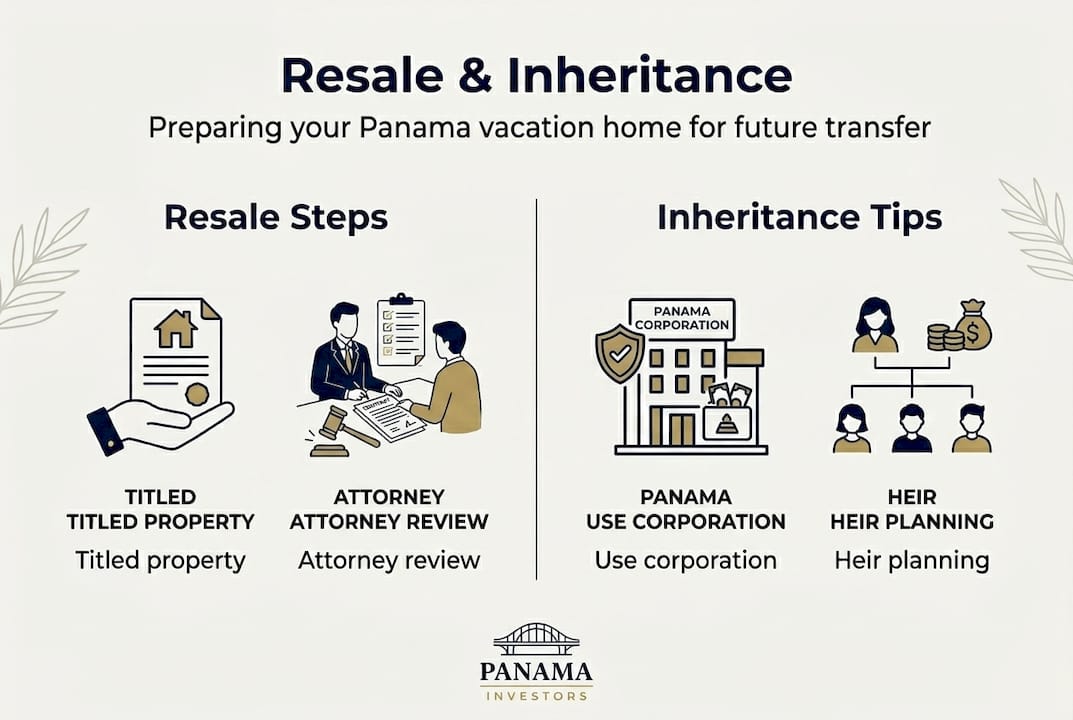
Holding your property in a corporation makes future transfer significantly simpler. Instead of re-executing a full transfer deed (which triggers transfer taxes), you simply transfer the shares of the corporation. This is a common and legal strategy widely used in Panama. Discuss inheritance planning with your attorney at the time of purchase, not five years later.
What most overlook about Panama vacation home purchases
Now that the journey is mapped, here’s a deeper truth successful buyers understand. Most buyers who run into serious trouble in Panama did not ignore all the rules. They just assumed that because the legal framework looked simple on the surface, the risks were equally simple.
The reality is that Panama’s real estate market has genuine, country-specific red flags that no amount of internet research fully prepares you for. ROP properties are often marketed as “beachfront with character” rather than “non-titled land with contested boundaries.” Developer agreements on pre-construction projects sometimes include clauses that limit your recourse if the project stalls or never delivers.
We have seen buyers arrive at closing tables with all the right intentions but without independent legal counsel, trusting that the developer’s attorney was neutral. That is an expensive assumption. The process is straightforward when every party is acting in good faith. It is not self-correcting when they are not.
The most underestimated asset in any Panama purchase is a genuinely local, genuinely independent team. Not someone who knows someone. Someone who has handled hundreds of transactions, knows the Public Registry clerks, understands which developers deliver and which stall, and who has no financial incentive to close your deal at any cost.
Initial structuring mistakes, such as buying in the wrong name, skipping escrow, or accepting ROP land without understanding the implications, can cost far more to correct than they saved at the outset. Learn why invest in Panama makes sense, and then invest in the process that protects that decision.
Expert support for your Panama home purchase
Ready to take the uncertainty out of your Panama vacation home purchase?

At Panama Investors, Luca Piva and the advisory team have guided international buyers through every stage of this process for over 12 years. From identifying the right region and structuring your ownership entity to vetting listings and managing your closing, the support is hands-on and deeply local. Whether you are evaluating your first Panama property or expanding an existing portfolio, a direct consultation cuts through the noise and gives you a clear, personalized path forward. Speak with an expert to discuss your target property type, budget, and timeline with someone who knows Panama’s market from the inside.
Frequently asked questions
What is required for non-residents to finance a vacation home in Panama?
Foreign buyers typically need at least a 30 to 50% down payment with interest rates ranging from 5 to 8%, and most experienced buyers choose to transact in cash to simplify the purchase and strengthen their negotiating position.
How do I avoid scams when buying Panama beachfront property?
Always verify the finca number in the Public Registry before any commitment, since ROP beachfront risks are common and titled land is significantly safer for long-term liquidity and resale value.
Does buying a vacation home grant Panamanian residency?
No, purchasing property does not automatically grant residency, but property investments of $200,000 or more can qualify you for Qualified Investor or Friendly Nations residency visa programs.
Why should I use a local, independent lawyer and escrow account?
An independent attorney works exclusively in your interest, while escrow protects your deposit and ensures AML compliance standards are met, eliminating the conflicts of interest that arise when buyers rely on the seller’s legal team.
Recommended
