
What Is Market Liquidity in Panama: 2026 Investor Guide
What Is Market Liquidity in Panama: 2026 Investor Guide
Market liquidity in Panama is defined as the ease and speed with which investors can buy or sell assets at stable prices without significantly moving the market. Understanding Panama market liquidity is not optional for serious investors. It determines how quickly you can exit a position, how fairly you are priced, and whether the market has enough depth to absorb your transaction. Panama’s capital markets and real estate sector are both directly shaped by liquidity conditions, and the 2025 to 2026 data tells a story worth reading carefully before you commit capital.
What is market liquidity in Panama’s capital markets?
Market liquidity in Panama’s capital markets is measured through four primary indicators: traded volume, turnover value, assets under custody, and instrument mix. Each metric reveals a different dimension of how efficiently the market functions for buyers and sellers.
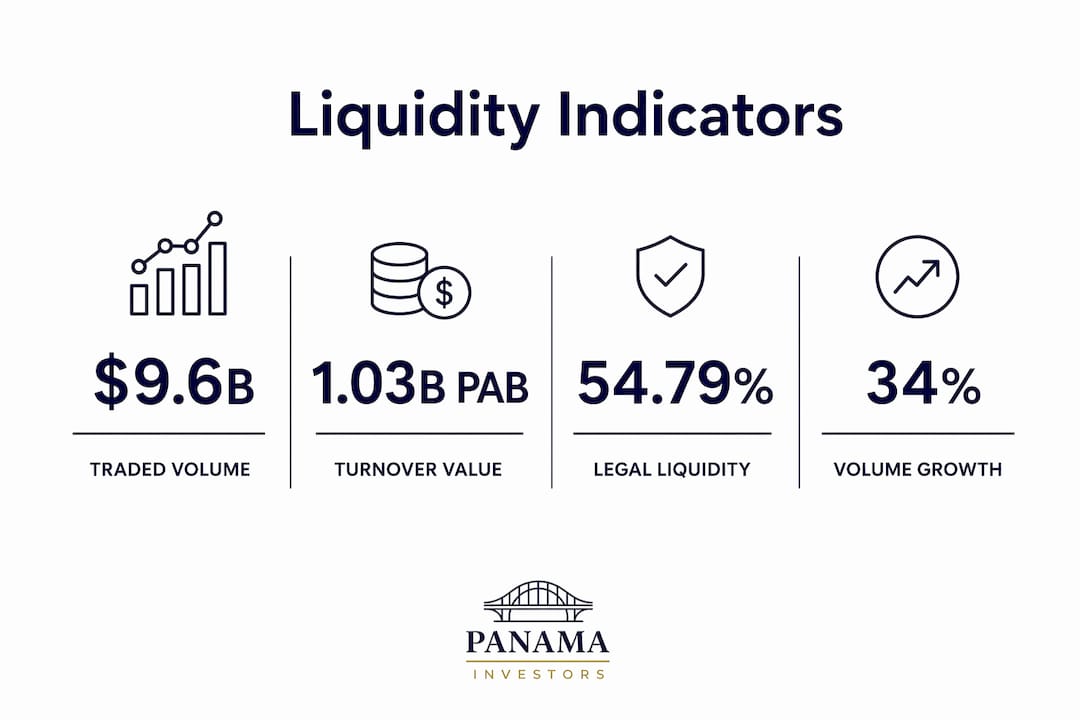
Latinex, Panama’s primary stock exchange, reported total 2025 trading volume exceeding $9.6 billion, a 34% increase from 2024. That growth rate signals a market gaining real depth, not just nominal price appreciation. By mid-May 2026, Latinex had already traded over $4.4 billion in accumulated volume, putting 2026 on pace to exceed the prior year’s record.

Turnover value data from CEIC reinforces this picture. Panama Stock Exchange turnover hit approximately 1.03 billion PAB in March 2026, up sharply from 574 million PAB in February 2026. That near-doubling within a single month reflects meaningful liquidity volatility, which matters because it tells you the market can surge but also contract quickly.
Assets under custody are the third signal. When custody balances are high, it indicates that investors are holding securities within the system, creating a pool of potential sellers and buyers. A market with deep custody infrastructure supports faster execution and tighter bid-ask spreads.
The instrument mix matters too. Panama’s market is heavily weighted toward debt securities rather than equities. Debt markets tend to trade in larger blocks with institutional counterparties, which produces high volume figures but can mask thinner liquidity for retail-sized transactions.
Pro Tip: Never judge Panama’s market liquidity by price indexes alone. Traded volume and turnover value are the real indicators of execution quality. A rising index with flat volume is a warning sign, not a green light.
| Metric | What it measures |
|---|---|
| Traded volume ($9.6B in 2025) | Total market activity and depth |
| Turnover value (1.03B PAB, Mar 2026) | Monthly execution intensity |
| Assets under custody | Available pool of tradable securities |
| Instrument mix | Debt vs. equity liquidity profile |
How does cross-border infrastructure affect liquidity in Panama?
Panama’s market liquidity is not self-contained. The country’s integration with global settlement systems is a structural advantage that directly raises the tradability of its securities for international investors.
Latinex operates iLink connectivity to Euroclear, the world’s largest securities settlement system. This means eligible debt securities issued in Panama can be settled internationally, not just domestically. For a foreign investor, that distinction is critical. A security that can only be settled locally is effectively illiquid to you until you establish local custody relationships. A security settled through Euroclear is accessible from any major financial center.
This infrastructure produces three concrete effects for investors:
- Foreign participation increases. Global custodians and institutional investors can access Panamanian securities without building local infrastructure from scratch. More participants means tighter spreads and faster execution.
- Regional volume flows in. Panama’s geographic position as a financial hub for Central America and the Caribbean means neighboring markets route transactions through Latinex, adding volume that deepens liquidity beyond what domestic issuance alone would generate.
- Nominal listing versus true liquidity diverges. A security listed on an exchange without settlement connectivity is only nominally available. The cross-border settlement infrastructure is what converts a listing into a genuinely tradable asset for international buyers.
Pro Tip: When evaluating any Panamanian security, confirm whether it is iLink-eligible for Euroclear settlement. That single check separates assets with real international liquidity from those that are technically listed but practically hard to exit.
What is the difference between market liquidity and funding liquidity?
Market liquidity and funding liquidity are distinct concepts that investors frequently conflate, and the confusion leads to poor risk assessment. Understanding both is mandatory for anyone deploying capital in Panama.
Market liquidity describes how easily you can trade an asset at a fair price. Funding liquidity describes your ability to obtain cash or credit to finance a position or transaction. The two can move in opposite directions at the same time, which is exactly what Panama’s 2026 data shows.
Here is how each concept plays out in practice:
- Market liquidity rising, funding liquidity tightening. Latinex trading volume is accelerating in 2026, meaning securities are changing hands efficiently. At the same time, bank lending in Panama contracted in early 2026, meaning the cash needed to finance new purchases is harder to access. An investor relying on leverage to buy Panamanian bonds faces a market that is liquid in theory but constrained in practice.
- Funding liquidity affecting real estate transaction speed. Even if a property is priced fairly and buyers exist, a mortgage market with tighter credit conditions slows the pace of closings. The asset is not illiquid. The financing is.
- Independent risk monitoring required. Market and funding liquidity can diverge sharply during stress periods. Monitoring only one gives you half the picture. Investors who track both are positioned to act when others are frozen.
For real estate investors specifically, this distinction shapes your buying strategy in Panama. A property in a liquid neighborhood with motivated sellers is still a slow transaction if your financing takes 90 days to close. Funding liquidity is the bottleneck that market liquidity data will not show you.
How does banking system liquidity influence real estate investment in Panama?
Panama’s banking system liquidity is a leading indicator for real estate transaction activity, and the current data presents a split picture that investors need to interpret carefully.
Panama’s banks maintained an average Legal Liquidity Ratio near 54.79% in July 2025, well above the regulatory floor of approximately 30%. That buffer means banks have the structural capacity to lend. High liquidity ratios support credit expansion, which translates directly into mortgage availability and real estate transaction volume.
The 2026 data complicates that picture. New bank lending contracted by approximately 2.7% in the first four months of 2026, with mortgage originations falling 23.5%. The banks have liquidity. They are choosing not to deploy it aggressively into new loans. That behavioral shift, not a structural shortage, is what is tightening real estate financing conditions.
| Indicator | 2025 Reading | 2026 Signal |
|---|---|---|
| Legal Liquidity Ratio | ~54.79% (July 2025) | Structurally strong |
| New lending growth | Positive | Down ~2.7% (Jan-Apr 2026) |
| Mortgage originations | Growing | Down 23.5% (Jan-Apr 2026) |
| Real estate transaction pace | Active | Slowing at financing stage |
The practical implication is that buyers with cash or pre-arranged international financing hold a significant advantage in the current market. Sellers who previously expected quick mortgage-backed closings are now more motivated to negotiate. That dynamic creates opportunity for prepared investors.
Pro Tip: Track Panama’s monthly mortgage origination data from the Superintendencia de Bancos as a leading signal for real estate transaction liquidity. Origination declines typically precede slower sales velocity by 60 to 90 days.
What liquidity trends should investors monitor in Panama in 2026?
Panama’s market liquidity outlook for 2026 is shaped by two competing forces: accelerating capital market activity and tightening credit conditions. Investors who understand both can position themselves ahead of the market rather than react to it.
The positive signals are clear. Latinex’s first-half 2026 trading momentum and the deepening iLink-Euroclear integration point toward a market that is becoming more accessible and more active. Regional integration is adding volume from neighboring economies, and the infrastructure to support international participation is already in place.
The risks are equally real and require active monitoring:
- Global capital flow volatility. Panama’s dollarized economy ties its financial conditions to U.S. monetary policy. When U.S. rates stay elevated, dollar-denominated credit globally tightens, and Panama is not immune.
- Credit contraction in the mortgage market. The 23.5% drop in mortgage originations is not a rounding error. It reflects lender caution that could persist through 2026 if macroeconomic uncertainty continues.
- Turnover volatility as a regime signal. The near-doubling of turnover value between February and March 2026 shows the market can move fast in both directions. Using turnover time-series data to identify whether you are in a high-liquidity or low-liquidity regime is more useful than any single monthly reading.
- Instrument concentration risk. Panama’s debt-heavy market means liquidity is concentrated in a narrow instrument class. A shift in institutional appetite for Panamanian debt would reduce overall market liquidity faster than a diversified equity market would.
The investors who will perform best in this environment are those who triangulate across multiple liquidity measures, including traded volume, custody balances, and banking credit data, rather than relying on any single indicator.
Key takeaways
Panama’s market liquidity is strong at the capital market level but tightening at the credit and real estate financing level, making it critical to monitor both dimensions simultaneously.
| Point | Details |
|---|---|
| Capital market liquidity is rising | Latinex traded $9.6B in 2025, up 34%, with 2026 on pace to exceed that figure. |
| Cross-border infrastructure matters | iLink-Euroclear connectivity converts listed securities into genuinely tradable international assets. |
| Market and funding liquidity diverge | High banking liquidity ratios coexist with a 23.5% drop in mortgage originations in early 2026. |
| Turnover is the best execution signal | Monthly turnover value fluctuations reveal liquidity regimes better than price indexes. |
| Credit tightening leads real estate slowdowns | Mortgage origination declines typically precede slower transaction velocity by 60 to 90 days. |
Why I read Panama’s liquidity data differently than most investors do
Most investors I speak with focus on Panama’s headline trading volume and stop there. The $9.6 billion figure for 2025 sounds impressive, and it is. But volume alone tells you the market is active. It does not tell you whether you can get in and out at a fair price on the day you need to.
What I find more revealing is the gap between banking system liquidity and actual credit deployment. Panama’s banks are sitting on a Legal Liquidity Ratio nearly double the regulatory minimum. That is not a market with a liquidity problem. That is a market where lenders are choosing caution. The distinction matters enormously for real estate investors, because a cautious lender environment means cash buyers and internationally financed buyers gain pricing power that simply does not exist in a loose credit cycle.
The iLink-Euroclear connection is the piece most foreign investors underestimate. I have seen investors walk away from Panamanian securities because they assumed settlement would be complicated. In many cases, it is no more complex than settling a European bond. That perception gap creates real pricing inefficiencies that informed investors can exploit.
My honest advice: do not triangulate liquidity from a single source. Combine Latinex volume data, CEIC turnover figures, and the Superintendencia de Bancos monthly reports. Each one shows you a different layer of the same market. Together, they give you a picture that is genuinely actionable.
— Roie
How Panamainvestors helps you act on Panama’s liquidity data
Understanding Panama’s market liquidity is the analytical foundation. Turning that analysis into a well-timed, well-priced real estate acquisition is where Panamainvestors adds direct value.

Panamainvestors, led by Luca Piva with over 12 years of on-the-ground experience, translates market and credit liquidity signals into specific property opportunities. When mortgage originations tighten and seller motivation rises, that is precisely when the right buyer with the right guidance captures the best deals. Panamainvestors monitors these conditions continuously and matches investors to listings that reflect current market realities, not outdated asking prices. If you want to apply Panama’s liquidity data to a real investment decision, schedule a strategy call and get a personalized read on where the market stands today.
FAQ
What is the Panama market liquidity definition?
Market liquidity in Panama refers to how easily securities or real estate assets can be bought or sold at stable prices without significantly affecting their value. Latinex’s $9.6 billion in 2025 trading volume is the primary benchmark for capital market liquidity.
How does liquidity affect Panama’s real estate market?
Liquidity affects Panama’s real estate market primarily through credit availability. When mortgage originations fall, as they did by 23.5% in early 2026, transaction velocity slows even when properties are fairly priced and buyers exist.
What influences market liquidity in Panama?
Panama’s market liquidity is influenced by Latinex trading volume, banking system credit deployment, iLink-Euroclear settlement connectivity, and global capital flow conditions tied to U.S. dollar monetary policy.
Is Panama’s banking system liquid enough to support real estate investment?
Panama’s banks held a Legal Liquidity Ratio near 54.79% in July 2025, well above the 30% regulatory minimum. The structural capacity exists, but lender caution in 2026 has reduced actual mortgage originations despite that buffer.
What is the difference between market liquidity and funding liquidity in Panama?
Market liquidity measures how easily you can trade an asset. Funding liquidity measures your access to cash or credit to finance that trade. In Panama’s 2026 environment, capital market liquidity is rising while funding liquidity through mortgage channels is tightening simultaneously.
