
Private sale in Panama: Secure elite real estate deals
Private sale in Panama: Secure elite real estate deals
- Panama Investors
- 4 days ago
- 10 min read
Panama attracts billions in cross-border capital every year, and yet one of the most persistent misconceptions among foreign investors is that signing a “private sale” agreement instantly secures their property ownership. It does not. The gap between signing a private agreement and achieving legally registered ownership is where fortunes are protected or lost, and understanding that gap is the single most important insight any serious investor can carry into the Panamanian market. This guide breaks down every critical layer of private real estate sales in Panama so you can move with precision, not guesswork.
Table of Contents
Key Takeaways
Point | Details |
Private sale basics | A private sale in Panama involves an agreement between buyer and seller but does not immediately grant official ownership rights. |
Legal ownership process | Ownership is only legally transferred when the sale is recorded by public deed and registered in the Panamanian Public Registry. |
Due diligence is vital | Buyers must verify title status, seller authority, and perform full due diligence to avoid investment risks. |
Tax and payment timing | The ITBI transfer tax and payment processes must align with official registration to finalize safe and compliant property deals. |
Expert help pays off | Engaging skilled local counsel and using escrow offers maximum protection and investment success in Panama. |
What is a private sale in Panama real estate?
The term “private sale” sounds straightforward, but the Panamanian legal context gives it a specific and nuanced meaning. In Panama real estate, a private purchase-and-sale agreement is a contract between buyer and seller that sets the essential terms of a transaction, including price, payment schedule, deadlines, and any special clauses. Critically, this agreement does not need to be registered with any public entity. That is both its strength and its vulnerability.
The private agreement operates as the roadmap for the deal. It locks in the commercial terms before the formal, public process begins. For sophisticated buyers, that early-stage contract is also where leverage lives: pricing negotiations, contingencies, financing conditions, and exclusivity windows are all defined here. But signing it does not make you the owner. That distinction matters enormously.
Here is what a private sale in Panama typically involves:
Initial private agreement: Sets price, payment terms, and conditions between buyer and seller privately.
Deposit or earnest money: Often 5 to 10 percent of the purchase price, held pending completion.
Due diligence period: Time granted to the buyer to inspect titles, encumbrances, and seller authority.
Conditions precedent: Clauses that must be satisfied before the deal proceeds to the public deed stage.
No automatic public registration: The agreement itself is not filed at the Public Registry and therefore does not transfer legal ownership.
“A private sale agreement is a legitimate and widely used instrument in Panama, but it must be understood as a bridge to ownership, not ownership itself.”
The off-market property deals that appeal most to high-net-worth buyers frequently begin through private agreements. Think beachfront lots in Coronado, luxury penthouses in Punta Pacifica, or agricultural land in the Chiriquí highlands. These assets rarely appear on public listing platforms, and the private agreement structure gives sellers the discretion they want and buyers the exclusivity they seek. The risk, however, is that the informal nature of these deals can tempt parties to shortcut the legal process entirely.
From agreement to ownership: The legal path
Understanding the gap between a private agreement and actual legal title is not optional knowledge for a serious investor. It is foundational.
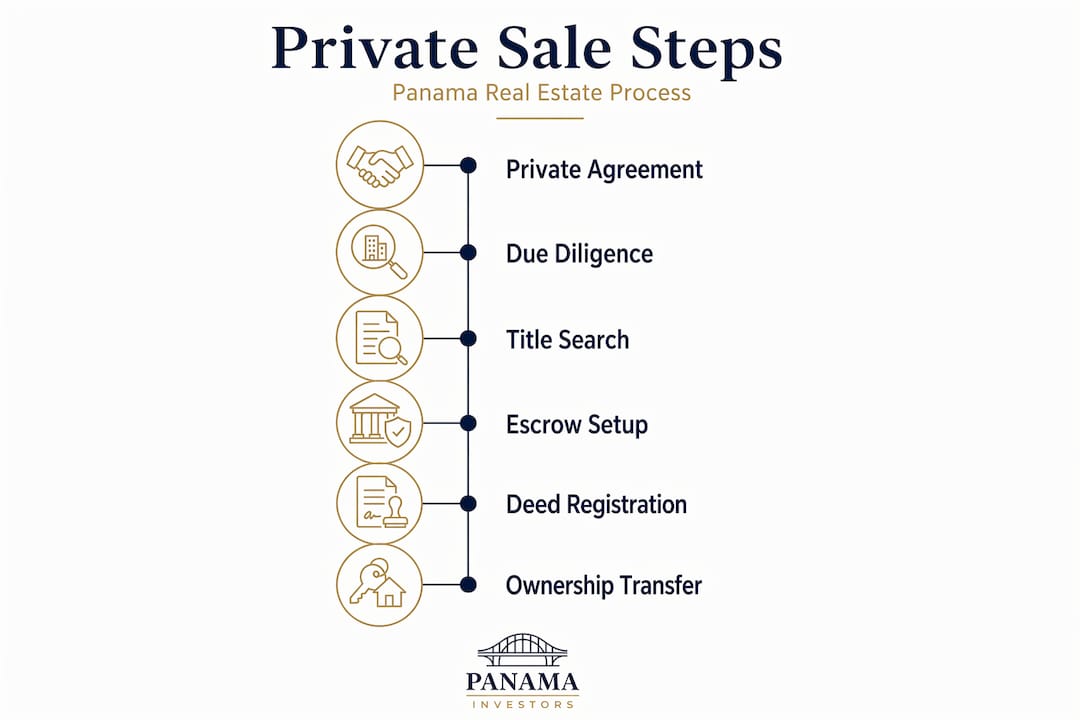
The formal path to ownership in Panama follows a clear sequence:
Private purchase-and-sale agreement signed by both parties, setting all commercial terms.
Due diligence completed including title search at the Public Registry, tax clearance checks, and verification of seller authority.
Public deed (escritura pública) prepared by a Panamanian notary public, incorporating the agreed terms.
Notary execution: Both parties sign the public deed before a licensed Panamanian notary.
Payment of transfer taxes and fees before registration can proceed.
Registration at the Public Registry (Registro Público): The ownership officially transferred against all third parties only at this stage.
This sequence is non-negotiable. Step 6 is where you become the owner in the eyes of Panamanian law, not a moment before.
Stage | Legal status | Protection level |
Private agreement signed | Contractual obligation only | Moderate (breach remedies) |
Due diligence completed | No ownership change | Informational clarity |
Public deed executed | Transfer initiated | Strong (notarized) |
Registered at Public Registry | Full legal ownership | Maximum (enforceable vs. all) |
Many buyers, particularly those coming from common-law jurisdictions like the United States or the United Kingdom, assume that a signed and notarized agreement is sufficient. In Panama’s civil law system, notarization alone is not enough. Registration at the Public Registry is what perfects the transfer and makes it enforceable against third-party claims, creditors, or competing buyers.
Pro Tip: Request a certified extract (certificación) from Panama’s Public Registry after registration is completed. This one document is your definitive proof of ownership and should be stored securely alongside your public deed.
The full property purchase steps require attention to each stage. Skipping or rushing any step, particularly title search and post-registration verification, creates exposure that no private agreement can adequately compensate.
Due diligence and risks for private sales
Private deals carry inherent risks that public, MLS-listed transactions at least partially mitigate through standardized procedures. For international and high-net-worth buyers operating across borders, those risks multiply quickly.
The single most important distinction to make before signing any agreement in Panama is whether the property carries titled ownership or only Rights of Possession (ROP). These are fundamentally different legal concepts.
Feature | Titled property | ROP (Rights of Possession) |
Public Registry status | Fully registered | Not registered as ownership |
Bank financing eligibility | Generally yes | Typically no |
Legal enforceability vs. third parties | Strong | Limited |
Transfer mechanism | Public deed + registration | Separate ROP agreement |
Investor risk level | Lower | Higher |
ROP properties are common in rural and coastal areas, where land may have been occupied for generations without formal titling. A private sale agreement alone is not the same thing as titled ownership, and due diligence must verify what is actually being transferred, whether that is titled property or possessory rights, and whether the seller has the legal authority to sell it. Failing to make this distinction is one of the most expensive mistakes a foreign buyer can make.
Your due diligence checklist for any private sale in Panama should include:
Title search at the Public Registry: Confirm the seller is the registered owner with no outstanding encumbrances, liens, or mortgages.
Tax clearance certificate: Verify there are no unpaid property taxes or ITBI obligations attached to the asset.
Seller authority verification: If the seller is a corporation, confirm the signing representative holds valid power of attorney or board authorization.
Physical inspection and survey: Verify the property boundaries match the registered description.
Environmental and zoning review: Particularly relevant for coastal, agricultural, or development properties in Panama.
Encumbrance and easement check: Some properties carry access easements or utility rights that affect use and value.
Strong buyer legal safeguards begin here, not at closing. Investors who skip this phase to move quickly on a deal almost always pay more in legal fees or lost deposits later than they would have spent on a thorough upfront review.
The importance of vetting exclusive listings properly cannot be overstated. Off-market deals can be extraordinary opportunities, but they require even more rigorous verification precisely because they bypass the scrutiny that public market exposure provides.
Pro Tip: Always engage a Panamanian attorney who is independent from the seller’s legal team. In many private sale scenarios, a single attorney may represent both parties. For any transaction above $200,000, your own counsel is not a luxury; it is the minimum standard.
Payment structures and tax implications
Panama’s dollarized economy simplifies currency risk, but the payment mechanics and tax obligations in a private sale require careful structuring to protect both your capital and your legal position.
The transfer tax in Panama, known as ITBI (Impuesto de Transferencia de Bienes Inmuebles), is calculated at 2% of whichever is higher: the registered cadastral value or the actual sale price. The seller is technically responsible for this payment, but buyers must verify it is settled before registration proceeds. Unpaid ITBI blocks title transfer at the Public Registry.
Tax/fee | Rate | Who pays | Timing |
ITBI transfer tax | 2% of higher value | Seller | At closing, before registration |
Capital gains tax | 3% of sale price (seller) | Seller | At closing |
Notary and legal fees | Approx. 1 to 2% | Typically split | At deed execution |
Public Registry fees | Variable by value | Buyer | At registration |
For payment flow in a private sale, a properly structured escrow arrangement is the standard for any serious transaction. Here is how funds should move:
Initial deposit: Placed in escrow, not paid directly to seller, upon signing the private agreement.
Due diligence phase: Funds held in trust while title and legal checks are completed.
Conditions satisfaction: Escrow releases funds only when all agreed conditions are met and the public deed is executed.
Final disbursement: Remaining balance released only after confirmation of registration at the Public Registry.
The role of escrow in Panama real estate is not merely a courtesy. It is the structural mechanism that prevents buyers from losing funds if a deal collapses at any stage before registration. Disbursing the full purchase price before the deed is registered is one of the most common and costly errors in Panama’s private sale market.
Understanding the full Panama real estate tax guide is especially valuable for cross-border investors, as Panama offers meaningful exemptions and incentives that directly affect net return calculations at the time of purchase.
Pro Tip: Confirm that your escrow agent is a licensed Panamanian attorney or regulated financial institution. Never allow escrow to be managed by the seller’s own agent or an unregulated intermediary.
Expert strategies for navigating private sales
Knowing the mechanics is one thing. Executing a private sale safely, efficiently, and to maximum advantage requires a strategic approach that most first-time Panama buyers do not arrive with.
Here are the action steps that experienced buyers and their advisors follow:
Engage Panamanian legal counsel before signing anything. Your attorney should review or draft the private agreement, not just the public deed.
Order a title certificate from the Public Registry before committing any funds. This takes days, not weeks, and eliminates the most common source of disputes.
Structure your deposit through a formal escrow agreement. The deposit amount, release conditions, and default remedies should all be written into the escrow instructions.
Negotiate a realistic due diligence window. Thirty to sixty days is standard for most transactions; complex or large properties may require more.
Insist on a promesa (promise to sell) rather than a simple letter of intent if you are making a deposit before full due diligence is complete. A properly drafted promesa agreement creates enforceable obligations and protects your deposit if the seller defaults.
Confirm the timeline for deed execution and registration and build in contractual penalties for delays caused by the seller.
Verify all representations in writing. Verbal assurances about rental income, zoning approvals, or construction permits are legally meaningless in Panama.
“The investors who come out ahead in Panama’s private sale market are not necessarily those with the best deal flow—they are the ones with the cleanest process.”
Securing experienced Panama legal counsel is not just a defensive measure. A skilled local attorney can accelerate timelines, resolve title issues proactively, and negotiate protections into agreements that most buyers would not think to request.
The uncomfortable truth about exclusive deals in Panama
Here is something few advisors say out loud: the excitement of accessing a private deal in Panama can be genuinely dangerous to your capital.
High-value investors are often attracted to off-market or private transactions precisely because they feel exclusive, discreet, and advantageous. And sometimes they are. But that sense of privilege can create a blind spot. When a deal feels like an insider opportunity, buyers lower their guard at exactly the moment they should be raising it.
We have seen this play out in Panama’s market repeatedly. A buyer secures access to a stunning oceanfront property through a private contact. The price looks favorable. The seller is motivated. Everyone moves fast because “there are other buyers interested.” The private agreement is signed. A substantial deposit changes hands. And then the due diligence reveals an unresolved encumbrance, a disputed boundary, or a seller who is not the registered titleholder. The “exclusive deal” becomes a legal dispute.
True exclusivity in Panama’s real estate market is not a function of who you know or how fast you move. It is a function of how thoroughly you have verified the asset. An exclusive deal with a clean title, a registered seller, a proper escrow structure, and a formal deed process is genuinely valuable. An exclusive deal without those elements is just a fast path to a slow legal problem.
The opportunity to unlock elite deals in Panama is real and accessible to foreign buyers. But elite deals require elite process. The investors who build lasting wealth in this market are the ones who treat legal rigor as a competitive advantage, not an inconvenience.
Unlock Panama’s elite real estate market with expert guidance
Navigating Panama’s private sale market requires more than research—it requires relationships, local knowledge, and a trusted advisor who knows exactly where the risks hide and where the real opportunities exist.

At Panama Investors, we specialize in guiding international buyers and expatriates through every stage of private real estate transactions in Panama. From sourcing exclusive, off-market properties to coordinating due diligence, escrow, and legal verification, our team brings over 12 years of on-the-ground experience to every client engagement. We connect you with vetted sellers, independent legal counsel, and the local networks that make the difference between a smooth acquisition and a costly dispute. If you are ready to explore Panama’s private real estate market with confidence, speak with a Panama property advisor today and take your first step toward a secure, strategic investment.
Frequently asked questions
Does a private sale mean I own the property immediately in Panama?
No. Legal ownership is only transferred when the public deed (escritura pública) is executed and then registered at the Public Registry. A private agreement is a binding contract but not a title transfer.
What is the main risk with a private real estate sale in Panama?
The biggest risk is proceeding without verifying title and seller authority. A private agreement alone does not equal titled ownership, and buyers who skip due diligence face potential legal or financial loss.
How is the Panama real estate transfer tax (ITBI) calculated?
ITBI is calculated at 2% of whichever is higher: the registered cadastral value or the actual sale price. The seller pays it at closing as a mandatory condition before title transfer can proceed.
Is using escrow recommended for private real estate sales?
Absolutely. Escrow protects your deposit and ensures no funds are released to the seller until ownership is properly transferred and registered. It is the single most effective safeguard available in a private transaction.
Can I buy property in Panama off-market as a foreign investor?
Yes, foreign investors can access off-market deals in Panama, often through local advisors with exclusive networks. However, the same legal requirements apply: title verification, public deed execution, and Public Registry registration are all mandatory to secure true ownership.
Recommended
