
Panama coastal property: risks, rights, and real opportunities
Panama coastal property: risks, rights, and real opportunities
- Panama Investors
- 6 days ago
- 9 min read

Most buyers who inquire about beachfront property in Panama picture a clear deed, ocean views, and full legal ownership down to the waterline. The reality is more complicated, and more than a few investors have been caught off guard after signing contracts they didn’t fully understand. Panama has specific laws governing coastal zones that override what any sales brochure says, and knowing these rules before you write a check could save you hundreds of thousands of dollars and years of frustration.
Table of Contents
Key Takeaways
Point | Details |
Public domain setback | The first 22 meters from the Pacific coast’s high-tide line are public domain, not privately owned. |
ROP land carries risks | Rights of Possession properties come with legal uncertainty, resale difficulty, and limited financing. |
Titled property safer | Titled land is generally more secure and easier to resell, making it a better choice for most investors. |
Due diligence required | Always verify title, setbacks, and obtain legal review before purchasing coastal property in Panama. |
Best regions for investment | Coronado, Pedasí, and Bocas del Toro are top areas for both lifestyle and coastal real estate investments. |
Understanding Panama’s coastal property laws
Panama’s coastline is not a free-for-all for private development. The country applies a strict legal framework that designates certain coastal land as public domain, meaning no individual can hold full private title to it regardless of what a seller tells you.
The most important rule every buyer needs to memorize is this:
The first 22 meters from the high-tide line on Panama’s Pacific coast is treated as public domain. Marketed beachfront plots may be concession or possession rights rather than full private title, not the freehold ownership most buyers assume they are getting. (source)
This single rule disqualifies a significant portion of land that gets listed and marketed as “beachfront property.” When an agent shows you a plot that sits right up against the sand, you need to ask a very direct question: is the actual land parcel starting at meter 23, or does it include land inside the public-domain zone?
What counts as coastal land?
Panama differentiates between several coastal land categories. Understanding which category a property falls into shapes your rights, your ability to build, and your ability to resell or finance. Here is a quick breakdown of the main categories:
Land type | Description | Private ownership possible? |
Titled property (beyond setback) | Registered freehold land outside the 22-meter zone | Yes, full title |
Government concession | Right to use public-domain land under license | No, lease-type arrangement |
Rights of Possession (ROP) | Informal land occupation recognized by use | Partial, no formal title |
Public beach/maritime zone | The 22-meter strip itself | No |
Key distinctions that matter for buyers:
Land beyond the 22-meter setback can carry full private title, but you must verify this in the public registry.
Concession land can be legitimately developed but requires renewal and is subject to government conditions.
ROP land exists in a legal gray area and carries serious risk for buyers who do not conduct thorough due diligence.
Before signing anything, reviewing the beachfront home benefits and understanding what you are actually buying will anchor your expectations. The step-by-step buying guide covers the procedural side of confirming land type before any contracts are exchanged.
Titled land vs. Rights of Possession (ROP): What you must know
Once you move past the 22-meter rule, you face a second major fork in the road: titled versus ROP land. This distinction is where many coastal deals go wrong, and it is where buyers with good intentions and real budgets sometimes lose significant money.
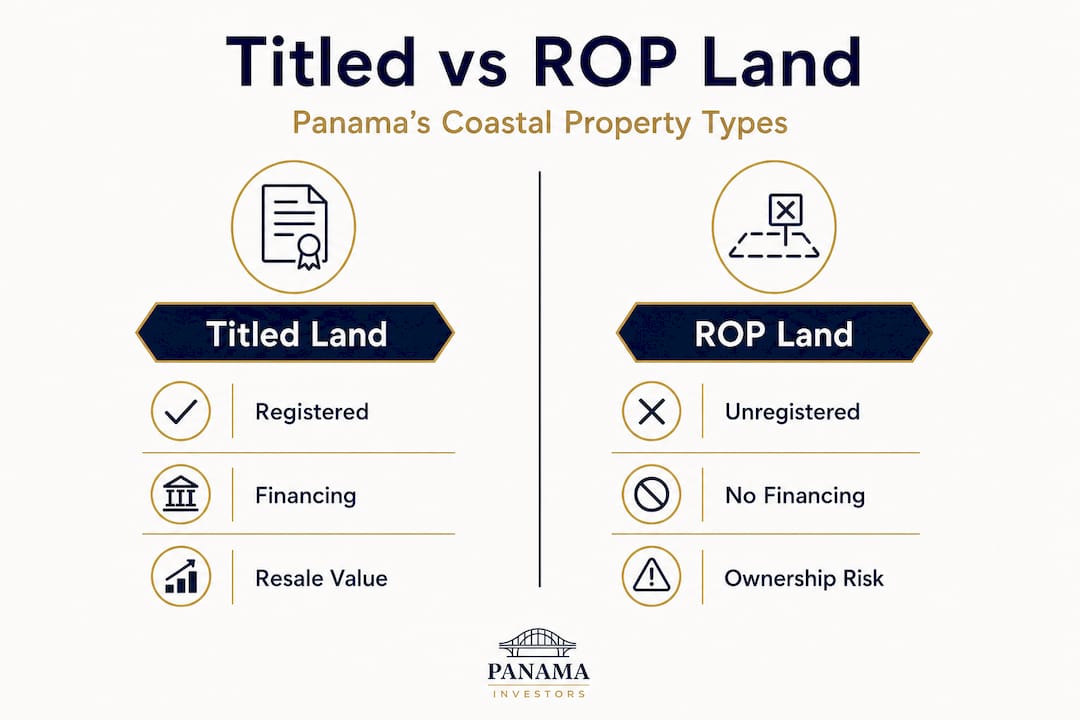
Titled property means the land is registered in Panama’s public property registry. You receive a registered deed, the government recognizes your ownership, and the land can be pledged as collateral for a mortgage. It is the gold standard, and it functions very similarly to freehold property in the United States or Europe.
Rights of Possession (ROP) is a very different animal. ROP land is unregistered land where someone has established possession through long-term occupation and use, typically farming, building, or maintaining the land. The government acknowledges this possession informally, but it does not equal a formal title. ROP land carries materially higher legal risk and lower market liquidity than titled property. Banks generally will not accept ROP land as mortgage collateral, and competing possession claims from other parties can surface years after a purchase.
Here is a direct comparison to frame the difference:
Factor | Titled property | ROP land |
Legal security | High, government registered | Low, informal recognition only |
Financing | Bank mortgages available | Very difficult or impossible |
Market liquidity | Strong resale potential | Limited, smaller buyer pool |
Risk of disputes | Low | High, competing claims possible |
Building permits | Straightforward process | Complicated, often blocked |
Suitability for foreigners | Strong | Requires expert legal guidance |
The risks of buying ROP land without proper legal counsel include:
Overlapping possession claims from previous occupants or neighbors
Inability to secure a local or international mortgage
Reduced buyer pool when you attempt to sell
Difficulty obtaining construction permits
Potential government intervention if land use laws change
Legal costs to defend possession in court
Pro Tip: If a seller is offering what sounds like an unusually low price on a coastal parcel, investigate the land classification first. ROP properties are frequently priced attractively because sellers know full well that the legal limitations reduce its actual market value. Get a Panamanian attorney to review the title registry and possession documentation before you proceed. The legal protections for buyers in Panama are real, but only if you use them correctly.
Navigating the buying process and key risks
Understanding the legal landscape is step one. Actually executing a purchase correctly requires a disciplined process that most buyers, especially those acting on their own, skip or rush through.
Here is the practical sequence you should follow for any coastal property purchase in Panama:
Identify the land category. Before you get emotionally attached to a property, confirm whether it is titled, ROP, or concession land. Request the property registry folio number and verify it independently.
Verify the setback zone. Commission a licensed surveyor to confirm exactly where the 22-meter high-tide line falls and whether the usable parcel lies fully outside it.
Conduct a title search. A Panamanian attorney should search the public registry for liens, encumbrances, mortgages, and any legal disputes tied to the property.
Check zoning and use restrictions. Some coastal areas have environmental protections, national park boundaries, or tourism zone restrictions that limit what you can build.
Negotiate a purchase agreement, not a letter of intent. The purchase agreement should be contingent on clean title confirmation and legal due diligence, giving you an exit if problems surface.
Close through a Panamanian notary. All property transfers must be formalized through a notary public and registered in the public registry to be legally binding.
Pro Tip: Always verify the setback zone and public domain status before signing any contract, even a preliminary one. Some agents present letters of intent as harmless but they can create obligations or expectations that are hard to unwind if due diligence reveals a problem.
The data backs up the caution: ROP buyers face financing and resale challenges that simply do not exist with titled property. If your investment strategy involves eventual resale or using the property as collateral for future financing, ROP land is a structural liability you should avoid unless you are an experienced buyer with deep local knowledge.
The international buying guide walks through cross-border financial considerations, and the foreign investor guide addresses the specific legal rights foreigners hold in Panama, which are actually very strong once you have clear titled property.
Best coastal areas and investment strategies
Panama offers a diverse coastal geography that gives buyers real choice. Not every region presents the same mix of legal risk, lifestyle appeal, and investment return. Here are the most sought-after coastal destinations:
Coronado: A well-established beach town about 80 kilometers from Panama City. Coronado has the largest concentration of titled beachfront and near-beach land outside of the capital. Infrastructure is solid, the expat community is significant, and property values have appreciated consistently. Ideal for buyers who want proximity to the city and strong resale fundamentals.
Pedasí: A small town in the Azuero Peninsula with a charm that has attracted a growing wave of buyers over the past decade. Pedasí offers a more authentic Panamanian coastal experience, cooler culture, and some genuinely attractive titled land opportunities. It is less developed, which means more potential upside but also more due diligence required.
Bocas del Toro: An archipelago on Panama’s Caribbean coast with striking natural beauty. Bocas is unique because a meaningful portion of land there is ROP rather than titled, which is a red flag for buyers focused on legal security. The area’s tourism appeal is undeniable, but the legal complexity demands extra care.
Santa Catalina: A surfer destination on the Pacific with growing international interest. Like Bocas, some parcels here carry ROP status, so buyer caution applies.
Gorgona and Coronado surroundings: Smaller beach communities adjacent to Coronado that offer more affordable entry points while maintaining access to the same titled land benefits and infrastructure.
Pro Tip: Favor regions where titled beachfront and near-beach land is available and confirmed. The small premium you pay for a clean title over an ROP property is almost always worth it when you factor in financing flexibility, resale liquidity, and legal peace of mind.
High-tide setbacks and ownership structure directly affect not just legal risk but also long-term investment value. A plot with full title 30 meters from the ocean will hold and grow in value more reliably than an ROP plot that technically sits closer to the water but carries unresolved legal questions.
Serious buyers should compare markets. The premium investment markets resource covers Panama’s top appreciating zones, and the Latin America investment comparison shows how Panama stacks up regionally for coastal buyers considering multiple countries.
What most guides overlook about coastal property risks
Most real estate guides do the basics reasonably well. They mention the 22-meter rule. They note that ROP exists. Then they move on. What they consistently underestimate is how often these legal nuances become the actual reason a deal fails, a property loses value, or a buyer ends up in court.
Here is what we observe repeatedly in the field. Buyers fall in love with a property, sometimes spending days or even weeks imagining their life there. Then when legal due diligence reveals an issue, they rationalize it. They tell themselves the ROP status is not a real problem, that other foreigners have bought similar land, that the price is too good to pass up. This is exactly the moment that separates buyers who do well in Panama from those who regret their purchase.
The reality is that legal setback issues and ROP complications are not minor technicalities. They are material factors that affect every future decision you make about the property. Want to refinance to fund renovations? Not possible with ROP. Want to sell quickly if your life circumstances change? Expect a much smaller buyer pool and a longer wait. Want to build a rental property and generate income? Permit complications can paralyze your timeline.
Our honest position, after working in this market for over a decade, is that the psychological appeal of “closer to the water” is not worth compromising on title clarity. A titled property 50 meters from the beach is a better investment than an ROP plot at the waterline. The Panama real estate blog covers specific case examples and market observations that reinforce this perspective for buyers who want to go deeper.
The buyers who succeed in Panama’s coastal market are those who treat property selection as a legal and financial decision first, and a lifestyle decision second. The lifestyle will still be excellent, we promise you that.
Next steps with Panama Investors
Coastal property in Panama offers genuine opportunity for expatriates and investors who approach it with the right information and the right team.

At Panama Investors, Luca Piva and the advisory team specialize in helping international buyers navigate exactly these complexities, from confirming land classification and setback status to connecting buyers with vetted legal professionals and accessing exclusive titled listings that never hit the open market. Whether you are exploring your first coastal purchase or adding to an existing portfolio, a focused consultation can save you months of confusion and protect your capital. Book a strategy call to discuss your goals, your budget, and which coastal regions best match your investment profile.
Frequently asked questions
What does ‘beachfront property’ actually mean in Panama?
Beachfront property in Panama often excludes the first 22 meters from the high-tide line, which is public domain and cannot be privately titled. Always confirm where the actual titled parcel begins before making an offer.
Is it safer to buy titled coastal land than ROP land in Panama?
Yes. Titled property offers legal registration, bank financing options, and stronger resale potential, while ROP land carries higher legal risk and is very difficult to finance or resell.
What is the main risk when buying Rights of Possession (ROP) land?
The main risk is exposure to legal disputes and unclear ownership, since ROP buyers face financing and resale challenges that simply do not apply to titled property buyers.
What coastal areas are most popular for expats in Panama?
Coronado, Pedasí, and Bocas del Toro are the most sought-after regions, each offering different mixes of infrastructure, lifestyle, and investment potential for coastal buyers.
How can I avoid surprises when buying coastal property?
Verify the land title in Panama’s public registry, confirm the setback and public domain boundaries with a licensed surveyor, and engage a Panamanian attorney to complete full legal due diligence before signing any agreement.
Recommended
