Why Second Citizenship in Panama Is Worth It
Why Second Citizenship in Panama Is Worth It
Panama keeps getting mischaracterized in second citizenship conversations. People either assume it’s a quick passport grab or dismiss it because the Panamanian passport isn’t as powerful as a German or Singaporean one. Both views miss the point. The real reasons why second citizenship in Panama makes strategic sense have almost nothing to do with passport rankings and everything to do with tax structure, lifestyle, and long-term asset protection. This article cuts through the noise and gives you a clear picture of what Panama actually offers, what the process genuinely looks like, and what legal realities you need to understand before committing.
Table of Contents
- Key takeaways
- Why second citizenship in Panama appeals to global investors
- Pathways to Panamanian citizenship
- Benefits of Panamanian citizenship
- Legal nuances and dual citizenship
- Strategic planning for your citizenship application
- My take on Panama as a second citizenship destination
- How Panamainvestors can help you get there
- FAQ
Key takeaways
| Point | Details |
|---|---|
| Residency before citizenship | You must hold permanent residency for 5 years before applying for Panamanian naturalization. |
| Investor visa is the fastest entry | A $300,000 real estate investment can secure permanent residency in 45 to 60 days. |
| Territorial tax is the real draw | Foreign-sourced income is generally exempt from Panamanian tax, but physical economic activity changes that calculus. |
| Dual citizenship is a legal gray area | Panama requires renunciation at oath-taking, but many countries including the US and UK do not recognize it in practice. |
| Citizenship is discretionary | Meeting residency requirements does not guarantee citizenship. Integration, language, and solvency all factor in. |
Why second citizenship in Panama appeals to global investors
Most people chasing a second passport fixate on visa-free access. Panama challenges that instinct. The global citizenship-by-investment market is projected to grow from $5.2 billion in 2024 to $12.8 billion by 2033, driven not by travel convenience but by long-term business risk mitigation. The investors leading that trend are not looking for a second stamp in their passport. They want structural protection for their wealth, a credible residency base in a stable jurisdiction, and tax efficiency that holds up to scrutiny.
Panama delivers on all three. Its dollarized economy removes currency risk entirely. Its territorial tax system taxes only Panama-sourced income, leaving most foreign earnings untouched. And its legal framework for permanent residents and citizens provides genuine protections for private wealth. That combination is rare, and it explains why Panama draws serious investors rather than just globe-trotters.
The lifestyle dimension matters too. Panama City has world-class hospitals, international schools, and a cost of living significantly below comparable cities in North America or Western Europe. For families relocating internationally, that quality-of-life floor matters as much as the tax structure above it.

Pathways to Panamanian citizenship
The standard residency route
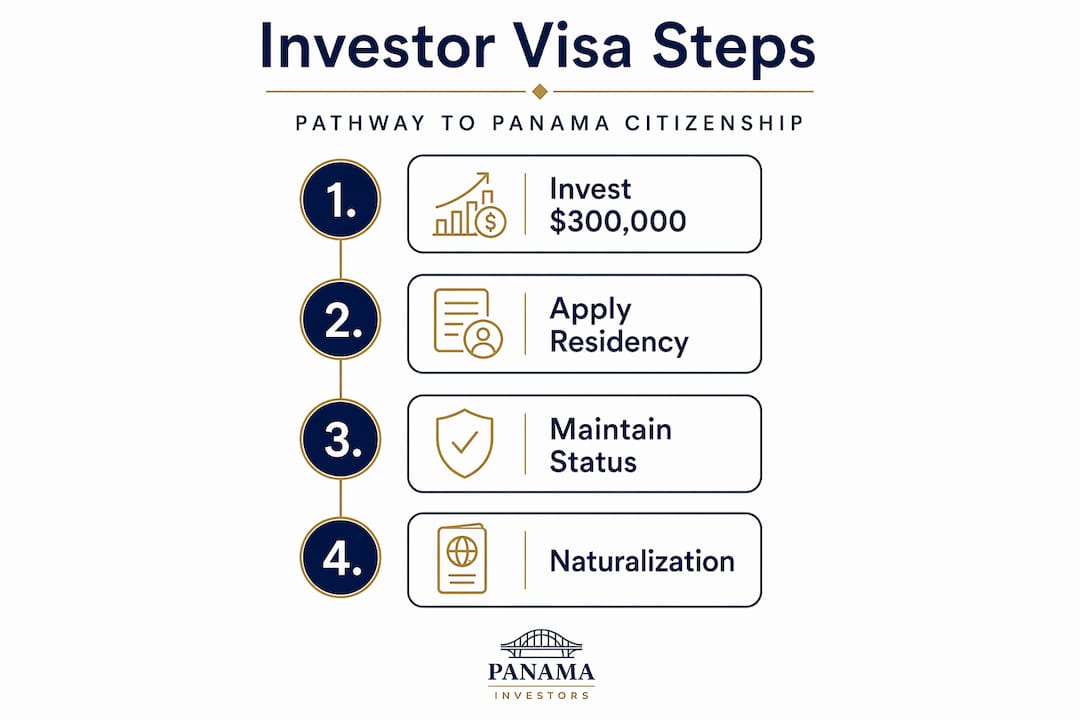
The most common path is straightforward in theory and demanding in practice. You obtain permanent residency, maintain it continuously for five years, then file a naturalization petition. The standard pathway adds another one to one and a half years for the naturalization process itself, so total timeline from first residency approval to citizenship is typically six to seven years. Spouses of Panamanian citizens or parents of Panamanian children qualify after just three years of continuous residency.
The Qualified Investor Visa
For most internationally mobile investors, the Qualified Investor Visa is the entry point worth knowing. A minimum real estate investment of $300,000 qualifies you for immediate permanent residency, with approval in 45 to 60 days. That investment must be held for five years to maintain citizenship eligibility. The threshold is set to increase after October 2026, so anyone seriously considering this route should act on current pricing.
This visa is particularly attractive because it bypasses the longer provisional residency stages other pathways require. You go directly to permanent status, which means your five-year naturalization clock starts ticking sooner. For a detailed walkthrough of the legal and financial steps, the investor visa guide from Panamainvestors covers the process step by step for 2026 applicants.
What naturalization actually requires
Here is where many applicants get surprised. Completing your five years of residency does not mean citizenship is automatic. The Panamanian government treats citizenship as a discretionary decision, evaluated case by case. You must demonstrate genuine integration: conversational Spanish proficiency, knowledge of Panama’s history and civic structure, financial solvency, and a clear record showing you actually lived in the country rather than just holding a residency card.
The naturalization petition itself is a formal legal document. It needs to be thorough and well-prepared. Weak petitions from otherwise eligible applicants get delayed or denied.
Pro Tip: Start preparing your naturalization petition documentation at year three, not year five. Gathering proof of integration, bank records, tax filings, and language credentials takes longer than most applicants expect.
Steps in the citizenship process:
- Obtain permanent residency through a qualifying visa category
- Maintain continuous physical presence and legal compliance for five years
- Pass Spanish language proficiency and civic knowledge assessments
- File a formal naturalization petition with supporting documentation
- Attend an interview with immigration authorities
- Receive discretionary approval and take the oath of citizenship
Benefits of Panamanian citizenship
The territorial tax advantage
Panama’s territorial tax system is the most cited advantage and also the most misunderstood. Foreign-sourced income is generally exempt from Panamanian income tax, which means dividends, capital gains, rental income, and business revenue generated outside Panama are not taxed locally. For high-net-worth individuals whose income is internationally structured, that exemption is genuinely significant.
The caveat matters, though. If you are physically working in Panama, or if your business has economic substance in Panama, that income may be reclassified as locally sourced. Post-2025 updates have tightened economic substance tests, so structuring your income correctly before establishing residency is not optional. It is necessary.
- Foreign passive income: Generally exempt with proper structuring
- Local business income: Taxed at rates up to 25%
- Remote work performed in Panama: May trigger local tax liability depending on sourcing rules
- Dividends from Panama-incorporated companies: Subject to withholding tax at varying rates depending on source
Pro Tip: Work with a Panama-based tax attorney before you relocate, not after. Tax structuring decisions made before you establish residency are far easier to defend than retroactive restructuring.
Travel access and lifestyle
The Panamanian passport ranks approximately 31st globally with visa-free or visa-on-arrival access to around 149 countries, including Schengen zone countries, most of Latin America, and significant portions of Asia. It is not the world’s strongest travel document, but it covers the regions most relevant to internationally active investors and business owners.
Beyond travel, Panama’s location as a logistics hub creates real business advantages. Panama City is a four-hour flight from Miami and a similar distance from major South American capitals. For entrepreneurs managing businesses across the Americas, that geographic positioning has concrete operational value. The investment climate Panama has built around foreign investors also means your assets are legally protected with a clear framework from the moment you establish residency.
Legal nuances and dual citizenship
What Panama’s constitution actually says
Panama’s constitution formally requires applicants to renounce their prior citizenship upon taking the Panamanian oath. That requirement is stated plainly. What is also true, and widely documented, is that many countries including the United States, the United Kingdom, and Canada do not recognize foreign renunciation ceremonies as legally effective. Those countries simply do not remove citizenship based on a pledge made before a Panamanian official.
The practical result is that most applicants from those countries maintain both passports. They carry their original citizenship by default, and they add a Panamanian one. That gray area is well-known and commonly navigated. But calling it risk-free would be inaccurate.
Country-specific considerations
| Country of origin | Dual citizenship recognition | Key consideration |
|---|---|---|
| United States | Generally yes | US taxes citizens on worldwide income regardless of residency |
| United Kingdom | Generally yes | UK does not revoke citizenship for naturalization abroad |
| Canada | Generally yes | Canada permits dual nationality explicitly |
| EU member states | Varies by country | Some EU states limit or discourage dual nationality |
| Other countries | Check individually | Some nations treat foreign naturalization as renunciation |
The most significant issue for US citizens is not citizenship status. It is tax liability. The United States taxes its citizens on worldwide income regardless of where they live, which means Panamanian territorial tax benefits do not apply to the US tax obligation. A US citizen with Panamanian citizenship still files US taxes on global income.
Pro Tip: If you hold US citizenship, consult a dual-qualified attorney who practices both US tax law and Panamanian immigration law. The intersection of FATCA obligations and Panama’s banking environment requires specific expertise, not general advice.
Strategic planning for your citizenship application
Getting citizenship in Panama is less about meeting a checklist and more about building a genuine record of integration. The difference between applicants who succeed and those who stall at the petition stage almost always comes down to how carefully they managed residency compliance across the five years before they applied.
The most common mistakes applicants make are worth understanding directly:
- Spending too little time in Panama: Continuous residency means physical presence. Long absences can disrupt your eligibility and weaken your naturalization case.
- Choosing the wrong residency pathway: Not all residency visas lead to citizenship on the same timeline. Some pathways have conditions that complicate naturalization.
- Neglecting Spanish proficiency: The language requirement is assessed, not assumed. Starting language study at year one gives you time to reach genuine conversational ability.
- Ignoring documentation throughout residency: Tax returns, bank statements, lease agreements, and utility bills from every year of residency all strengthen your petition. Gaps are hard to explain.
- Underestimating the petition itself: Successful citizenship outcomes depend heavily on how well the naturalization petition is prepared, not just how long you have lived there.
Panama citizenship, done right, functions as a long-term wealth and lifestyle planning tool. It pairs best with a real estate investment that builds equity while satisfying the residency requirement, a tax structure reviewed before relocation, and a five-year plan for genuine integration rather than a passive waiting period.
My take on Panama as a second citizenship destination
I’ve worked with enough second citizenship applicants to spot the pattern that separates the ones who succeed from the ones who stall. The people who get this wrong almost always chose Panama for the wrong reason. They heard “territorial tax” and imagined an instant exemption from everything. Or they assumed the investor visa meant citizenship was essentially purchased. Neither is true.
What I’ve learned is that Panama rewards preparation and genuine commitment. The clients who come in with a five-year plan, who actually move to the country, who learn Spanish with real intention, those are the ones who end up with a Panamanian passport and a life that works financially and personally. The ones who treat it as a tax hack from a distance tend to run into legal complications around economic substance, residency compliance, or a weak naturalization petition.
Panama is not primarily a passport-strength destination. Anyone telling you to choose it because the passport opens 149 doors is missing the actual case for Panama citizenship. The real case is a stable, dollarized jurisdiction with a territorial tax system, strong property rights, and a quality of life that holds up to daily living. The passport is a benefit. The jurisdiction is the asset.
— Roie
How Panamainvestors can help you get there
For investors who want to pursue Panamanian citizenship through real estate, the path starts with the right property at the right price, structured correctly from day one. That is exactly what Panamainvestors specializes in.

Luca Piva and the Panamainvestors team have spent over 12 years working inside Panama’s real estate market, connecting investors with properties that satisfy Qualified Investor Visa requirements while building genuine long-term equity. From selecting the right investment to preparing documentation for residency applications, the advisory process covers every step that matters. Whether you are early in your research or ready to move, book a strategy call to get personalized guidance on how to structure your residency and citizenship pathway in 2026. You can also explore Panama’s real estate investment opportunities directly at Panamainvestors to see what the market currently offers at the investor visa threshold.
FAQ
How long does it take to get citizenship in Panama?
The standard timeline is six to seven years. You need five years of continuous permanent residency followed by a naturalization process that typically takes one to one and a half additional years.
Does Panama allow dual citizenship?
Panama’s constitution requires renunciation of prior citizenship, but many countries including the US, UK, and Canada do not recognize this renunciation. In practice, most applicants from those countries retain both citizenships, though the legal situation involves nuance worth discussing with an attorney.
What is the minimum investment for the Panama investor visa?
The current minimum is $300,000 in qualifying real estate. This threshold is scheduled to increase after October 2026, making 2026 the final year to access citizenship eligibility at the current investment level.
Is Panamanian citizenship guaranteed after meeting residency requirements?
No. Citizenship approval is discretionary. You must demonstrate genuine integration, Spanish language proficiency, civic knowledge, and financial solvency. Meeting the residency requirement is necessary but not sufficient for approval.
Do US citizens benefit from Panama’s territorial tax system?
Not fully. The United States taxes its citizens on worldwide income regardless of where they live or what other citizenship they hold. Panamanian tax exemptions on foreign income do not eliminate US federal tax obligations for American passport holders.
