What Is Offshore Real Estate Investment? 2026 Guide
What Is Offshore Real Estate Investment? 2026 Guide
Offshore real estate investment is the practice of purchasing and holding property in a foreign jurisdiction through ownership structures separate from your country of residence, typically to gain tax advantages, asset protection, and portfolio diversification. According to Wikipedia, this approach commonly uses offshore companies or special purpose vehicles to hold properties internationally. The strategy appeals to investors seeking exposure to high-growth international markets while managing legal liability and tax obligations at home. Understanding the structures, compliance rules, and real risks involved is what separates profitable offshore investors from those who face costly surprises.
What is offshore real estate investment and how does it work?
Offshore real estate investment, known in professional circles as international real estate investment through offshore structures, means your property title is held by a foreign legal entity rather than by you personally. That entity, whether a corporation, trust, or foundation registered in a low-tax or privacy-friendly jurisdiction, becomes the legal owner of record. You own the entity; the entity owns the property.
This structure matters because it changes how income is taxed, how assets are transferred, and who bears legal liability. Panama, the Cayman Islands, the British Virgin Islands, and the Isle of Man are among the most commonly used jurisdictions for these structures. Each offers different combinations of tax treatment, reporting requirements, and legal protections. Investors choose based on their home country’s tax treaties, the target property’s location, and their specific goals around privacy or estate planning.

The motivations are concrete and measurable. Tax efficiency, protection from creditors, simplified cross-border estate transfers, and access to markets with stronger appreciation potential all drive demand. For U.S. investors specifically, the IRS still taxes worldwide income regardless of where property is held, which means offshore structures reduce certain taxes but never eliminate domestic reporting obligations.
What legal structures are used for offshore real estate ownership?
The most common vehicles for offshore property ownership are offshore companies, trusts, and foundations. Each serves a distinct purpose, and choosing the wrong one creates legal and tax problems that can take years to unwind.
Offshore companies are the most widely used structure. Offshore companies act as legal owners of properties, with the company’s name appearing on the title deed instead of the individual investor’s name. This shields personal identity, separates liability, and makes transferring ownership as simple as selling company shares rather than going through a full property conveyance process.
Trusts and foundations serve investors focused on estate planning and multi-generational wealth transfer. A trust places legal ownership with a trustee who manages the asset for named beneficiaries. Foundations, more common in civil law countries like Panama, operate similarly but with a distinct legal personality. Both structures add a layer of separation between the investor and the asset.
Key distinctions between direct ownership and entity ownership include:
- Direct ownership places your name on the title deed, creating personal liability and making the asset visible to creditors and courts in your home country.
- Entity ownership separates the asset legally, often reducing estate taxes and simplifying cross-border transfers.
- Privacy is significantly higher with entity ownership since public records show the company name, not the individual.
- Transfer efficiency improves because selling company shares avoids property transfer taxes in many jurisdictions.
- Compliance complexity increases because the entity itself must file returns, maintain records, and meet local corporate requirements.
Pro Tip: The structure you choose directly affects your U.S. tax filing obligations. A foreign corporation holding rental property triggers different IRS forms than a trust or direct ownership. Consult a tax attorney who specializes in cross-border real estate before registering any entity.
In practice, layered ownership via foreign entities requires careful tracking of domestic tax, treaty, and reporting rules that go well beyond simply recording the title in a foreign name. The structure is the foundation; compliance is the ongoing cost of maintaining it.
What are the tax and compliance implications for U.S. investors?
U.S. investors face the most complex compliance environment of any nationality when investing in offshore real estate. The IRS taxes worldwide income, which means foreign rental income, capital gains, and entity distributions are all reportable regardless of where the property sits.
The key compliance obligations U.S. investors must track are:
- Foreign rental income reporting. Rental income is taxable if the property is rented for more than 15 days per year. This income must be reported on your U.S. federal return even if it was already taxed in the foreign country.
- PFIC classification risk. Offshore REITs and corporations holding rental or appreciating real estate may be classified as Passive Foreign Investment Companies under U.S. tax law. PFIC status triggers punitive tax rates and complex annual reporting requirements that most investors are unprepared for.
- FBAR and Form 8938 filing. U.S. persons with foreign financial accounts or specified foreign assets above threshold amounts must file FinCEN Form 114 and IRS Form 8938 annually. Failure to file carries penalties starting at $10,000 per violation.
- New FinCEN Residential Real Estate Rule. Starting March 1, 2026, new FinCEN rules require detailed reporting for certain non-financed residential real estate transfers to entities and trusts. This rule targets the opacity that has made offshore property ownership attractive for decades.
- Currency impact on taxable income. Dollar strength affects buying power and sale proceeds when converting foreign currency gains back to U.S. dollars. Currency gains themselves can be taxable events separate from property appreciation.
Pro Tip: PFIC classification is not automatic, but it is easy to trigger accidentally. Before investing through any offshore collective vehicle, have a qualified CPA analyze the entity’s income and asset composition against the PFIC tests. Catching this early saves tens of thousands in penalties.
Panama offers a notable advantage here. Its tax benefits for foreign investors include territorial taxation, meaning Panama only taxes income earned within its borders. For U.S. investors, this does not eliminate IRS obligations, but it does prevent double taxation on foreign-source income in many cases.
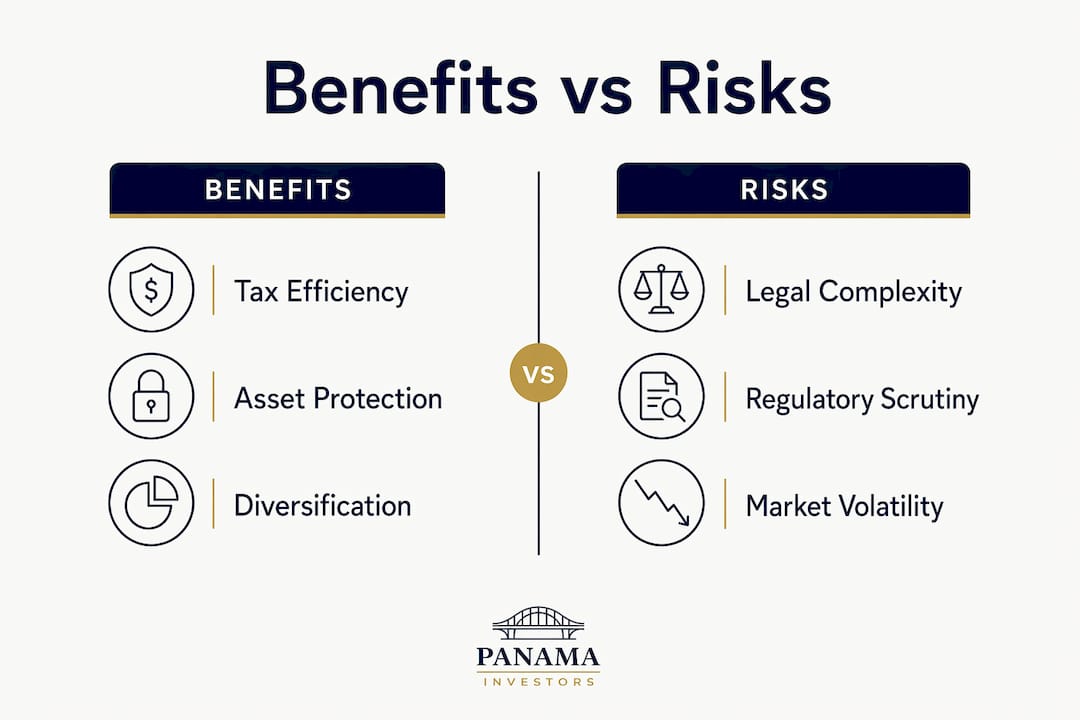
What are the main benefits and risks of offshore real estate investment?
Offshore property investment delivers real advantages, but it also carries risks that are frequently underestimated by first-time international investors. A clear-eyed comparison is the starting point for any sound decision.
Core benefits
The benefits of offshore real estate are specific and measurable when the right structure and jurisdiction are chosen:
- Tax efficiency through jurisdictions with low or zero property taxes, territorial tax systems, or favorable treaty networks.
- Asset protection by placing property inside a foreign entity that is difficult for domestic creditors to reach.
- Privacy because entity ownership keeps individual names off public title records in most jurisdictions.
- Portfolio diversification across currencies, economies, and real estate cycles that do not correlate with U.S. or European markets.
- Multi-currency income that can act as a natural hedge against home-currency depreciation.
Key risks investors must evaluate
| Risk | What it means in practice |
|---|---|
| Legal complexity | Offshore structures require ongoing legal maintenance, local filings, and treaty analysis. |
| Regulatory scrutiny | Offshore real estate through tax havens draws anti-money laundering attention from regulators globally. |
| Opacity concerns | Tangible assets like real estate are often excluded from automatic information exchange regimes, prompting new transparency rules. |
| Currency risk | Exchange rate swings can erase gains when converting rental income or sale proceeds back to your home currency. |
| Geopolitical exposure | Political instability, expropriation risk, or sudden regulatory changes in the target country can devalue or freeze assets. |
The EU Tax Observatory notes that automatic financial information exchange agreements fail to fully capture tangible asset ownership like real estate, which is precisely why regulators are now pushing for beneficial ownership transparency rules. This means the regulatory environment around offshore property is tightening, not loosening, in 2026.
For investors considering Panama specifically, the country’s dollarized economy eliminates currency risk entirely, which removes one of the most common sources of offshore investment loss. Panamainvestors covers the full picture of international property buying in Panama, including how local ownership laws affect foreign buyers.
How to approach investing in offshore real estate strategically
A structured approach to offshore real estate investment separates investors who build lasting wealth from those who buy impulsively and manage problems for years afterward. The following steps reflect what experienced international investors actually do before committing capital.
- Define your investment objective clearly. Personal use, rental income, and long-term capital appreciation each require different jurisdictions, structures, and financing strategies. Mixing objectives without a clear priority creates conflicting decisions at every stage.
- Evaluate political, economic, and legal stability in the target country. UBS advises evaluating local property laws, ownership rights, and financing availability before any purchase. Countries with strong rule of law, transparent title registries, and stable governments protect your investment far better than high-yield markets with weak institutions.
- Build a currency risk management plan. Currency fluctuations significantly impact returns, rental income, and financing costs. Investors in dollarized economies like Panama avoid this problem entirely. Those in euro or peso-denominated markets need hedging strategies or must accept currency volatility as part of their return calculation.
- Assemble a cross-border professional team. You need a local real estate agent with verified market knowledge, a tax attorney familiar with your home country’s international tax rules, and a corporate lawyer experienced in offshore entity formation. No single professional covers all three areas.
- Monitor 2026 compliance updates actively. The FinCEN Residential Real Estate Rule, expanding FATF recommendations, and EU beneficial ownership directives are all reshaping what offshore property ownership requires in terms of disclosure. Investors who treat compliance as a one-time setup rather than an ongoing obligation face the largest penalties.
- Conduct thorough due diligence on the specific property. Title searches, local zoning laws, environmental restrictions, and coastal concession rules (particularly relevant in Panama) all affect what you can legally do with the property and how easily you can sell it later.
For investors exploring Panama’s coastal market, understanding coastal property rights and risks is a non-negotiable first step before any purchase decision.
Key takeaways
Offshore real estate investment delivers genuine tax, privacy, and diversification advantages only when investors pair the right legal structure with rigorous compliance and a clear understanding of currency and geopolitical risks.
| Point | Details |
|---|---|
| Definition and structure | Offshore real estate is held through foreign entities like companies or trusts, not in the investor’s personal name. |
| U.S. tax obligations | IRS taxes worldwide income; PFIC rules, FBAR, and the 2026 FinCEN rule all apply to offshore property holders. |
| Benefits are real but conditional | Tax efficiency, asset protection, and diversification require the right jurisdiction and structure to materialize. |
| Risks require active management | Currency swings, regulatory tightening, and legal complexity can erode returns without ongoing professional oversight. |
| Panama as a practical option | Panama’s dollarized economy, territorial tax system, and stable legal framework reduce several common offshore investment risks. |
Why offshore real estate is more complex than most investors expect
Most investors I speak with come in focused on the upside: lower taxes, a second home abroad, a hedge against domestic market volatility. Those benefits are real. But the gap between what offshore real estate promises and what it delivers in practice almost always comes down to how well the investor understood the compliance burden before they signed anything.
The PFIC rules alone have caught experienced investors off guard. A foreign corporation holding rental property can trigger PFIC classification without the investor realizing it, and the resulting tax treatment is punitive enough to wipe out years of rental income. The 2026 FinCEN reporting requirements add another layer that did not exist even three years ago. The regulatory direction is clear: offshore property ownership is becoming more transparent, not less.
What I find most underestimated is currency risk. Investors calculate returns in local currency and forget that converting those returns back to dollars at an unfavorable rate changes the entire picture. Panama sidesteps this completely because it uses the U.S. dollar as its official currency. That single factor eliminates one of the most common sources of offshore investment disappointment.
My honest view is that offshore real estate works best as part of a deliberate, professionally structured strategy, not as a tax shortcut or a spontaneous purchase made during a vacation. The investors who succeed are those who treat it like a business decision: clear objectives, the right team, and ongoing attention to a compliance environment that keeps evolving.
— Roie
How Panamainvestors can guide your offshore investment strategy

Panamainvestors specializes in guiding foreign buyers and international investors through every stage of acquiring property in Panama, one of the most accessible and legally transparent offshore real estate markets available to U.S. and international buyers. Led by Luca Piva, a licensed agent with over 12 years of on-the-ground experience, the platform connects investors with exclusive listings, local legal networks, and personalized strategy sessions designed to match your investment goals with the right property and structure. Whether you are evaluating Panama for the first time or ready to move forward, start with a strategy call to get expert guidance tailored to your situation.
FAQ
What is offshore real estate investment in simple terms?
Offshore real estate investment means buying property in a foreign country, typically through a legal entity like an offshore company or trust, to gain tax advantages, asset protection, or portfolio diversification outside your home country.
Do U.S. investors have to report offshore property to the IRS?
Yes. The IRS taxes worldwide income, so U.S. investors must report foreign rental income, file FBAR and Form 8938 for qualifying accounts, and comply with the 2026 FinCEN Residential Real Estate Rule for certain property transfers to entities.
What is a PFIC and why does it matter for offshore real estate?
A Passive Foreign Investment Company is a foreign corporation where most income or assets are passive. Offshore companies holding rental real estate can qualify as PFICs, triggering punitive U.S. tax rates and complex annual reporting requirements.
What are the biggest risks of offshore property investment?
The primary risks are legal complexity, currency volatility, geopolitical instability, and increasing regulatory scrutiny over beneficial ownership transparency. Investors who do not maintain ongoing compliance face significant financial penalties.
Why do investors choose Panama for offshore real estate?
Panama offers a dollarized economy that eliminates currency risk, a territorial tax system that does not tax foreign-source income, accessible residency programs, and a stable legal framework that protects foreign property ownership rights.
