
Panama's Dollarized Economy: Investor's 2026 Guide
Panama’s Dollarized Economy: Investor’s 2026 Guide
A dollarized economy is one where a foreign currency serves as legal tender. Panama’s version is the most stable in Latin America: the U.S. dollar circulates as the sole paper currency, while the Panamanian Balboa exists only in coin form at a fixed 1:1 parity. Understanding what is dollarized economy Panama means recognizing a system over 120 years old that eliminates exchange rate risk, keeps inflation low, and makes the country one of the most financially predictable markets in the Western Hemisphere. For investors, expatriates, and anyone considering property or business in Panama, this monetary structure is the foundation everything else is built on.
What is a dollarized economy in panama?
Panama’s dollarized economy is defined by the complete absence of locally printed paper money. The Panamanian Balboa is pegged to the U.S. dollar at a fixed 1:1 exchange rate and has held that parity for over 120 years. That kind of consistency is almost unheard of in monetary history. Every banknote in your wallet in Panama City is a U.S. dollar. Balboa coins circulate alongside U.S. coins, but they are interchangeable at face value.
Panama adopted this system proactively, not as a crisis response. Most Latin American countries that later turned to dollarization did so after currency collapses, hyperinflation, or economic emergencies. Panama chose dollar integration from the start, which is why economist Carlos Arauz describes the model as built on commercial certainty and financial soundness rather than desperation. That distinction matters enormously when you are evaluating long-term investment risk.

The formal term for Panama’s arrangement is “full dollarization” or “official dollarization.” It differs from a currency board or a simple peg because Panama does not issue its own paper money at all. There is no Balboa bill to devalue. That structural fact is the single most important thing to understand about Panama’s monetary system.
How does panama’s monetary system work day to day?
The mechanics are simpler than most people expect. Here is how the system operates in practice:
- Paper currency: All banknotes in circulation are U.S. dollars. No Panamanian Balboa banknotes exist, so visitors from the United States need zero currency exchange.
- Coins: Balboa coins circulate alongside U.S. coins at equal value. A 25-centésimo coin is worth exactly one U.S. quarter.
- Exchange rate: The 1:1 parity is fixed by law, not managed by a central bank. There is no floating rate to monitor.
- Money supply: Panama cannot print money. The money supply grows only through trade surpluses, foreign investment inflows, and borrowing. This is the core discipline the system imposes.
- International trade: Transactions with foreign partners require no currency conversion on Panama’s side, which cuts transaction costs and speeds up settlement.
Panama lacks a central bank or a lender of last resort. That sounds alarming until you realize it forces the government and banking sector to maintain genuine fiscal discipline rather than relying on money printing to solve problems. Panama’s financial system cannot manufacture liquidity. It must earn it.
Pro Tip: If you are wiring funds to Panama for a real estate purchase, you are sending U.S. dollars to a U.S. dollar account. There are no conversion fees, no rate fluctuation windows to time, and no hedging instruments to buy. The process is as straightforward as a domestic wire.
What are the main economic benefits of dollarization in panama?
Panama’s dollarized economy delivers concrete advantages that directly affect investment returns and daily financial life.
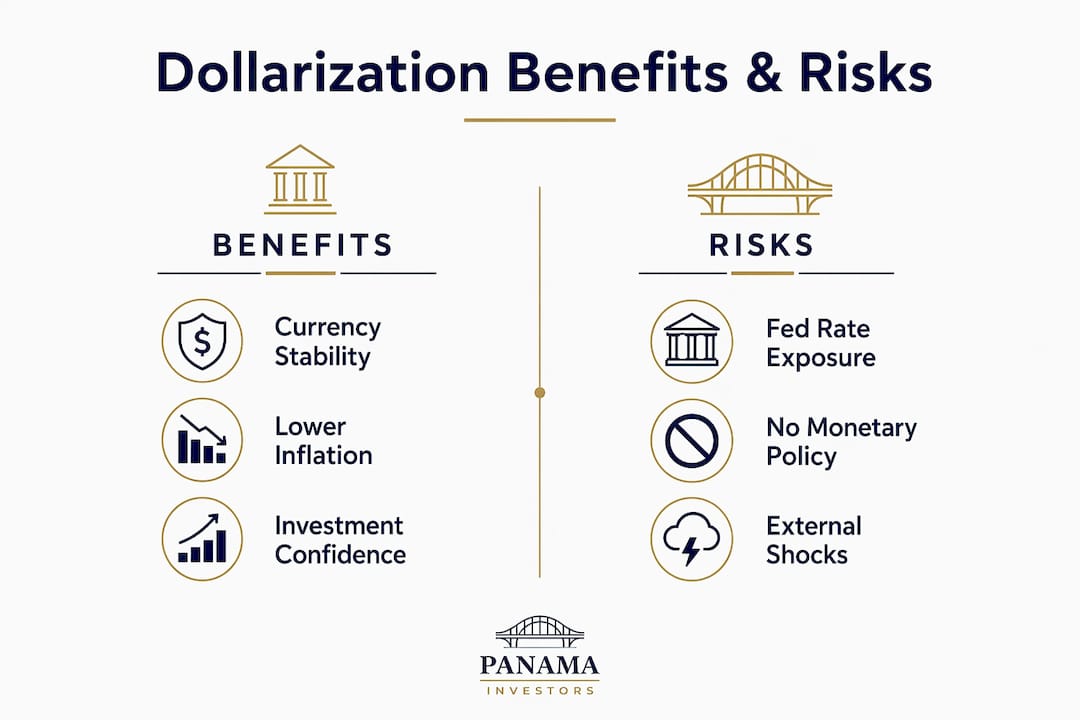
- Low inflation and stable pricing: Panama maintains low inflation and high economic stability, integrating the country into global financial markets without currency hedging costs. Stable prices mean your property’s value is not eroded by local currency depreciation.
- No exchange rate risk: Dollarization eliminates exchange rate risk entirely for U.S. dollar holders. A European investor still faces euro-to-dollar conversion, but once funds are in Panama, there is no further currency exposure.
- Better borrowing costs: Credit rating agencies favor Panama’s fixed exchange rate system, which translates into lower sovereign borrowing costs and a more stable lending environment for private borrowers.
- Simplified accounting: Multinational firms operating in Panama avoid currency conversion complexities entirely. Financial statements align with international accounting standards without adjustment.
- Investor confidence: Panama is classified as a high-income economy with no foreign exchange regulations. That classification opens the door to institutional capital that would otherwise avoid the region.
The combined effect is a business environment where pricing, contracts, and financial projections stay reliable over time. For real estate investors specifically, this means rental income projections made today remain valid in dollar terms five years from now, regardless of what happens to currencies in neighboring countries.
What are the risks of panama’s dollarized system?
No monetary system is without trade-offs. Panama’s dollarization carries specific vulnerabilities that every serious investor should understand before committing capital.
- No independent monetary policy: Panama cannot adjust interest rates independently to counter recessions or overheating. When the U.S. Federal Reserve raises rates to fight American inflation, Panama absorbs those higher rates whether its own economy needs them or not.
- Exposure to U.S. policy decisions: Dollarization makes Panama vulnerable to U.S. monetary policy shifts and international sanctions, limiting financial autonomy in ways that other sovereign nations do not face.
- Sensitivity to capital flows: Panama’s monetary stability depends on free capital flows and fiscal balance. A sudden reversal of foreign investment or a global credit crunch hits Panama harder than countries with their own currency tools.
- No lender of last resort: If a major Panamanian bank faces a liquidity crisis, there is no central bank to inject emergency funds. The government must rely on fiscal reserves or external credit lines.
Pro Tip: Watch the U.S. Federal Reserve’s rate cycle when timing a Panama real estate purchase. Rising U.S. rates increase local mortgage costs in Panama just as they do in the United States. Buying during a rate plateau or early decline gives you better financing terms.
The risks are real, but they are also well-understood and priced into the market. Panama has operated under this system for over a century without a currency crisis. That track record is the strongest argument for the model’s durability.
How does dollarization affect investors and expatriates?
The practical implications of Panama’s dollarized economy are significant for anyone moving money into the country.
Real estate and mortgage lending
Property prices in Panama are quoted in U.S. dollars. Mortgages are denominated in U.S. dollars. Rental income is collected in U.S. dollars. For American buyers, the entire transaction chain operates in their home currency. For buyers from other countries, the mortgage options in Panama are structured around U.S. dollar rates, which means your financing cost is tied to a globally recognized benchmark rather than an opaque local rate.
Sectors that benefit most from dollarization
Panama’s service-based economy benefits most from dollarization in three specific sectors:
- Banking and financial services: Panama City hosts over 70 licensed banks. Dollar-denominated accounts, loans, and investment products are standard. The absence of currency risk makes Panama a regional banking hub.
- Logistics and trade: The Panama Canal processes roughly 5% of global maritime trade. All Canal tolls are collected in U.S. dollars. Shipping companies, freight forwarders, and logistics firms operate in a fully dollarized environment with no conversion friction.
- Real estate and tourism: Foreign buyers and tourists arrive with dollars and spend dollars. There is no currency barrier to entry, which sustains consistent demand for rental properties and hospitality assets.
Panama vs. non-dollarized neighbors
| Factor | Panama (Dollarized) | Costa Rica (Own Currency) |
|---|---|---|
| Exchange rate risk | None for USD holders | Colón fluctuates against USD |
| Inflation control | Tied to U.S. inflation trends | Subject to local monetary policy |
| Mortgage currency | U.S. dollars | Colones or USD (mixed) |
| Accounting complexity | Minimal for foreign firms | Requires currency conversion |
| Investment predictability | High | Moderate |
The comparison makes clear why Panama consistently attracts more foreign direct investment per capita than most of its neighbors. The Panama vs. Costa Rica real estate dynamic illustrates this directly: exchange rate stability in Panama removes a layer of risk that Costa Rica investors must actively manage.
Key takeaways
Panama’s dollarized economy is the single most important structural advantage the country offers foreign investors, because it eliminates currency risk, stabilizes pricing, and aligns the market with global dollar-denominated capital.
| Point | Details |
|---|---|
| Full dollarization since inception | Panama adopted the U.S. dollar proactively, not as a crisis measure, giving it over 120 years of stability. |
| No Balboa banknotes exist | All paper currency is U.S. dollars; Balboa coins circulate at 1:1 parity with no conversion needed. |
| No central bank or money printing | Panama cannot manufacture liquidity, which enforces fiscal discipline and keeps inflation low. |
| Exchange rate risk is eliminated | U.S. dollar holders face zero currency exposure on Panama transactions, simplifying investment accounting. |
| Vulnerability to U.S. Fed policy | Panama absorbs U.S. interest rate changes with no independent monetary response available. |
Panama’s dollarization: a century of evidence worth trusting
I have worked with investors across Latin America, and the question I hear most often is some version of: “Is Panama’s stability real, or is it marketing?” After watching this market for years, my answer is that the stability is structural, not cosmetic. Panama cannot devalue its currency. It physically cannot print money to paper over fiscal problems. That constraint forces a level of economic honesty that most countries avoid.
What I find underappreciated is how much this benefits real estate specifically. When you buy property in a country with its own currency, you are making two bets simultaneously: one on the property and one on the currency. In Panama, you make only one bet. That simplicity is worth more than most investors realize until they have experienced currency erosion in another market.
The genuine risk, in my view, is not dollarization itself but Panama’s fiscal management. If the government runs persistent deficits without the discipline the system demands, the consequences arrive faster and harder than in countries that can print their way out. Panama’s government has generally managed this well, but it is the variable I watch most closely. Investors who understand why Panama leads Latin America for investment returns will recognize that dollarization is the foundation, not the whole story.
— Roie
Explore panama investment opportunities with confidence

Panama’s dollarized economy removes the currency uncertainty that complicates real estate investment across most of Latin America. For investors and expatriates ready to act on that stability, Panamainvestors offers direct access to vetted property opportunities guided by Luca Piva, a licensed Panama real estate agent with over 12 years of local market experience. Luca’s network reaches listings that never appear on public portals, and his process is built around protecting buyers from the risks that come with unguided foreign investment. If you are serious about putting capital into one of the region’s most stable markets, explore current investment opportunities in Panama and book a strategy call to get started.
FAQ
Why does panama use the u.s. dollar instead of its own currency?
Panama adopted the U.S. dollar at the time of its founding in 1904, choosing monetary integration for stability and trade facilitation rather than issuing a sovereign currency. This decision was proactive, not a crisis response, and the system has remained intact for over 120 years.
Are there any panamanian balboa banknotes?
No. The Panamanian Balboa exists only in coin form. All paper currency in Panama is U.S. dollars, so American visitors and investors need no currency exchange at any point.
Does dollarization make panama real estate safer for foreign buyers?
Dollarization eliminates exchange rate risk for U.S. dollar holders, meaning property values, rental income, and mortgage payments all stay in the same currency with no conversion exposure. That predictability is a direct financial advantage compared to non-dollarized markets in the region.
What happens to panama’s economy when the u.s. federal reserve raises interest rates?
Panama absorbs U.S. rate increases directly because it has no independent monetary policy. Higher Fed rates translate into higher local borrowing costs in Panama, which affects mortgage rates and business lending just as they would in the United States.
Can panama ever abandon dollarization?
Abandoning dollarization would require introducing a new currency, rebuilding monetary institutions, and managing the transition without triggering capital flight. Experts note this would be economically disruptive and politically difficult. The system’s 120-year track record makes any near-term change extremely unlikely.
