
Panama vs Costa Rica real estate: investor's guide
Panama vs Costa Rica real estate: investor's guide
- Panama Investors
- May 9
- 10 min read

Panama and Costa Rica are frequently mentioned in the same breath when investors talk about Latin American real estate. Both offer tropical scenery, a growing expat community, and a reputation for political stability. But treating them as interchangeable is a costly mistake. The tax structures differ, the transaction costs diverge, the ownership laws are not identical, and the residency pathways lead to very different outcomes. This guide cuts through the noise and lays out what the numbers and legal realities actually mean for your portfolio.
Table of Contents
Key Takeaways
Point | Details |
Tax differences | Panama has clear transfer and advance income taxes, while Costa Rica rates are less predictable for foreign investors. |
Ownership laws | Foreigners can purchase property in both markets, but residency incentives differ and simplify Panama’s pathway. |
Market liquidity | Panama’s real estate market generally offers faster transactions and higher rental demand than Costa Rica. |
Decision criteria | Investors should weigh upfront and ongoing costs, legal considerations, and market goals to select the right destination. |
Professional support | Expert advice is essential to navigate taxes, closing timelines, and maximize returns in either country. |
Comparing real estate markets in Panama and Costa Rica
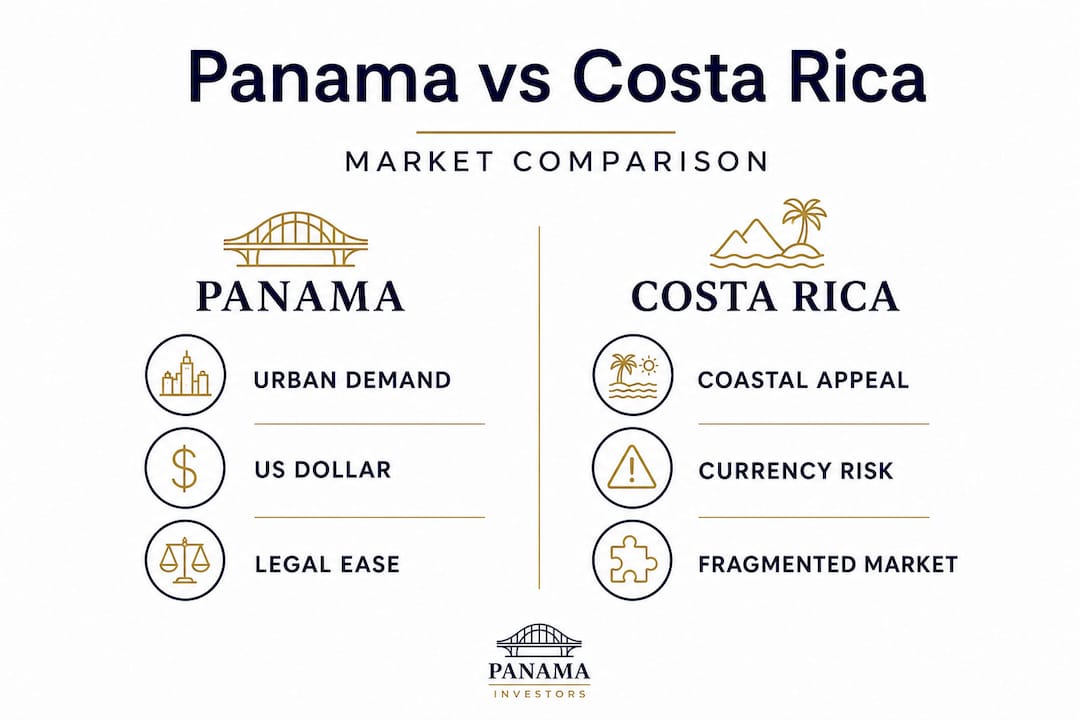
The first thing to understand is that Panama and Costa Rica serve different investor profiles. Panama attracts buyers looking for strong rental yields, urban appreciation, and a dollarized economy that removes currency risk almost entirely. Costa Rica appeals more to lifestyle buyers, retirees, and investors chasing eco-tourism rental income in less urban settings.
Market trends and investor profiles
Panama City continues to drive the bulk of investment activity in Panama, with areas like Casco Viejo, Costa del Este, and Punta Pacifica commanding consistent demand from both local and international buyers. Coastal and island markets are growing too, and top Panama markets outside the capital now attract buyers seeking second homes and vacation rental properties.
Costa Rica’s market is more fragmented. The Central Valley around San José and the Guanacaste Pacific coast remain the most active zones. However, price appreciation has been slower and less predictable than in Panama. The market is also more dependent on tourism cycles, which adds a layer of volatility for rental investors.
Liquidity and appreciation
Panama’s market benefits from a larger pool of international buyers and a well-established legal infrastructure for foreign ownership. Properties in prime urban zones have appreciated steadily over the past decade, and rental demand from multinational company employees, finance sector workers, and regional headquarters staff keeps occupancy rates strong.

In Costa Rica, appreciation has been healthy in premium coastal areas like Tamarindo and Manuel Antonio, but resale liquidity is generally lower. Fewer investors are actively buying and selling, which can extend time-on-market and compress the returns you ultimately capture.
Side-by-side comparison
Factor | Panama | Costa Rica |
Currency | US Dollar (no exchange risk) | Costa Rican Colón (exchange risk applies) |
Transfer tax | 2% of sale price | ~1.5% of registered value |
Income tax advance on sale | 3% (creditable against capital gains) | Varies by transaction structure |
Urban rental demand | High (Panama City) | Moderate (San José, Guanacaste) |
Transaction speed | Fast, 30 to 60 days typical | Slower, 60 to 90 days common |
Foreign ownership restrictions | None | Minor (coastal zone rules apply) |
One important distinction for buyers comparing investing in Latin America broadly: Panama is consistently ranked as the most investor-friendly environment in the region, and the data backs that up. The dollarized economy alone eliminates a risk that trips up investors in Colombia, Costa Rica, and Mexico.
Panama also functions as a regional business hub. That creates structural demand for housing that does not exist in the same way in Costa Rica. For a full breakdown of what makes Panama stand out among all regional options, our Latin America real estate blog covers the latest market updates and investment analysis.
Taxation and transaction costs: Panama vs Costa Rica
Taxes are where the differences between Panama and Costa Rica become very concrete and very consequential.
Panama’s tax structure
When you sell property in Panama, a 2% transfer tax and 3% income-tax advance payment are applied. The 3% is calculated on the sale price and is paid at closing as an advance against any capital gains tax you ultimately owe. If your actual capital gain is lower than the amount covered by the 3% advance, you may be entitled to a credit or refund after filing. This structure gives sellers a degree of planning flexibility that is rarely discussed in generic investment guides.
Transaction cost breakdown
Cost item | Panama | Costa Rica |
Real estate transfer tax | 2% | ~1.5% |
Capital gains / income advance | 3% (creditable) | 15% capital gains tax on gains |
Legal fees | 1 to 1.5% | 1 to 2% |
Notary and registry fees | ~1% | ~1% |
Real estate agent commission | 3 to 5% (typically paid by seller) | 3 to 5% |
Costa Rica introduced a formal capital gains tax of 15% on gains from property sales, applying to properties acquired after July 2019. For properties bought before that date, different rules may apply. This 15% rate can significantly erode returns on appreciation-driven investments, especially in high-growth coastal areas.
Pro Tip: In Panama, if you hold property for a long period and your actual capital gain is smaller than the 3% advance, filing for a reconciliation can recover that overpayment. Investors who skip this step leave money on the table.
What foreign buyers often miss
Several costs catch first-time foreign buyers off guard in both markets. Property transfer costs in Costa Rica are split between buyer and seller by local custom, but this is negotiable. In Panama, the seller typically absorbs transfer taxes, but your purchase agreement needs to specify this clearly.
Beyond taxes, there are notary fees, public registry fees, and due diligence costs that add up. In Costa Rica, the maritime zone law (the Zona Marítimo Terrestre) applies to the first 200 meters from the coastline. Most of that land cannot be privately owned, meaning buyers often purchase concession rights rather than titled property. This adds legal complexity and reduces security compared to fee-simple ownership in Panama.
For a thorough walkthrough of the tax benefits in Panama that foreign investors can access, including exemptions for new construction and special economic zones, read our dedicated guide. And if you’re preparing for a transaction, the complete buying in Panama resource covers every step.
Ownership laws and residency: What investors need to know
Foreign ownership in Panama
Panama grants foreigners the same property ownership rights as Panamanian citizens. There are no special permits, no restrictions on how much land you can own, and no requirement to partner with a local citizen. This is not universal in Latin America. Mexico, for instance, restricts direct foreign ownership near coastlines. Panama does not have that limitation, which makes Panama beachfront benefits accessible to international buyers without legal workarounds.
Residency linked to investment
Panama offers several residency pathways that connect directly to real estate investment:
The Friendly Nations Visa allows citizens of 50-plus approved countries to obtain permanent residency by purchasing property worth $200,000 or more.
The Pensionado Visa is available to retirees with a qualifying pension and offers substantial discounts on goods and services.
The Qualified Investor Visa requires a minimum $300,000 investment in real estate or securities and fast-tracks permanent residency.
These pathways are well-documented, consistently applied, and available to most North American and European investors. The Panama residency guide breaks down each visa category with current requirements and timelines.
Costa Rica’s ownership and residency landscape
Costa Rica also allows foreigners to own titled property freely. The issue arises with coastal properties, where the maritime zone law restricts private ownership of the first 50 meters from the high tide line entirely, and limits the next 150 meters to concession-based leases through local municipalities. Valuations, renewals, and municipal relationships add ongoing management complexity that titled ownership in Panama simply does not have.
For residency, Costa Rica offers a Rentista Visa (requiring proof of $2,500 monthly income) and a Pensionado Visa (requiring at least $1,000 per month in pension income). A dedicated investor visa tied specifically to real estate does not exist in the same streamlined form as Panama’s options.
“The single most underestimated advantage Panama has over Costa Rica for international buyers is not the tax rate or the dollar economy. It is the combination of fee-simple titled ownership nationwide, straightforward residency pathways, and a legal system designed to protect foreign investors at every step.”
For a step-by-step breakdown of the buying process, the Panama buying guide is an essential read before you engage any agent or notary.
Investor takeaways: Deciding between Panama and Costa Rica
Where each country excels
Panama is stronger for:
Investors prioritizing capital preservation through a dollarized economy
Buyers seeking strong urban rental yields and tenant stability
Expats who want a realistic, affordable path to permanent residency
Investors who need transaction speed and legal predictability
Anyone wanting fee-simple titled property in coastal or beach locations
Costa Rica is stronger for:
Lifestyle buyers who prioritize natural environment over financial optimization
Investors targeting eco-tourism niches in specific coastal zones
Buyers comfortable with concession-based coastal tenure
Those who already have established local networks in the Costa Rican market
Decision framework
Your priority | Better option |
No currency risk | Panama |
Fastest residency pathway | Panama |
Urban rental income | Panama |
Eco-tourism rental income | Costa Rica |
Beachfront titled ownership | Panama |
Low capital gains tax exposure | Panama |
Lifestyle over financial return | Costa Rica |
Pre-closing checklist for investors
Before committing capital in either market, confirm the following:
Title search completed by an independent attorney (not the seller’s lawyer)
Property free of liens, mortgages, or contested boundaries
Tax payment history verified at the public registry
Coastal zone status confirmed if purchasing near the ocean
Residency eligibility reviewed against current visa thresholds
Transaction costs itemized in writing before signing a promise-to-purchase agreement
The Panama investment destination case is strong, and the data consistently supports Panama over Costa Rica for pure investment return. That said, the right choice depends on your specific goals, timeline, and risk tolerance.
The 2% transfer tax and 3% income-tax advance structure in Panama is more favorable for most investors than Costa Rica’s 15% capital gains regime, particularly for those planning to sell within a ten-year horizon.
For buyers considering urban locations specifically, our detailed review of Panama City neighborhoods will help you narrow down exactly where to focus your search.
Why conventional wisdom on Panama vs Costa Rica often misleads
Most articles comparing these two markets focus on headline numbers: transfer tax rates, visa thresholds, average property prices. That surface-level analysis misses what actually determines whether an investment performs.
The real trap is operating costs. Investors calculate their purchase price, taxes, and projected rent, then forget about HOA fees in Panama City towers (which can run $500 to $900 per month in premium buildings), property management fees, short-term rental platform commissions, and maintenance reserves. In Costa Rica, the same trap exists, with the added complication of concession renewal fees, municipal taxes that are not always predictable, and infrastructure costs in rural coastal areas.
There is also a widespread assumption that Costa Rica’s stable political environment translates directly into stable investment returns. That is not automatically true. Political stability supports tourism, but tourism is seasonal and cyclical. If you are depending on Airbnb income from a beach house in Tamarindo, two slow seasons can eliminate a full year of net return.
Panama’s advantage is structural, not cyclical. The demand for housing in Panama City is driven by regional corporate activity, an international banking sector, and a logistics industry anchored by the Canal. Those drivers do not disappear when travel sentiment shifts.
From my perspective, having worked in this market for over a decade, the investors who regret their Costa Rica purchases are almost always those who made lifestyle decisions using investment logic. They fell in love with the scenery, ran optimistic rental projections, and underestimated the friction of managing a property in a rural coastal zone from abroad. The investors who succeed in Costa Rica go in with realistic expectations and a strong local management partner from day one.
Panama is more forgiving because the fundamentals are stronger. But even here, going in without guidance, without local knowledge of which buildings have poor construction quality or which neighborhoods are overpriced, costs real money. The Latin American investment comparison across Panama, Costa Rica, and Colombia shows that no market is risk-free. The difference is how manageable and predictable those risks are.
Start your real estate investment journey with Panama Investors
Making a well-informed decision between Panama and Costa Rica requires more than reading guides. It requires access to current listings, on-the-ground knowledge, and an advisor who has navigated both the wins and the pitfalls of this specific market.

Panama Investors is led by Luca Piva, a licensed Panama real estate agent with over 12 years of active market experience. Whether you’re evaluating your first international purchase or adding to an existing portfolio, the team provides personalized guidance that goes beyond generic advice. From identifying the right neighborhood to structuring your offer and managing due diligence, every step is handled with local expertise. Ready to take the next step? Contact Panama Investors to schedule your strategy call and get a clear picture of what your investment could realistically achieve.
Frequently asked questions
What are the main taxes when buying real estate in Panama?
Buyers should be aware that on a real estate sale, a 2% transfer tax and a 3% income-tax advance are applied at the time of transfer, with the 3% potentially credited against the final capital gains assessment.
Do foreigners face any property purchase restrictions in Panama?
Foreigners can own property in Panama with the same rights as Panamanian citizens, including titled beachfront properties, with no requirement for local partnerships or special permits.
Is it easier to obtain residency via real estate investment in Panama or Costa Rica?
Panama offers a more streamlined and direct residency program tied to real estate investment, generally considered faster and more accessible than equivalent pathways in Costa Rica.
Are capital gains taxes in Panama higher than in Costa Rica?
Panama’s 3% income-tax advance is creditable against the final capital gains assessment, making the effective rate competitive. Costa Rica’s 15% capital gains tax on post-2019 acquisitions is notably higher for appreciation-driven investors.
What is the typical closing timeline for property deals in Panama versus Costa Rica?
Panama transactions typically close in 30 to 60 days when documentation is in order, while Costa Rica closings more commonly run 60 to 90 days due to additional legal complexity, especially for coastal properties.
Recommended
