
How to Build Custom Real Estate Strategies That Perform
How to Build Custom Real Estate Strategies That Perform
Generic real estate investment strategies fail most investors quietly. You follow a standard playbook, screen deals against broad benchmarks, and wonder why your portfolio underperforms or why deals that looked good on paper disappoint at close. Learning how to build custom real estate strategies changes that equation entirely. Instead of applying someone else’s risk tolerance and return assumptions to your decisions, you build a system calibrated to your own financial goals, historical deal data, and market context. This guide walks you through the entire process, from defining your investment thesis to operationalizing a repeatable decision engine.
Table of Contents
- Key takeaways
- How to build custom real estate strategies: defining your thesis and scoring model
- Underwriting best practices: using T12, rent rolls, and pro formas
- Integrating DSCR into your deal evaluation logic
- Operationalizing your strategy with a logic engine
- My take: why calibration beats conviction every time
- How Panamainvestors helps you build and execute your strategy
- FAQ
Key takeaways
| Point | Details |
|---|---|
| Define a scored investment thesis | Assign measurable weights to categories like financial attractiveness, risk profile, and value-creation potential to score every deal consistently. |
| Anchor underwriting in historical actuals | Use T12 actuals reconciled against rent rolls and pro formas to build a reliable baseline and avoid seller-inflated projections. |
| Incorporate DSCR thresholds early | Model a minimum 1.20x to 1.25x DSCR into your deal filters before committing time to deeper analysis. |
| Operationalize with a logic engine | Separate raw data from your personal assumptions to create a repeatable, bias-resistant evaluation workflow. |
| Rebalance with defined triggers | Set explicit drift thresholds and allocation caps to prevent your portfolio from silently drifting away from your target risk profile. |
How to build custom real estate strategies: defining your thesis and scoring model
Every effective custom real estate plan starts with one honest question: what does a good deal actually look like for you? Not for a textbook, not for a fund manager with a 10-year exit horizon. For you, with your capital, your tax situation, and your risk ceiling.
The answer lives inside a structured investment thesis, and the thesis only becomes useful when you translate it into a scoring model with weighted categories. Custom scoring frameworks typically allocate percentages across four categories: financial attractiveness, market fundamentals, risk profile, and value-creation potential. The exact percentages depend on your priorities.
Here is what those categories often look like in practice:
- Financial attractiveness covers cash-on-cash return, cap rate, and projected IRR. A yield-focused investor might weight this at 40%.
- Market fundamentals captures population growth, employment trends, and rental demand. A long-hold investor may weight this heavily, at 30% or more.
- Risk profile scores vacancy history, tenant concentration, deferred maintenance, and neighborhood trajectory.
- Value-creation potential rewards properties where renovation, lease-up, or repositioning could push NOI meaningfully higher.
The critical mistake most investors make is applying equal weights across categories. Equal weighting implies you care about every dimension the same amount, which is almost never true. A retired investor generating passive income weights risk lower and cash flow higher than a 40-year-old building wealth through appreciation.
Calibration is what separates a useful model from a decorative one. Back-testing against 20 to 30 historical deals and adjusting weights until your model scores your best past deals highest and your worst deals lowest is the fastest path to a model you can actually trust. Target roughly 80% accuracy before relying on it for live decisions.
Pro Tip: Don’t build your scoring rubric in isolation. Pull three deals you wish you had passed on and three you wish you had pursued. Map why each felt right or wrong. Your emotional history contains weight data you haven’t yet formalized.
Underwriting best practices: using T12, rent rolls, and pro formas
Once your scoring model exists, every deal you evaluate needs a reliable data foundation. Underwriting is that foundation, and most investors get it wrong by starting in the wrong place.

The three documents you will work with on any income property are the trailing twelve months (T12) statement, the current rent roll, and the seller’s pro forma. They are not interchangeable.
| Document | What it shows | How to use it |
|---|---|---|
| T12 (trailing twelve months) | Actual income and expenses over the past year | Your primary baseline for NOI reconstruction |
| Rent roll | Current tenant occupancy, lease terms, and rent rates | Snapshot of present cash flow capacity |
| Seller’s pro forma | Projected future performance, optimized for the sale | A starting point to challenge, not accept |
T12 actuals form your reliable historical baseline while the pro forma represents a projection you must validate against reality. The gap between the two is where risk hides. Sellers routinely include stabilized occupancy assumptions, projected rent bumps, and reduced expense ratios that do not reflect how the property has actually operated.
Your reconciliation process should surface anomalies: free rent periods that inflate the rent roll, seasonal vacancy spikes buried in annual averages, or deferred maintenance costs excluded from the T12. Reconstructing NOI from actuals protects you from making acquisition decisions on numbers the seller assembled for marketing, not accuracy.
Once you have a clean NOI figure, feed it into your scoring model’s financial attractiveness category. This keeps your deal evaluation grounded in reality rather than optimism.
Pro Tip: When you receive a T12, compare monthly income line items across all twelve months. Unusual spikes or drops often indicate one-time payments, owner concessions, or unreported vacancies that annual summaries hide.
Integrating DSCR into your deal evaluation logic
Scoring a deal highly means nothing if the financing math does not work. Debt Service Coverage Ratio, or DSCR, is the metric lenders use to determine whether the property’s income can support the loan payments. Lenders generally require a minimum DSCR of 1.20x to 1.25x, meaning the property must generate at least 20 to 25 percent more income than it takes to service the debt each year.
The formula is straightforward: divide the property’s net operating income by the annual debt service. A property generating $120,000 in NOI against $100,000 in annual loan payments carries a 1.20x DSCR. Fall below that threshold, and most commercial lenders pass.
Build this check into your evaluation process before you invest time in deeper analysis. Here is a practical sequence:
- Calculate NOI from your reconciled T12 data, not the seller’s pro forma.
- Model the proposed debt structure (loan amount, rate, and amortization period) to calculate the annual debt service.
- Divide NOI by debt service. If you land below 1.20x, stop and assess your options before moving forward.
- Run sensitivity scenarios: what happens to your DSCR if vacancy rises 5%, or if your interest rate is 50 basis points higher at close?
- If DSCR is marginal, model structural adjustments. Increasing your down payment reduces the loan amount and therefore the debt service. Extending the amortization period lowers annual payments. In some markets, a rate buydown may be worth modeling too.
One nuance most investors miss: DSCR calculation semantics vary by lender. Some lenders cap the rental income they will recognize for DSCR purposes. Others treat replacement reserves differently, either deducting them before NOI or excluding them entirely. Your internal DSCR model needs to mirror the lender’s definition, not your own, or you will show up at the loan committee with a number that does not match theirs.
Pro Tip: Build a simple DSCR sensitivity table in your underwriting spreadsheet with three scenarios: base case, 5% vacancy increase, and 0.5% rate increase. A deal that only works at best-case assumptions is not a deal. It is a bet.
Operationalizing your strategy with a logic engine
A scoring model and solid underwriting are not enough by themselves. The real power comes from turning them into a repeatable system that applies consistently across every deal, whether you evaluate three this quarter or thirty.
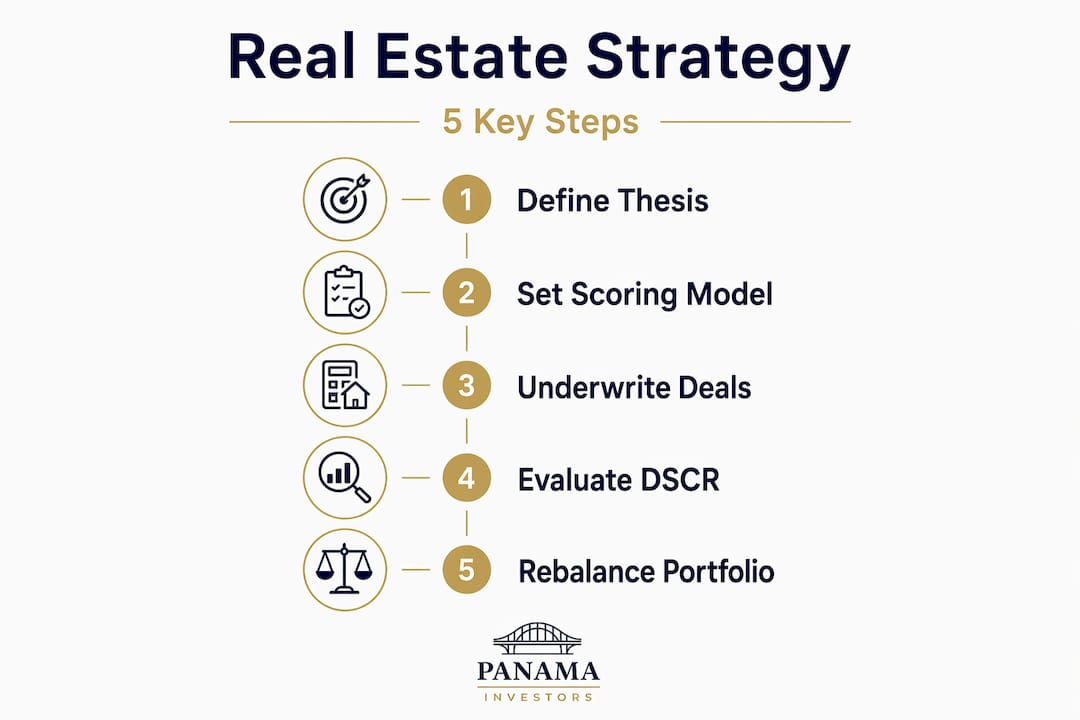
This is where the concept of an investment logic engine becomes useful. Separating raw data ingestion from your personal assumption overlays ensures every deal gets scored under your specific financing terms, tax bracket, depreciation schedule, and risk assumptions rather than generic defaults. The raw data stays objective. Your context shapes the output.
In practice, this means building workflows with defined inputs and outputs:
- Data intake layer: Standardized intake form for T12, rent roll, and pro forma with required fields before analysis begins.
- Reconciliation layer: Step-by-step NOI reconstruction protocol that runs the same way every time.
- Scoring layer: Your weighted rubric applied automatically once financial inputs are clean.
- Decision gate: A clear threshold (for example, a minimum composite score of 70 out of 100) that moves a deal to due diligence or removes it from consideration.
Portfolio rebalancing is the operational discipline that keeps your strategy coherent over time. Without it, concentration risk builds silently as certain assets appreciate while others stagnate, shifting your actual risk exposure far from your intended targets.
A practical rebalancing framework looks like this:
| Allocation type | Target % | Max concentration | Review trigger |
|---|---|---|---|
| Stable cash flow | 60% | 70% | 10% drift |
| Value-add assets | 30% | 40% | 10% drift |
| Opportunistic plays | 10% | 20% | 10% drift |
Quarterly reviews with defined drift triggers prevent you from chasing recent performance rather than maintaining your planned risk profile. If your value-add bucket drifts above 40%, you know it is time to either harvest or redirect new capital before adding more risk.
Pro Tip: Schedule your quarterly portfolio review as a recurring calendar block, not something you do when it feels necessary. Discipline is a process design problem, not a motivation problem.
My take: why calibration beats conviction every time
I’ve spent enough time watching investors confidently execute strategies built on borrowed assumptions to know what actually goes wrong. It rarely comes from bad markets or bad luck. It comes from using a system designed for someone else’s risk tolerance and calling it a strategy.
What I’ve learned is that the investors who consistently outperform are not the ones with the best market timing. They are the ones who have done the unglamorous work of calibrating their models against their own deal history. They know, based on actual outcomes rather than theory, which scoring categories predict their best deals. They adjust weights when the data tells them to, not when a podcast trend shifts.
The operational side is where most people quietly fail. They build a solid thesis, do good underwriting on the first few deals, and then let the process erode as volume increases or markets move. Consistent underwriting discipline, specifically starting always with actuals and reconciling against projections, separates investors who scale well from those who hit a ceiling and wonder why. For international investors, especially those considering markets like Panama, this discipline matters even more because you are operating with less local intuition and more dependence on data you can verify yourself. I’ve seen deals in markets like Panama that looked mediocre on a seller’s pro forma but looked excellent once T12 actuals and current rent rolls were properly reconciled. The financial reality of passive income from well-selected properties often diverges sharply from what a surface-level review suggests.
Build the system. Back-test it. Run it consistently. Then update it when your own data tells you something has changed.
— Roie
How Panamainvestors helps you build and execute your strategy

Panamainvestors does not hand you a generic playbook and wish you luck. The advisory approach, led by Luca Piva with over 12 years of on-the-ground experience in Panama’s real estate market, is built around helping investors develop custom real estate plans that reflect their actual goals, risk tolerance, and financial situation.
That means working with you to define your investment thesis and scoring priorities before you look at a single listing. It means underwriting support that reconciles T12 actuals against market conditions specific to Panama, where a dollarized economy, favorable tax laws, and strong local networks create dynamics that generic frameworks miss entirely.
For investors building or scaling a portfolio, Panamainvestors also supports financing modeling, DSCR scenario analysis, and portfolio allocation review to keep your strategy coherent as your holdings grow. The goal is not just to find you a property. It is to make sure every property you acquire fits a strategy you can defend, scale, and adjust over time.
Book a strategy call to start building a tailored approach grounded in Panama’s market realities.
FAQ
What is a custom real estate investment strategy?
A custom real estate investment strategy is a personalized decision framework built around your specific financial goals, risk tolerance, and market context. It uses weighted scoring categories, calibrated underwriting standards, and defined portfolio rules rather than generic benchmarks.
How do you weight scoring categories in a real estate model?
Assign percentages to categories like financial attractiveness, market fundamentals, risk profile, and value-creation potential based on your priorities. Back-test the model against 20 to 30 past deals and refine weights until the model’s rankings align with your actual best and worst decisions.
Why does DSCR matter when building a real estate strategy?
DSCR measures whether a property generates enough income to cover its debt payments. Most lenders require a minimum of 1.20x to 1.25x, so building this threshold into your deal filters early prevents you from advancing deals that cannot be financed on acceptable terms.
What is the difference between a T12 and a pro forma?
A T12 (trailing twelve months) shows actual historical income and expenses, making it your most reliable underwriting baseline. A pro forma projects future performance and is typically optimized for the sale, so it should be validated against T12 actuals before informing any acquisition decision.
How often should you rebalance a real estate portfolio?
Quarterly reviews with a defined drift trigger of around 10% work well for most investors. When any asset class exceeds its concentration cap, redirect new capital or consider harvesting before adding additional exposure to that category.
