
Capital Gains Tax in Panama: What Investors Need to Know
Capital Gains Tax in Panama: What Investors Need to Know
Capital gains tax in Panama is a 10% tax applied to net gains from Panama-source assets, primarily real estate and certain corporate asset sales, while foreign-source gains are fully exempt under the country’s territorial tax system. This distinction is the single most important concept for any foreign investor evaluating Panama. Whether you are buying a condo in Panama City, holding a securities portfolio, or planning an exit strategy, understanding how Panama’s territorial taxation works determines your actual tax exposure. This article covers the full picture: rates, withholding mechanics, real estate rules, and practical compliance steps for 2026.
What is capital gains tax in Panama and how does it work?
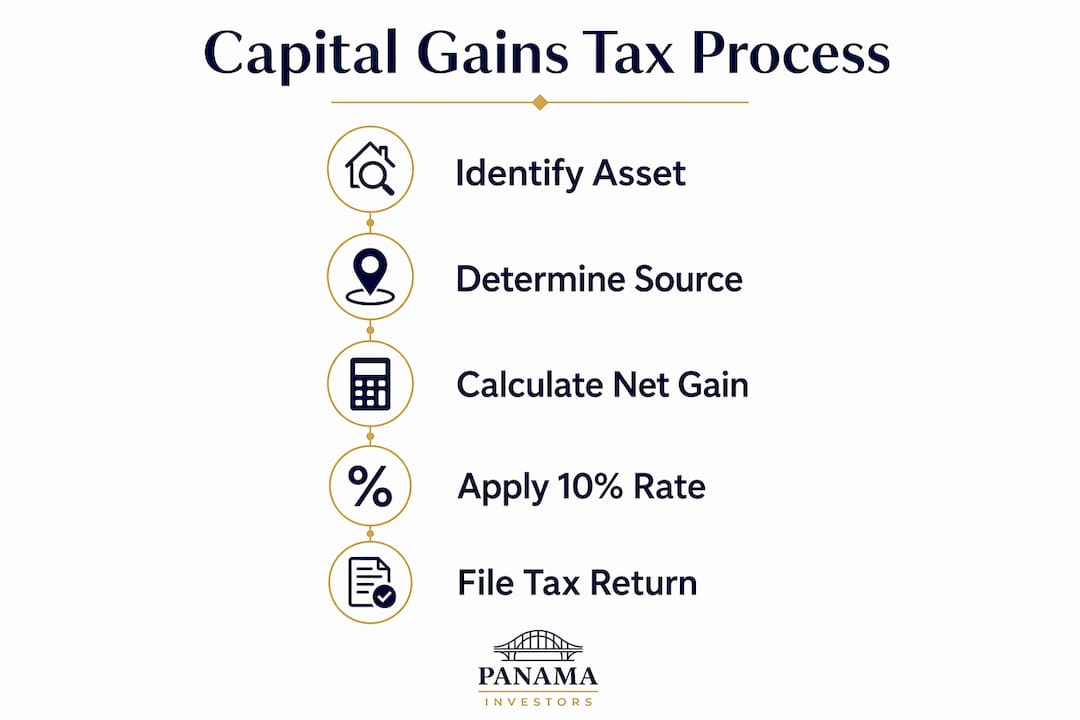
Panama’s capital gains tax (CGT) is the official term for the levy applied to profits realized from selling qualifying assets located in Panama. The 10% CGT rate applies to net gains from Panama-source real estate and corporate asset sales. Net gain means the sale price minus the documented cost basis, including purchase price, legal fees, and capital improvements.
Panama does not impose CGT on a worldwide basis. The country uses a territorial tax system, which means the government taxes only income and gains that originate within Panama’s borders. A U.S. investor selling a stock portfolio held in New York pays zero Panamanian CGT on that transaction, even if the proceeds land in a Panamanian bank account. The place where proceeds are deposited does not determine tax liability. The source of the asset and the transaction location do.
This framework makes Panama structurally attractive for international investors who hold diversified global portfolios. Your Panama real estate sale triggers CGT. Your London property sale does not. That asymmetry is by design, and it is one reason Panama consistently ranks as a favorable destination for foreign capital.
How does Panama’s territorial tax system determine CGT liability?
The territorial tax principle is the foundation of Panama’s entire tax code, not just capital gains. Panama taxes income and gains that are earned in Panama or derived from Panama-source assets. Everything else falls outside the tax net entirely.
For capital gains purposes, the key categories break down as follows:
- Panama real estate sales: Always Panama-source. CGT applies at 10% on net gain.
- Panama corporate asset sales: Panama-source. CGT applies at 10%.
- Foreign real estate sales: Foreign-source. Zero Panamanian CGT.
- Foreign securities and portfolio gains: Foreign-source. Zero Panamanian CGT.
- Foreign dividends and rental income: Foreign-source. Zero Panamanian CGT, even if remitted to Panama.
Pro Tip: Investors focus more on the source of income than on their residency status when calculating Panama tax exposure. A non-resident selling Panama real estate owes CGT. A Panama resident selling foreign stocks owes nothing. Source beats residency every time.
This matters practically for investors structuring cross-border portfolios. If you hold a mix of Panama property and international equities, only the Panama property sale creates a CGT event. The territorial system’s exemption covers foreign securities and foreign portfolio gains explicitly, which is a significant advantage for high-net-worth investors managing global assets from Panama.
What are the capital gains tax rules for real estate sales in Panama?
Real estate is the focal point of Panama’s CGT system. Property sales represent the highest-confidence taxable trigger for investors, and the mechanics involve multiple layers that require careful planning.
Here is how the process works step by step:
- Sale agreement is signed. The buyer and seller agree on a sale price.
- 3% withholding tax is applied at closing. The buyer withholds 3% of the gross sale price and remits it to Panama’s tax authority (DGI) as an advance payment against the seller’s final CGT liability.
- 2% real estate transfer tax is assessed. This separate tax applies to the higher of the gross sale price or the cadastral value. Developers selling new constructions may qualify for exemptions on this transfer tax.
- Seller calculates final CGT. The seller computes 10% of the actual net gain using documented cost basis, improvement costs, and transaction expenses.
- Withholding is credited against final tax. If the 3% withholding exceeds the final 10% CGT liability, the seller can claim a refund from the DGI.
The table below summarizes the key tax components on a Panama real estate sale:
| Tax component | Rate | Basis | Notes |
|---|---|---|---|
| Capital gains tax | 10% | Net gain | Creditable against withholding paid |
| Withholding tax at closing | 3% | Gross sale price | Advance payment, refundable if excess |
| Real estate transfer tax | 2% | Higher of sale price or cadastral value | Exemptions for new developer sales |
Pro Tip: If your documented cost basis is high relative to the sale price, your actual 10% CGT on net gain may be lower than the 3% withholding already paid. File for the recalculation and claim the refund. Many sellers leave money on the table by simply accepting the withholding as final.
The 3% withholding mechanism is designed as a cash flow tool for the government, not as the final tax. Sellers who maintain thorough records of purchase price, legal costs, and capital improvements consistently pay less than those who cannot document their cost basis. Panamainvestors works with clients specifically on this documentation strategy before any sale is initiated.
How are capital gains from securities and other assets treated in Panama?
Securities and financial assets receive different treatment than real estate under Panama’s CGT rules. The distinction matters for investors holding stocks, bonds, or fund interests alongside physical property.
Stock and securities sales are largely exempt from CGT under the territorial system, particularly when the underlying assets are foreign-source. However, when a securities transaction does involve Panama-source income, a 5% withholding tax may apply. That 5% withholding functions the same way as the real estate withholding: it is an advance payment that can be credited against any final tax liability if the investor elects to compute actual CGT.
The practical comparison between real estate and securities CGT treatment looks like this:
| Asset type | CGT rate | Withholding rate | Foreign-source exemption |
|---|---|---|---|
| Panama real estate | 10% on net gain | 3% of gross sale price | No, always Panama-source |
| Panama corporate assets | 10% on net gain | Varies | No |
| Panama-source securities | Up to 10% | 5% | Partial, depends on source |
| Foreign securities/portfolio | 0% | None | Yes, fully exempt |
For investors holding diversified portfolios, this structure creates a clear planning opportunity. Foreign equities and international funds generate zero Panamanian CGT. Panama real estate generates a predictable 10% CGT on net gain with a 3% advance withholding. Knowing which bucket each asset falls into allows investors to model their after-tax returns accurately before committing capital.
Corporate asset sales deserve a specific note. When a company sells assets located in Panama, the gain is treated as Panama-source and subject to 10% CGT. Investors who hold Panama real estate through a corporate structure need to account for this at the entity level, not just the personal level.
What practical steps do investors need to comply with Panama CGT requirements?
Compliance with Panama’s CGT rules is straightforward when investors prepare in advance. The most common mistakes come from poor documentation, not from misunderstanding the rates.
The core documentation every seller needs includes:
- Original purchase contract and price paid. This establishes the cost basis.
- Records of capital improvements. Renovations, additions, and major repairs increase your cost basis and reduce taxable net gain.
- Closing costs and legal fees from the original purchase. These are deductible from the gain.
- Any prior withholding tax receipts. Proof that the 3% was remitted at closing is required to claim the credit.
Beyond documentation, timing matters. Withholding tax at closing creates a cash flow event at the moment of sale. Sellers who plan ahead can model whether the 3% withholding will exceed their final 10% CGT liability and prepare the refund claim paperwork in advance, rather than scrambling after closing.
Panama residency status does not change your CGT obligation on Panama-source assets. A foreign investor with no Panama residency owes the same 10% CGT on a Panama property sale as a permanent resident. What residency can affect is access to certain investor programs and the broader tax treatment of global income, but the CGT rate on Panama real estate is consistent across investor categories.
Pro Tip: Compliance scrutiny around economic substance documentation is increasing for foreign-source passive income claims. If you are asserting that gains are foreign-source and therefore exempt, maintain clear records showing the asset’s location, the transaction’s origin, and the nature of the income. A well-documented exemption claim is far stronger than an undocumented one.
How does Panama’s CGT compare to other Latin American countries?
Panama’s investor-friendly CGT conditions stand out clearly when placed against the broader Latin American region. Most countries in the region impose higher effective rates, fewer exemptions, and less flexible withholding credit systems.
Panama’s 10% rate on net gains, combined with the territorial exemption for foreign-source gains, creates a lower total tax burden for internationally diversified investors than most regional alternatives offer. The 3% withholding credit system also provides a built-in mechanism for refunds, which is uncommon in the region. Many Latin American jurisdictions treat withholding as a final tax with no recalculation option.
For real estate specifically, Panama’s combination of a 10% CGT on net gain and a 2% transfer tax compares favorably to markets where CGT rates on property reach 15% to 30% of gross gain with no deduction for cost basis. The Panama vs. Costa Rica comparison is particularly relevant for investors evaluating Central American markets, as Costa Rica imposes its own distinct CGT structure that differs materially from Panama’s approach.
The territorial system is the differentiating factor. No other major Latin American economy offers a blanket exemption on foreign-source capital gains regardless of where the investor resides. That feature alone makes Panama the preferred base for investors managing international portfolios who want to minimize tax drag on global returns.
Key takeaways
Panama’s capital gains tax system is defined by a 10% rate on Panama-source net gains, a territorial exemption for all foreign-source gains, and a 3% withholding credit mechanism that rewards well-documented sellers.
| Point | Details |
|---|---|
| Core CGT rate | Panama taxes net gains from Panama-source assets at 10%, applied primarily to real estate and corporate asset sales. |
| Territorial exemption | Foreign-source capital gains, including foreign securities and property, are fully exempt from Panamanian CGT regardless of where proceeds are deposited. |
| Withholding credit | The 3% withholding at real estate closing is an advance payment, not a final tax. Sellers with documented cost basis can recalculate and claim refunds. |
| Securities treatment | Panama-source securities may carry a 5% withholding, while foreign portfolio gains face zero CGT under the territorial system. |
| Documentation priority | Maintaining purchase price records, improvement costs, and closing fees is the single most effective way to reduce final CGT liability on a Panama property sale. |
Why Panama’s CGT system rewards investors who plan ahead
Most investors I speak with initially assume Panama’s tax system is either completely tax-free or as complex as their home country’s code. Neither is true. Panama’s CGT system is genuinely simple once you understand the territorial principle. The 10% rate on net gains is predictable. The withholding credit is generous. The foreign-source exemption is real and well-established.
What surprises investors is how much the outcome varies based on documentation quality. I have seen sellers walk away from a Panama property sale paying close to the full 3% withholding as their effective tax rate because they could not document their cost basis. I have also seen sellers with identical sale prices receive substantial refunds because they kept every receipt from their renovation work and original purchase closing. The rate is the same. The outcome is completely different.
The other misconception worth addressing is the idea that structuring assets through a Panamanian corporation automatically reduces CGT. Corporate structures have legitimate uses for estate planning and liability protection, but they do not eliminate CGT on Panama-source asset sales. The 10% rate applies at the corporate level on asset sales just as it does at the individual level.
My honest recommendation: treat the documentation process as part of the investment itself. Start the file the day you buy, not the day you decide to sell. Panama’s CGT system is designed to reward sellers who can prove their cost basis. That is a system worth working with, not around.
— Roie
How Panamainvestors can help you navigate Panama real estate taxes
Panamainvestors, led by Luca Piva with over 12 years of on-the-ground experience in Panama’s real estate market, provides personalized advisory services that go well beyond finding the right property. Understanding the tax benefits of Panama real estate is a core part of every client engagement, from structuring the purchase to planning the eventual exit.

Whether you are calculating your expected CGT liability on a future sale, evaluating how Panama’s territorial system affects your global portfolio, or simply trying to understand what documentation to collect from day one, Panamainvestors connects you with the right local expertise. The team works with licensed tax professionals and legal advisors who specialize in Panama real estate transactions. Book a strategy call to get answers specific to your investment situation, not generic tax summaries.
FAQ
What is the capital gains tax rate in Panama?
Panama’s capital gains tax rate is 10% on net gains from Panama-source real estate and corporate asset sales. A 3% withholding tax is collected at closing as an advance payment and credited against the final 10% liability.
Are foreign investors subject to Panama capital gains tax?
Foreign investors owe Panama CGT on gains from Panama-source assets, primarily real estate located in Panama. Gains from foreign-source assets, including overseas property and international securities, are fully exempt under Panama’s territorial tax system.
Can I get a refund if the 3% withholding exceeds my actual CGT?
Yes. If your documented cost basis reduces the net gain enough that 10% of that gain is less than the 3% withheld at closing, you can file a recalculation with Panama’s DGI and claim the difference as a refund.
Are stock and securities gains taxed in Panama?
Most foreign securities gains are exempt from Panama CGT under the territorial system. Panama-source securities transactions may carry a 5% withholding tax, which is creditable against any final tax liability if the investor elects to compute actual CGT.
Does Panama tax capital gains on property held through a corporation?
Yes. When a Panamanian corporation sells Panama-source assets, the 10% CGT applies at the corporate level. Holding property through a corporation does not eliminate CGT on Panama real estate sales.
