What Is the Panama Friendly Nations Visa? 2026 Guide
What Is the Panama Friendly Nations Visa? 2026 Guide
The Panama Friendly Nations Visa is a two-stage residency program that grants citizens of over 50 qualifying countries a direct path to permanent residency through verifiable economic or professional ties to Panama. Established by Decreto Ejecutivo 197 in 2021, the program first issues a 2-year provisional residence before applicants become eligible for permanent status. To qualify, you must demonstrate one of three recognized ties: local employment, real estate investment of at least $200,000, or a fixed-term bank deposit. Panama’s dollarized economy, territorial tax system, and political stability make this one of the most sought-after residency options in Latin America for foreign nationals and investors.
What is the Panama Friendly Nations Visa and who is it for?
The Panama Friendly Nations Visa, formally known as the Visa de Países Amigos, is a residency permit designed for nationals of countries that maintain strong diplomatic and economic relationships with Panama. The program targets professionals, investors, and entrepreneurs who want to establish legal residency without the income restrictions tied to programs like the Pensionado Visa.
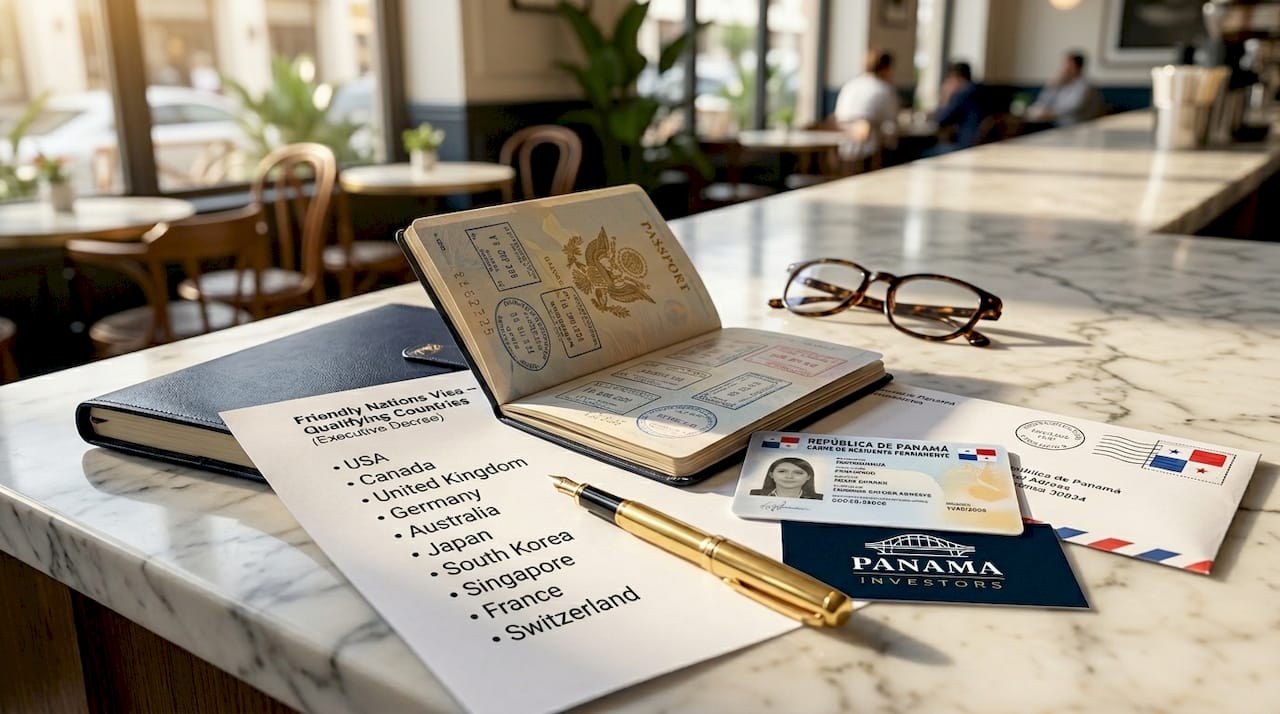
Eligible countries span North America, Europe, Asia, and South America. The United States, Canada, the United Kingdom, Germany, France, Australia, Japan, South Korea, Israel, and Brazil are among the most commonly represented nationalities. The full list covers 50+ compatible countries, and Panama’s National Immigration Service maintains the official registry.
The core concept behind “friendly nations” is reciprocity. Panama extends this residency pathway to countries with which it shares trade agreements, diplomatic ties, or mutual investment frameworks. This is not a passive visa. You must prove an active economic or professional connection to Panama, not just the intention to move there.
Who qualifies and what are the eligibility requirements?
Qualifying for this visa requires two things: citizenship from an approved country and documented proof of one of three recognized economic ties. The 2021 reform tightened these requirements significantly, replacing vague criteria with strictly defined investment and employment tracks.
The three qualifying ties are:
- Real estate investment: Purchase property in Panama worth at least USD 200,000, registered directly in your personal name. A property held through a corporation does not meet this requirement.
- Fixed-term bank deposit: Open a certificate of deposit (CD) at a Panamanian bank for a minimum of USD 200,000, held for at least 3 years.
- Labor tie: Secure a local employment contract with a Panamanian company registered with the Caja de Seguro Social (CSS), Panama’s social security system.
Beyond the qualifying tie, you must submit a package of supporting documents. These include an apostilled criminal background check from your home country, civil status documents (birth certificate, marriage certificate if applicable), proof of financial solvency, and a valid passport. Documentation quality and timing directly affect processing speed. Expired or improperly apostilled documents are the most common reason for delays in 2026.
Spouses and dependent children under 25 can be included in the same petition, though each dependent adds to the total government fees. The labor track carries one additional nuance worth understanding early: the visa does not automatically grant work rights. A separate work permit from the Ministry of Labor is required if employment is your qualifying tie.
How does the application process work?
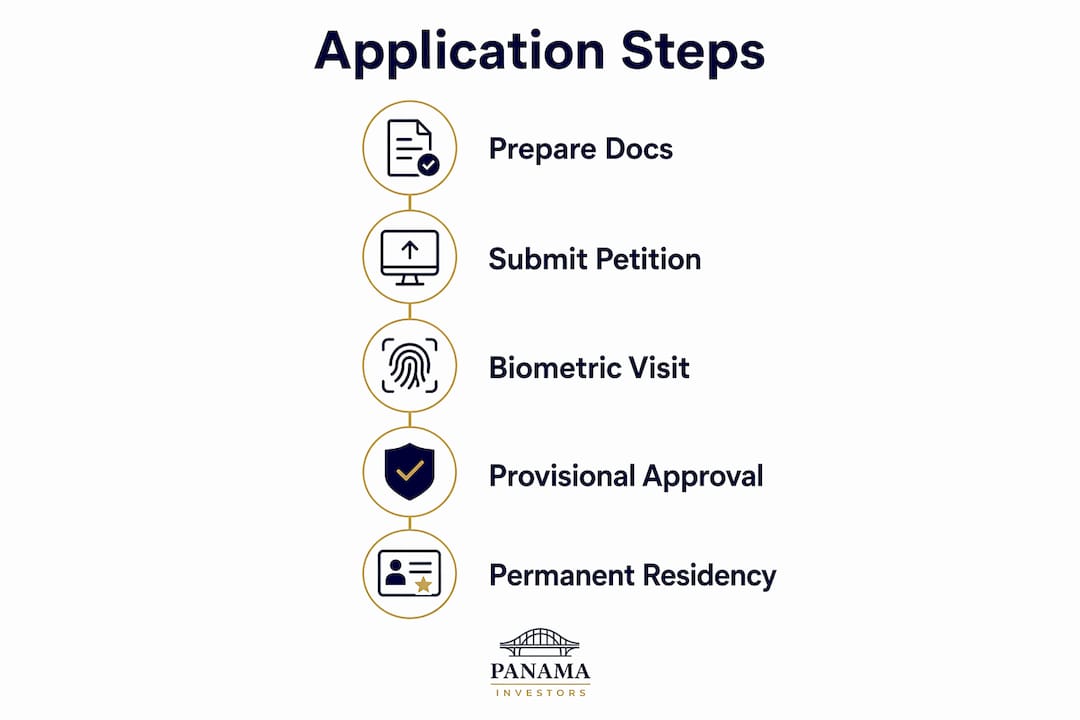
The application follows a structured sequence that requires physical presence in Panama at specific stages. You cannot file this visa remotely or through a foreign consulate. Here is how the process works from start to finish:
- Hire a registered Panamanian immigration attorney. Direct filings by foreigners are not permitted. Your attorney prepares and submits all documents to the National Immigration Service on your behalf.
- Gather and authenticate your documents. All foreign documents must be apostilled in the country of origin. Your attorney will advise on exact requirements based on your qualifying track.
- File the provisional residency application. Your attorney submits the full package along with government fees. The government fees approximate USD 1,050 for initial filings, covering the repatriation deposit and application costs.
- Complete biometric registration. You must appear in person at the National Immigration Service office in Panama City to submit fingerprints and photographs. This step cannot be delegated.
- Receive your provisional residency card. Processing typically takes 2 to 4 months from the date of filing. Your provisional card is valid for 2 years.
- Maintain your qualifying ties throughout the provisional period. Keep your property registered, your CD active, or your employment contract current. Any lapse can jeopardize your permanent residency application.
- Apply for permanent residency. Before your provisional card expires, your attorney files the conversion application. You have a 6-month window after expiration to file. Missing this window can void your entire process.
Pro Tip: Book your biometric appointment in Panama City before you travel. Appointment slots at the National Immigration Service fill up weeks in advance, and missing your window delays the entire timeline.
Legal fees for attorney services typically run $3,000 to $4,000 per stage, meaning the full two-stage process can cost $6,000 to $8,000 in legal fees alone, on top of government costs. Budget for both stages from the start.
What costs, timelines, and challenges should you expect?
Budgeting realistically for this process prevents the most common source of frustration among applicants. The numbers below reflect 2026 conditions.
Costs:
- Government fees: approximately USD 1,050 for the initial provisional application
- Legal fees per stage: $3,000 to $4,000, totaling $6,000 to $8,000 for both stages
- Dependent fees: additional government and legal costs per family member included in the petition
- Real estate or CD investment: minimum USD 200,000 if using the investment track
Timeline:
- Provisional residency processing: 2 to 4 months after filing
- Provisional residency validity: 2 years
- Permanent residency application: filed before or within 6 months of provisional card expiration
- Total time to permanent status: approximately 2.5 to 3 years from initial filing
“The 6-month conversion window is the single most misunderstood deadline in this process. Many applicants assume they have unlimited time after their provisional card expires. They do not. Missing that window means starting over.”
Common challenges include document apostille errors, outdated criminal background checks (most countries require checks issued within 3 to 6 months), and incorrect property ownership structures. The real estate track requires property to be registered in your personal name, not through a Panamanian corporation. Entrepreneurs who purchase property through a holding company for tax reasons often discover this conflict only after filing, which forces costly restructuring.
Maintaining your qualifying tie throughout the provisional period is not optional. If you sell the property, close the CD early, or terminate employment before permanent residency is granted, your application loses its legal foundation.
What benefits does the Friendly Nations Visa offer?
The Friendly Nations Visa delivers a combination of lifestyle, financial, and legal advantages that few other Panama residency options match.
Panama operates a territorial tax system, meaning income earned outside Panama is not subject to Panamanian income tax. For foreign investors and remote workers, this is a significant financial advantage. The country’s dollarized economy eliminates currency exchange risk for Americans and reduces volatility exposure for other nationalities.
Permanent residency through this program creates a clear pathway to Panamanian citizenship after 5 years of continuous residency. That is a concrete long-term option that programs like the Pensionado Visa or the Short-Stay Visa do not offer on the same timeline.
| Feature | Friendly Nations Visa | Pensionado Visa | Qualified Investor Visa |
|---|---|---|---|
| Minimum investment | USD 200,000 | None (income-based) | USD 300,000 |
| Work rights | Separate permit required | No | Yes |
| Path to citizenship | Yes (5 years) | Limited | Yes |
| Dependent inclusion | Yes (under 25) | Yes | Yes |
| Processing time | 2 to 4 months | 2 to 4 months | 3 to 6 months |
The Pensionado Visa requires a minimum monthly pension income of $1,000 and does not require investment. The Qualified Investor Visa requires a higher minimum investment but includes automatic work authorization. The Friendly Nations Visa sits between these two in terms of flexibility and cost.
Pro Tip: If you plan to purchase property in Panama anyway, structuring that purchase to meet the $200,000 threshold for the real estate track lets your investment serve double duty: it qualifies you for residency and builds equity in a growing market.
What practical steps maximize your chances of approval?
Success with this application comes down to preparation and structure. These are the steps that experienced practitioners consistently identify as the difference between smooth approvals and costly delays.
- Apostille every document before you travel. Criminal background checks, birth certificates, and marriage certificates must be apostilled in the country of origin. Panama does not accept notarized copies as substitutes.
- Register real estate in your personal name. The investment track requires direct personal ownership. If you plan to use a Panamanian corporation for other tax or estate planning purposes, keep the qualifying property separate and in your name.
- Start the permanent residency application early. Do not wait for your provisional card to expire. File the conversion application at least 3 months before expiration to give your attorney time to prepare and to absorb any processing delays.
- Obtain a work permit before starting employment. If you are using the labor track, a separate work permit from the Ministry of Labor must be in place before you begin working. Starting work without it creates a legal conflict that can undermine your application.
- Maintain consistent communication with your attorney. Immigration rules in Panama change. Your attorney tracks regulatory updates and deadline requirements that are not publicly announced in English.
Pro Tip: Choose an attorney who specializes exclusively in Panamanian immigration, not a general practice firm. The procedural details of the Friendly Nations Visa are specific enough that generalist errors are common and expensive.
Key takeaways
The Panama Friendly Nations Visa is the most accessible two-stage path to permanent residency for citizens of qualifying countries, provided you maintain a verifiable $200,000 investment, bank deposit, or local employment contract throughout the provisional period.
| Point | Details |
|---|---|
| Two-stage structure | Provisional residency lasts 2 years; permanent residency follows after maintaining qualifying ties. |
| Three qualifying tracks | Real estate ($200,000), fixed-term CD ($200,000 for 3 years), or local employment with CSS registration. |
| Critical conversion deadline | File for permanent residency within 6 months of provisional card expiration or restart the process. |
| Total cost estimate | Budget $7,000 to $9,000 in fees plus the minimum $200,000 investment for the investment track. |
| Work rights are separate | The visa alone does not authorize employment; a Ministry of Labor work permit is required for the labor track. |
Why the 2026 rules changed how I advise clients on this visa
I have watched the Friendly Nations Visa evolve from a relatively flexible program into one of the most document-intensive residency processes in Central America. The 2021 reform, which shifted from immediate permanent residency to a phased two-stage process, was the right call from a policy standpoint. But it created a new category of applicant who underestimates what the provisional period actually demands.
The most common misconception I encounter is that provisional residency is essentially permanent residency with a waiting period. It is not. Your qualifying tie must remain intact and verifiable for the full two years. I have seen applicants sell their qualifying property 18 months in, assuming they were close enough to the finish line. They were not. The application collapsed, and they had to restart.
The documentation challenge is equally underestimated. Proper documentation quality is not just about having the right papers. It is about having them in the right format, apostilled correctly, and submitted within validity windows that vary by document type. A criminal background check from the United States, for example, has a shelf life. If your attorney takes three months to file after you obtained it, you may need a new one.
My honest advice: choose your qualifying track based on your actual life plan, not just the path of least resistance. If you intend to buy property in Panama regardless, the real estate track makes sense. If you are a remote worker with no Panama-based income, the labor track creates compliance obligations that may not fit your situation. The residency through real estate route, when structured correctly, is the cleanest path for most foreign investors I work with.
— Roie
Ready to start your Panama residency journey?
Panamainvestors provides specialized guidance for foreign nationals pursuing the Friendly Nations Visa through real estate investment in Panama. Luca Piva, a licensed local real estate agent with over 12 years of market experience, connects clients with qualifying properties that meet the $200,000 investment threshold while building long-term equity in Panama’s growing market.

Whether you are evaluating the real estate track, comparing Panama residency options, or ready to move forward with a qualifying purchase, Panamainvestors offers direct advisory support at every stage. From identifying the right property to coordinating with immigration attorneys, the process is cleaner when you have the right team. Book a strategy call to discuss your specific situation and get a clear picture of what qualifying for permanent residency in Panama actually requires.
FAQ
What is the Panama Friendly Nations Visa?
The Panama Friendly Nations Visa is a two-stage residency program for citizens of 50+ qualifying countries who demonstrate economic ties to Panama through real estate investment, a fixed-term bank deposit, or local employment. It leads to permanent residency after a 2-year provisional period.
Which countries are eligible for the Friendly Nations Visa?
Over 50 countries qualify, including the United States, Canada, the United Kingdom, Germany, France, Australia, Japan, South Korea, Israel, and Brazil. Panama’s National Immigration Service maintains the official list of eligible nations.
How much does the Friendly Nations Visa cost in total?
Government fees approximate USD 1,050 for the initial application, with legal fees running $3,000 to $4,000 per stage. The investment track also requires a minimum $200,000 property purchase or bank deposit, bringing total costs well above $200,000 for most applicants.
Can I work in Panama with the Friendly Nations Visa?
The visa itself does not grant work authorization. If you qualify through the labor track, you must obtain a separate work permit from Panama’s Ministry of Labor before beginning employment.
How long does the full process take?
Provisional residency processing takes 2 to 4 months. After maintaining qualifying ties for 2 years, you can apply for permanent residency. The total timeline from initial filing to permanent status is approximately 2.5 to 3 years.
