
The Role of Market Analysis in Panama Investments
The Role of Market Analysis in Panama Investments
Panama looks straightforward on paper. Dollarized economy, strategic location, strong GDP growth. But the role of market analysis in Panama is far more consequential than most foreign investors realize. The market hides significant complexity beneath its appealing surface, from opaque transaction data and luxury oversupply to shifting economic momentum. Investors who skip rigorous analysis and rely on headline numbers or a single broker’s word routinely overpay, misread timing, or land in oversaturated segments. This guide explains what effective market analysis looks like in Panama and how to use it to make decisions you won’t regret.
Table of Contents
- Key takeaways
- The role of market analysis in Panama’s economy
- How to conduct market analysis in Panama
- Key trends every investor must monitor
- Applying market analysis to investment timing and strategy
- My take on what most investors get wrong
- How Panamainvestors helps you act on the data
- FAQ
Key takeaways
| Point | Details |
|---|---|
| Data opacity is a real risk | Public registry data is frequently under-reported, so triangulating multiple sources is non-negotiable. |
| Growth is moderating | Panama’s economy grew 4.14% in Q1 2026, down from prior-year pace, which directly affects pricing and absorption rates. |
| Luxury and mid-tier markets behave differently | With 6,000 to 8,000 unsold luxury units in Panama City, segment-level analysis matters more than market-wide averages. |
| Mixed methods outperform single-source research | Combining quantitative data with expert interviews and local intelligence produces far more reliable investment signals. |
| Timing requires local context | Market entry decisions hinge on neighborhood-level trends and logistics ecosystem dynamics that national data alone cannot reveal. |
The role of market analysis in Panama’s economy
Panama’s economic story has never been just about the canal. The country has spent the past decade building a diversified logistics platform that now spans major port hubs, Tocumen International Airport, the Colón Free Trade Zone, and a sophisticated financial services sector. For investors, this matters because real estate demand does not exist in isolation. It follows economic activity, and economic activity in Panama is now distributed across multiple high-growth sectors rather than one chokepoint.
The headline growth figures tell part of the story. Panama’s economy grew 4.14% in Q1 2026, compared to 7.88% in March 2025 and cumulative growth of 4.33% for full-year 2025. Growth is real, but decelerating. That deceleration changes the calculus on pricing expectations and rental yield assumptions.
Key sectors worth tracking in any Panama market analysis include:
- Logistics and trade: Port connectivity among the most connected in the Western Hemisphere, with cargo volumes driving demand for commercial and residential space near trade corridors.
- Financial and professional services: Panama City’s banking and legal sector draws a steady stream of relocated professionals who fuel mid-tier residential demand.
- Tourism and hospitality: Coastal markets like Pedasí are gaining traction, where lifestyle demand intersects with short-term rental economics.
- Real estate itself: A structural shift is underway, with the ANATI and ACOBIR partnership building a National Real Estate Observatory to share actual transaction data, which will materially improve analysis quality over the next few years.
Understanding these sectors together, not just real estate prices, is what separates a well-grounded Panama market analysis from a superficial one.
How to conduct market analysis in Panama
Effective analysis in Panama requires a multi-method approach. No single data source is reliable enough on its own, and experienced researchers know this.
Market research in Panama should combine quantitative data (big data sets, listing platform aggregates, SKU-level transaction records where available) with qualitative methods like expert interviews and consumer ethnography. This is not just academic advice. It reflects a real structural problem: Panama’s real estate transaction data is notoriously difficult to interpret without cross-referencing.
Here is a practical framework for how to perform Panama market analysis at the property investment level:
- Pull listing platform data. Sites aggregating Panama City and coastal listings give you a baseline for asking prices, days on market, and inventory counts by neighborhood.
- Cross-reference ACOBIR indicators. The national real estate association publishes periodic market data that, when read alongside the new ANATI framework, offers a cleaner view of actual transactions versus advertised prices.
- Conduct expert interviews. Talk to local property managers, attorneys handling conveyances, and commercial brokers. They see transactions the public registry misses or misrepresents.
- Analyze sector-level economic data. Track the IMAE index, logistics sector reports, and free trade zone activity to forecast demand drivers in specific neighborhoods.
- Review independent market entry assessments. For serious capital deployment, commissioning a formal market entry assessment from a Panama-based research firm adds rigor that broker materials simply cannot match.
Why does all this matter? Because under-reporting for tax reasons skews public registry data significantly. Buyers routinely record transactions below actual sale prices to reduce transfer tax exposure. If you price your entry based only on registry data, you may be anchoring to a number that is 10 to 20 percent below actual market value.
Pro Tip: Never rely on a single broker’s comparable sales data to validate pricing. Require your advisor to show you at least three independent data sources before accepting any valuation as accurate.

Key trends every investor must monitor
Panama’s real estate market in 2026 is not monolithic. The gap between market segments has widened considerably, and understanding where you are investing relative to those segments is critical.
The luxury oversupply problem
Panama City’s luxury condo market is under real pressure. Estimates put unsold luxury units at 6,000 to 8,000 in Panama City alone. Days on market for these units regularly exceed 120 to 180 days, and price declines in certain luxury neighborhoods have ranged from 2 to 6 percent. Developers are offering concessions including furniture packages, reduced closing costs, and extended payment terms to move inventory.
The mid-tier opportunity
The picture looks markedly different one tier down. Residential inventory sits near 9-year lows in mid-range segments, sale-to-asking price ratios run between 92 and 95 percent, and average condo rental yields are holding at 5 to 6 percent. New construction prices in this segment have risen 15 percent year over year, suggesting genuine demand absorption rather than speculative inflation.
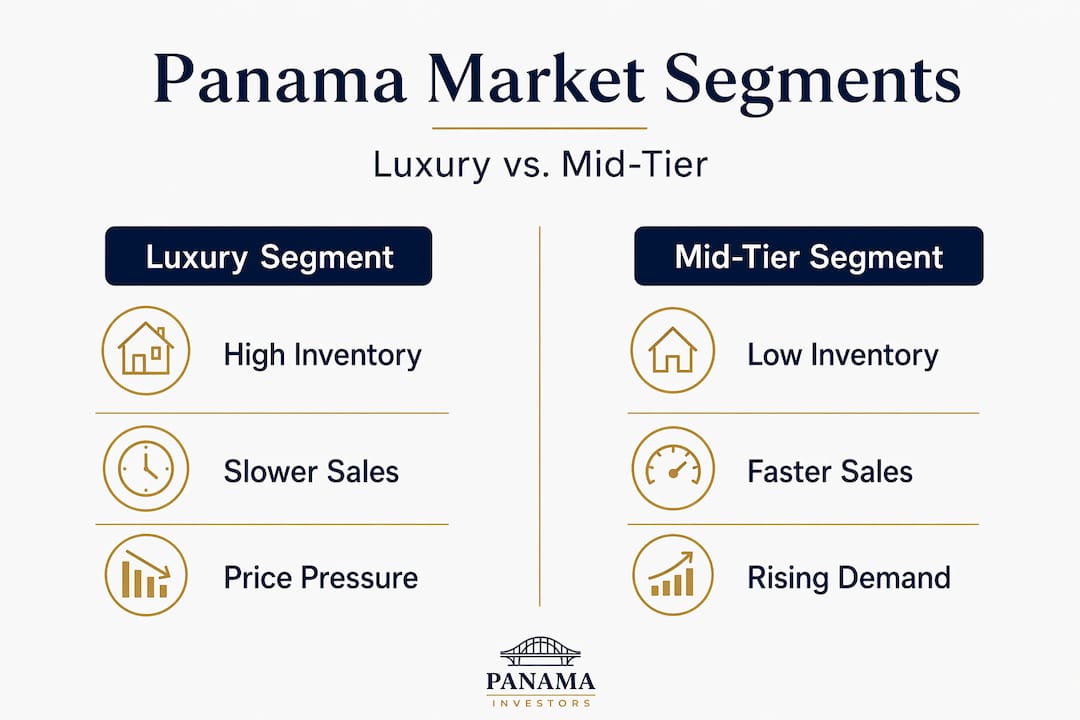
The contrast between these two segments in a side-by-side view:
| Metric | Luxury segment | Mid-tier segment |
|---|---|---|
| Unsold inventory | 6,000 to 8,000 units | Near 9-year lows |
| Days on market | 120 to 180+ days | Typically under 60 days |
| Price trend | Down 2 to 6% in some areas | Up 15% YoY in new builds |
| Rental yield | Compressed, often under 4% | 5 to 6% average |
| Buyer leverage | High (concessions common) | Low (sellers hold firm) |
Beyond Panama City, coastal and secondary markets are showing different dynamics again. Analyzing Panama market trends requires you to look at each submarket independently rather than applying city-wide or national averages.
Signals every investor should track on an ongoing basis:
- Absorption rates by neighborhood and property type, updated quarterly
- Rental vacancy trends in your target area
- Pipeline supply data (permits issued, construction starts) from MIVIOT
- Short-term rental occupancy rates if you are considering platforms like Airbnb for yield
- Currency flows and remittance patterns, which affect demand in workforce housing segments
Applying market analysis to investment timing and strategy
Knowing how to analyze Panama market trends is one thing. Applying that analysis to an actual decision is where most investors stumble.
The moderation in economic growth from above 7 percent to roughly 4 percent is not a crisis. But it does mean that investments relying on aggressive capital appreciation within 18 to 24 months carry more risk than they did in 2023 or 2024. The investors who are performing best right now are those with a 5-year-plus horizon who bought in mid-tier segments during periods of lower visibility.
For market entry timing, the most reliable signals are:
- Absorption rate acceleration: When a previously slow submarket starts clearing inventory faster, that typically precedes price movement by 6 to 12 months.
- Infrastructure commitment: Confirmed government or private infrastructure spending (road improvements, new commercial anchors) near a target area historically pulls residential demand within 24 to 36 months.
- Logistics sector expansion: Panama’s port and trade zone connectivity creates localized demand spikes around logistics corridors. Tracking freight volumes and free zone registrations can signal demand before it appears in residential data.
For portfolio strategy, the data argues for diversification across segments and timelines rather than concentrating in prestige luxury assets. Pairing a mid-tier Panama City condo with a coastal lifestyle property in a market like Pedasí captures both rental yield and appreciation potential from different demand pools.
Pro Tip: When conducting Panama market entry assessments, always request absorption rate data segmented by price band and neighborhood. A healthy market-wide absorption rate can mask severe oversupply in a specific segment where you are about to invest.
Due diligence on individual properties should include supplier and seller audits alongside standard legal title checks. Understanding who built a property, the developer’s track record, and how a building has been maintained is just as important as the location data your analysis surfaces.
For a comparative view of how Panama stacks up against neighboring markets before you commit, reviewing a Panama vs. Costa Rica comparison can sharpen your regional perspective before finalizing your allocation.
My take on what most investors get wrong
I’ve watched international investors approach Panama with enormous confidence and very little preparation. The most common mistake is not a bad property choice. It is an analytical one. Investors look at advertised listing prices, skim a broker’s market report, and conclude they understand the market. They don’t.
In my experience, Panama’s data opacity is genuinely unusual compared to established markets in North America or Western Europe. The gap between a listed price and an actual transaction price can be 10 to 20 percent, and the reasons for that gap are structural, not accidental. The under-reporting habit is deeply ingrained in how local transactions work.
What I’ve found actually works is building a network of independent sources before you make any offer. That means a local attorney who handles frequent conveyances, a property manager who sees rental vacancies in real time, and a broker who operates across multiple neighborhoods rather than pitching a single development. When those three sources tell you roughly the same thing about a submarket, you can act with genuine confidence.
The transparency improvements from the ANATI-ACOBIR collaboration are real progress, but they are still early. The investors who benefit most right now are those who do not wait for perfect data. They build relationships and triangulate aggressively. Panama’s top real estate markets reward that kind of preparation in ways that passive research never will.
The other thing I keep telling investors: do not let the logistics story be background noise. Panama’s ports, its airport, and its free trade zone are not just talking points for a country pitch deck. They are structural demand drivers that will shape residential values in specific corridors for the next decade. If your market analysis is not incorporating those signals, you are working with an incomplete picture.
— Roie
How Panamainvestors helps you act on the data
You now understand the framework. The harder part is executing it on the ground in a market where relationships and local intelligence are the actual differentiators.

Panamainvestors, led by Luca Piva with over 12 years of Panama real estate experience, provides exactly the kind of grounded, multi-source market intelligence this article describes. Luca’s network of local attorneys, developers, and property managers gives clients access to data that does not appear in any public listing or registry report. Whether you are evaluating your first Panama property or expanding an existing portfolio, the Panamainvestors investment advisory platform connects analysis directly to opportunities. When you are ready to move from research to action, schedule a strategy call to discuss your specific investment goals with a team that lives and works in this market every day.
FAQ
What is the role of market analysis in Panama real estate?
Market analysis helps investors identify accurate pricing, absorption trends, and segment-level risks in a market where public data is frequently incomplete or under-reported. Without it, investors risk overpaying or entering oversaturated segments.
Why is Panama real estate data difficult to analyze?
Transaction prices are regularly under-reported in public registries for tax reasons, which means relying on registry data alone produces distorted valuations. Effective analysis requires triangulating listing platforms, ACOBIR indicators, and expert interviews.
How do I analyze Panama market trends by segment?
Track absorption rates, days on market, rental vacancy, and sale-to-asking price ratios separately for luxury and mid-tier properties. Citywide averages obscure critical differences. Luxury in Panama City currently shows oversupply, while mid-tier inventory sits near 9-year lows.
What economic indicators should I monitor for Panama investments?
Watch the IMAE growth index, logistics sector freight volumes, free trade zone registration data, and MIVIOT construction permits. These indicators signal demand shifts before they show up in residential pricing.
How does Panama’s logistics sector affect real estate investment?
Panama’s port connectivity, Tocumen airport, and free trade zones generate concentrated demand for residential and commercial space along specific corridors. Tracking logistics activity gives investors a forward-looking signal that purely residential data misses.
