
Strata Titles in Panama: A Guide for Investors
Strata Titles in Panama: A Guide for Investors
- Panama Investors
- Apr 21
- 8 min read

Many international buyers assume that owning property in Panama works just like back home. It doesn’t. The moment you look at an apartment in Panama City or a mixed-use building in Casco Viejo, you’re entering a ownership system with its own legal logic, governance structure, and financial obligations. Strata titles, known locally as Propiedad Horizontal, give you individual ownership of a unit while tying you into shared responsibilities for common areas. Understanding how this system works, what the 2022 reforms changed, and what 2024 to 2026 updates mean for your investment is not optional. It’s essential.
Table of Contents
Key Takeaways
Point | Details |
Modern legal framework | Panama’s strata titles are governed by Law 284 (2022), offering secure ownership for unit owners and clear rules for shared spaces. |
Defined owner rights | Owners can buy, sell, mortgage, and pass on their units, but must also fulfill specific financial and governance duties. |
Recent reforms matter | Major legal updates from 2024 to 2026 mean investors must plan for accessibility, tech, and sustainability compliance. |
Risks and rewards | Strata titles provide flexibility, but require owners to balance individual freedom with collective building management. |
What is a strata title in Panama?
A strata title in Panama gives you full legal ownership of a specific unit within a larger building or complex, while simultaneously making you a co-owner of all shared spaces: lobbies, pools, parking structures, hallways, and rooftop areas. Think of it as owning a slice of a cake outright, while sharing custody of the plate, the table, and the kitchen with everyone else.
This system applies to a wide range of property types:
Residential apartments and condominiums
Mixed-use buildings combining retail and residential
Commercial office towers
Gated communities with shared infrastructure
Vacation resort properties with rental programs
Strata titles in Panama are governed by the Régimen de Propiedad Horizontal established by Law 284 of February 14, 2022. This legislation replaced an older framework and introduced clearer rules around governance, financial management, and resident rights. It was a significant overhaul, not a minor update.
“The Propiedad Horizontal regime is designed to balance individual property rights with the collective interest of all unit owners within a building or community.”
What makes this relevant to international investors is straightforward. Panama is a dollarized, stable market with strong demand for urban residential and commercial real estate. The strata title structure makes urban condominiums and mixed-use properties accessible to foreign buyers with full legal protection. Your unit is your asset. You can sell it, rent it, mortgage it, or pass it on to heirs without needing anyone else’s approval for that specific unit transaction.
The legal foundation provided by Law 284 gives international buyers something critical: predictability. Knowing exactly what you own, what you share, and who governs the rest removes a major layer of uncertainty that often deters foreign investment in emerging markets.
Key legal structures and how ownership works
Ownership under a strata title in Panama is split between two legally distinct interests. First, you own your individual unit outright. Second, you hold a proportional share of the common areas, which cannot be separated from unit ownership or sold independently. These two interests are always bundled together.

Here’s how the legal mechanics are structured:
Component | What it covers | Who controls it |
Individual unit | Private space within defined boundaries | Unit owner |
Common areas | Shared infrastructure and amenities | Assembly of Owners |
Co-ownership Regulation | Rules governing daily life and use | All owners collectively |
Board of Directors | Day-to-day administration | Elected by Assembly |
The registration process works through Panama’s Public Registry under the Horizontal Property section, where a Co-ownership Regulation and mandatory governance by an Assembly of Owners are formally recorded. Every strata development must have this documentation filed before individual unit titles can be issued.
The Assembly of Owners is the supreme governing body. It sets budgets, approves major expenditures, elects the Board of Directors, and can modify the Co-ownership Regulation by supermajority vote. As a foreign investor, you have full voting rights from day one of ownership.
Obtain the property’s Co-ownership Regulation from the Public Registry
Review the budget, maintenance fee structure, and contingency fund balance
Confirm the Assembly meeting minutes for the past two years
Verify the administrator’s credentials and current contract
Check for any outstanding liens or unpaid fees on the specific unit
Pro Tip: Before closing, always request a paz y salvo (clearance certificate) from the building administrator confirming the unit has no unpaid fees. Buyers can inherit financial obligations tied to a unit if they skip this step.
The step-by-step property buying process in Panama involves several legal touchpoints where strata documentation matters. Having legal counsel for purchasing real estate in Panama is not just advisable. It’s one of the most cost-effective investments you can make.
Rights, responsibilities, and financial obligations for owners
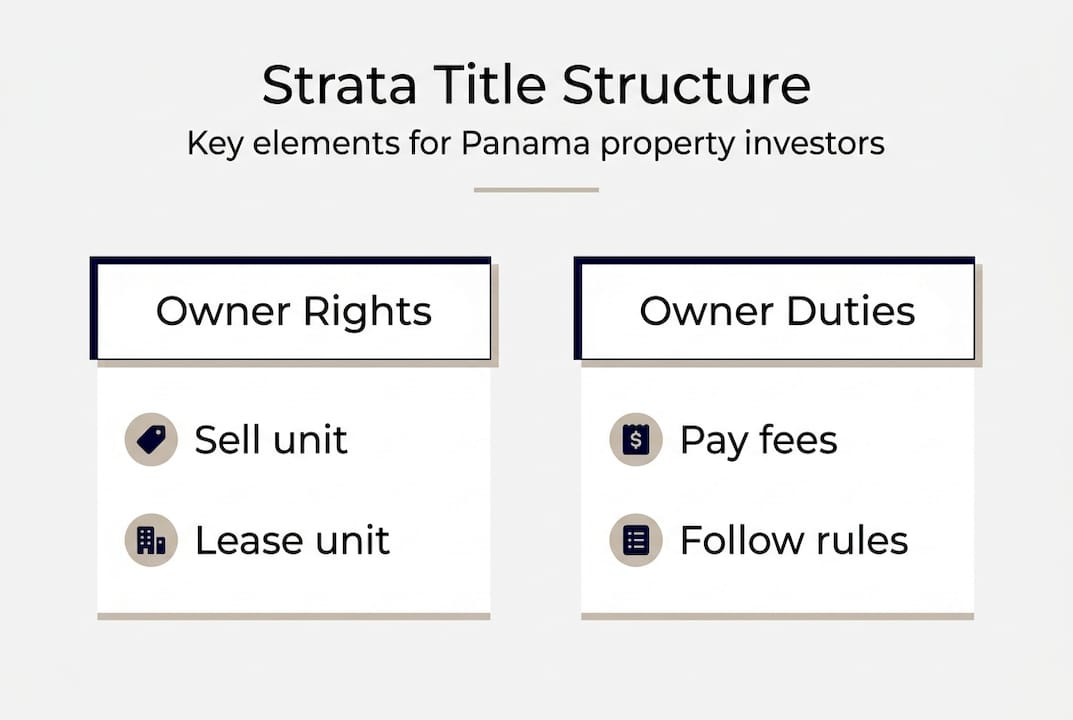
Owning a strata-titled unit in Panama gives you a defined set of rights. Units can be sold, mortgaged, or inherited independently, and Law 284 includes a mandatory contingency fund equal to at least 1% of annual income. This means your asset is highly liquid and legally protected as a standalone financial instrument.
Owner rights include:
Exclusive use and enjoyment of your unit
Proportional access to all common areas
Voting rights in all Assembly meetings
Right to rent your unit (subject to Co-ownership Regulation rules)
Right to sell, mortgage, or transfer the unit without collective approval
Responsibility | Owner | Administrator |
Monthly maintenance fees | Pay on time | Collect and account for |
Contingency fund contribution | Mandatory (min. 1% annual income) | Manage and report |
Common area repairs | Fund collectively | Procure and supervise |
Rule enforcement | Comply | Issue sanctions |
Assembly participation | Attend and vote | Prepare agenda and minutes |
Financial obligations are not optional. Non-compliance carries real consequences. Fines range from B/.500 to B/.5,000 depending on the violation, and persistent non-payers can lose access to common area facilities. The building administrator has legal standing to pursue collection through Panamanian courts.
The contingency fund requirement is one of the smartest provisions in the 2022 reform. It creates a mandatory financial cushion for unexpected repairs, structural issues, or emergency replacements. For investors, a well-funded contingency fund in a building is a quality signal. It means the property is being managed responsibly.
You can learn how to buy a unit and also review the significant tax advantages for owners that make strata-titled properties particularly attractive for long-term holding strategies.
Reforms, recent trends, and practical challenges (2024–2026)
The legal landscape for strata titles in Panama has shifted considerably between 2024 and 2026. These aren’t cosmetic updates. Reforms from 2024 to 2026 mandate accessibility retrofits, smart technology integration, green incentives, and updated rules around mortgage consent for building incorporation and arbitration in conflict resolution.
Here’s what changed and why it matters for investors:
Accessibility retrofits: Buildings must now meet updated accessibility standards. This affects renovation budgets and contingency fund planning for older buildings.
Green technology incentives: Properties incorporating solar panels, rainwater systems, or energy-efficient infrastructure qualify for tax incentives. This adds tangible financial upside to sustainable buildings.
Smart tech integration: Newer developments and upgraded buildings can qualify for regulatory benefits when implementing smart security, energy management, and utility monitoring systems.
Arbitration updates: Dispute resolution between owners and administrators now includes clearer pathways to arbitration, reducing reliance on slow court processes.
Mortgage consent rules: When incorporating an existing building into the strata regime, lenders holding mortgages must now formally consent, adding a procedural step that can delay timelines.
“The push toward green and smart building standards is reshaping property valuations in Panama City. Buildings that meet these standards are commanding measurable premiums in resale and rental markets.”
Practical challenges still exist. Arbitration costs remain high for smaller disputes. Regulatory adaptation varies by municipality. Some older buildings in prime locations face significant retrofit costs that may not be fully reflected in current listing prices.
Pro Tip: When evaluating a strata property built before 2015, always request a building compliance assessment. Retrofit obligations not yet completed can become your financial liability the moment you close.
Understanding the tax impacts of new reforms is essential. And if you want to put Panama’s strata market in context, comparing Panama to other markets in Latin America shows why it continues to outperform on investor protections and market liquidity. For the most current developments, the latest real estate updates cover regulatory and market changes as they happen.
What most investors overlook about strata titles in Panama
Most investors read the rights section and stop there. They focus on what they can do with their unit and underestimate the weight of shared governance. Strata ownership is not solo ownership with neighbors. It’s a legal partnership. The quality of your investment is directly tied to how well the building is governed, and you have both the right and the responsibility to participate in that governance.
We’ve seen investors purchase beautifully finished units in buildings where the contingency fund was near zero and the administrator had no formal contract. Within two years, a structural repair became a personal emergency assessment that nobody had planned for. That’s not bad luck. That’s the cost of ignoring governance due diligence.
The 2024 to 2026 reforms also add a layer many buyers haven’t priced in. Accessibility retrofits and green tech mandates aren’t just compliance costs. They’re reshaping what buildings are worth. Panama’s top investment strengths remain intact, but savvy investors are now factoring reform compliance status into their valuations before making offers.
Take the next step with Panama Investors
Navigating Panama’s strata title framework is manageable when you have the right guidance. Whether you’re analyzing a first acquisition or expanding an existing portfolio, the difference between a smooth transaction and a costly mistake often comes down to local expertise and preparation.

At Panama Investors, Luca Piva and the team have over 12 years of hands-on experience helping international buyers navigate exactly these complexities, from reviewing Co-ownership Regulations to identifying buildings with strong governance and compliance records. If you’re ready to move forward with confidence, speak to a Panama property expert today. Or explore our real estate investment solutions to see how we can support your strategy from start to close.
Frequently asked questions
Can a foreigner own a strata-titled apartment in Panama?
Yes, foreigners have the same ownership rights as Panamanian citizens when buying strata-titled units. Under Law 284, strata titles give equal ownership rights to both foreigners and Panamanians.
What are typical monthly fees for strata-titled properties?
Fees vary by building but typically range from $1.50 to $3.00 per square meter per month, covering maintenance, reserve fund contributions, and building management costs depending on amenities and services offered.
What happens if I don’t pay my maintenance fees?
Under Panama’s strata regime, non-payment sanctions include fines from B/.500 to B/.5,000 and potential restrictions on common area access, enforced by the Assembly or building Administrator.
Do banks provide mortgages for strata-titled units in Panama?
Yes, both Panamanian and select international banks offer mortgages for strata-titled units. Units can be mortgaged independently under Panama’s strata title regime once properly registered in the Public Registry.
What are the latest reforms affecting strata titles in Panama?
Between 2024 and 2026, updated regulations mandate accessibility retrofits and green incentives while also modernizing dispute resolution mechanisms for strata-titled properties across Panama.
Recommended
