
Why diversify with Panama assets: wealth protection
Why diversify with Panama assets: wealth protection
- Panama Investors
- Apr 24
- 8 min read

Panama attracted 300 millionaires in 2025, bringing $2.4 billion in fresh capital to a market that most international investors have barely considered. While traditional wealth destinations are seeing increased regulation, currency risk, and political turbulence, Panama quietly offers something rare: a dollarized economy, political stability, top-tier infrastructure, and an open door for foreign capital. If you’ve been exploring ways to protect and grow your wealth across borders, the logic behind putting serious assets here is stronger than it looks on the surface. This guide breaks down exactly why Panama is earning its place in sophisticated portfolios.
Table of Contents
Key Takeaways
Point | Details |
Panama’s unique market edge | Panama’s stability, strategic location, and world-class infrastructure set it apart in Latin America. |
Diversification reduces risk | Adding Panama assets helps protect your wealth from country-specific and global volatility. |
Multiple asset options | Investors can diversify with real estate, banking, and other structures suited for HNWIs. |
Expert guidance recommended | Navigating Panama’s market is best done with experienced local advisors to maximize results. |
Panama’s strategic advantage: Stability, growth, and global access
With Panama’s appeal catching global headlines, let’s break down what makes its assets uniquely strategic.
Panama sits at the crossroads of the Americas. The Panama Canal handles roughly 5% of global maritime trade, making it one of the most strategically important pieces of infrastructure on the planet. That’s not just geography trivia. It means Panama’s economy is deeply tied to global commerce, giving it a resilience that purely domestic Latin American economies simply don’t have. When global trade moves, Panama benefits.
Compared to its neighbors, Panama stands apart in terms of political and economic stability. Countries like Venezuela, Nicaragua, and even Argentina have seen currency collapses, capital controls, and political upheaval. Panama, by contrast, uses the U.S. dollar as its currency, eliminating exchange rate risk entirely for American investors. That one factor alone changes the risk profile dramatically.
Panama’s GDP growth is projected between 3.5% and 4.5% for 2025, which outpaces most developed economies. Pair that with infrastructure ranked number one in Latin America and you have a foundation that supports real, lasting asset appreciation.
Indicator | Panama | Regional LATAM Average |
GDP growth (2025 projection) | 3.5% to 4.5% | 2.1% |
Currency | USD (Dollarized) | Local currencies |
Infrastructure ranking (LATAM) | Varies | |
HNWI capital inflow (2025) | $2.4 billion | Fragmented |
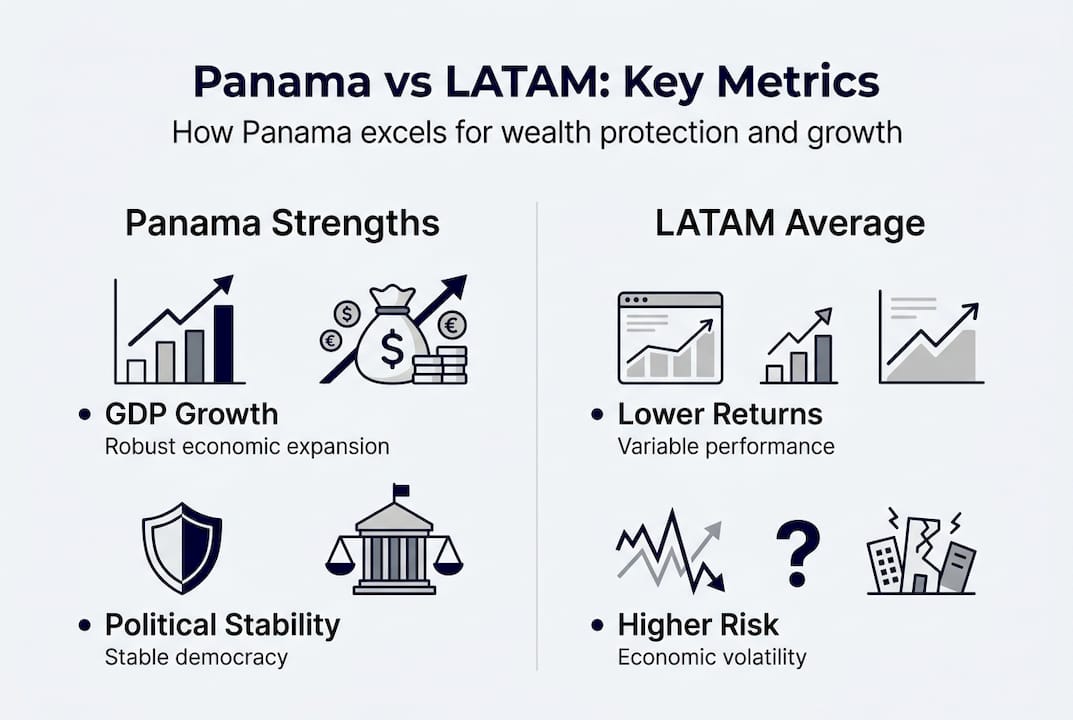
For investors evaluating Panama’s investment destination status, the data paints a consistent picture: stable growth, superior infrastructure, and growing international confidence.
Core benefits for investors at a glance:
Dollarized economy: No currency conversion risk for USD-based investors
International banking hub: One of the most developed banking sectors in Latin America
World-class infrastructure: Ports, airports, roads, and telecom ranked highest regionally
Business-friendly legal framework: Foreign and domestic investors receive equal property rights
Growing luxury real estate: Access to top real estate markets with increasing premium demand
Panama attracted 300 millionaires in 2025 alone, a clear signal that global wealth is recognizing what savvy investors have known for years.
Diversification benefits: Wealth protection and reduced risk
Understanding Panama’s unique market position leads naturally to the benefits. Here’s why putting capital here matters for your wealth.
When your assets are concentrated in one country, one currency, or one market, you’re exposed to systemic risk. A single legislative change, a banking crisis, or a currency devaluation can erode years of accumulated wealth. True diversification means spreading that exposure across jurisdictions. Panama delivers that in a way few markets do at this price point.

Panama’s stability and capital influx make it a safer haven for wealth compared to other emerging markets. The combination of USD denomination, rule of law for property rights, and strong international banking gives you layered protection that most offshore strategies lack.
Portfolio scenario | Risk exposure | Wealth resilience |
100% home country assets | High (systemic risk) | Low |
Mixed with Panama real estate | Moderate | High |
Panama + financial instruments | Low to moderate | Very High |
There’s also a compelling tax optimization angle. Panama uses a territorial tax system, meaning income generated outside Panama is not taxed locally. For investors who structure ownership through Panamanian corporations or foundations, this opens legitimate and legal pathways to reduce global tax burden significantly. You can learn more about the specific tax benefits in Panama for foreign investors.
How to start diversifying with Panama assets:
Clarify your primary goal: wealth protection, passive income, or residency
Research Panama relative to alternatives like Panama vs Costa Rica vs Colombia
Identify the asset class that fits your timeline and tax situation
Engage a licensed local advisor with proven market access
Conduct legal due diligence before committing capital
Finalize ownership structure with a qualified Panamanian attorney
Pro Tip: Many investors skip the corporate structure step and buy property in their personal name. This limits your estate planning flexibility and can complicate future transfers. Set up the right structure before you close.
Asset types: Real estate, bank accounts, and beyond
Once you’re clear on the benefits, the next step is knowing where and how to diversify in Panama.
Panama offers several asset classes that work well together. Real estate is the most popular starting point, and for good reason. Residential properties in Panama City, Bocas del Toro, and the Azuero Peninsula are attracting serious capital. Commercial real estate and hospitality assets are also expanding, fueled by Panama’s growing tourism sector and business travel.
Panama’s infrastructure is considered the top in LATAM, which directly supports the value and liquidity of real estate assets here. Strong infrastructure isn’t just a nice-to-have. It protects your investment over time by supporting demand.
Primary asset classes for HNWI diversification:
Residential real estate: Condos, luxury apartments, and gated communities offer rental yield and appreciation
Commercial real estate: Office space and retail in Panama City benefit from regional business activity
Hospitality and tourism properties: High occupancy rates near tourist corridors generate short-term rental income
Panamanian bank accounts: Some of the most private and internationally recognized accounts in the region
Corporate structures (SA or foundation): Flexible vehicles for holding assets, reducing liability, and planning estates
For investors combining real estate with financial instruments, the strategy typically works like this: hold the property inside a Panamanian corporation, open a local bank account for rental income, and use the corporation to manage distributions. It keeps things clean and tax-efficient.
Another often overlooked advantage is residency. Panama’s Qualified Investor Visa requires a minimum $300,000 real estate investment and grants you permanent residency. For investors who want optionality on where they live or hold passports, this is substantial.
Pro Tip: When evaluating developments, look for projects near established infrastructure and international schools. These two factors consistently correlate with higher resale values and stronger rental demand. The real estate buying guide covers the due diligence checklist in detail. You can also explore specific neighborhoods for investment in Panama City to understand where premium demand is concentrated. Investors chasing passive income opportunities will find strong numbers in tourist-heavy zones.
Practical strategies for international investors
Knowing your options, the focus shifts to putting diversification into action.
Getting started in Panama is more straightforward than many investors expect, but only when you approach it with a clear process. Flying in blind, relying on developer marketing materials, or skipping local legal advice are mistakes that cost investors real money.
Panama’s financial sector is robust and built to support international capital, but you still need the right local partners to navigate it efficiently.
Step-by-step approach to Panama diversification:
Define your investment objectives: yield, appreciation, residency, or estate planning
Set your budget and timeline, factoring in currency of origin and transfer costs
Select your preferred asset class based on goals and risk tolerance
Hire a licensed local real estate agent with verifiable transaction history
Engage a Panamanian attorney for title search, ownership structure advice, and contract review
Open a local bank account early in the process, as approval can take four to eight weeks
Close the transaction with proper documentation and register the title with the Public Registry
Common mistakes to avoid:
Relying solely on developer brochures without independent verification
Skipping the title search or assuming the seller’s attorney represents your interests
Underestimating closing costs (typically 2% to 4% of purchase price)
Failing to plan the ownership structure before purchase
Ignoring property management logistics for rental income properties
Pro Tip: Before buying property in Panama, request a registered title report directly from the Public Registry, not just a copy provided by the seller. This single step prevents the majority of title-related disputes. You’ll also find the Panama investment tips section on our blog useful for staying current on market shifts.
What most experts miss about Panama asset diversification
Most conversations about Panama focus on yield percentages, appreciation curves, and visa thresholds. Those numbers matter. But they’re not the full picture, and experienced investors know it.
The deeper value of Panama is what it does for your family over decades. This is a jurisdiction where your children can inherit property with minimal friction, where the legal system respects foreign ownership, and where you can physically live well if circumstances in your home country change. That optionality has real value that doesn’t show up in a spreadsheet.
Many overlook the long-term lifestyle and legacy advantages unique to Panama’s real estate market. Generational wealth planning is not just about returns. It’s about where in the world you can preserve and transfer assets without bureaucratic obstruction.
Most investment advice focuses on timing the market. Our view is different: the right question isn’t whether Panama will appreciate next quarter. It’s whether Panama gives your family jurisdictional security for the next 30 years. When you look at it that way, and review the actual returns data, the case becomes even more compelling. You’re not just buying an asset. You’re buying a foundation.
Start building a future-proof Panama portfolio
If strategic, expert-led diversification sounds compelling, you don’t have to navigate Panama alone.

At Panama Investors, we work directly with high-net-worth individuals and international investors who are serious about diversifying into Panama’s real estate and financial markets. Luca Piva brings over 12 years of on-the-ground experience, exclusive listing access, and a network of legal, banking, and property management professionals built to serve investors at your level. Whether you’re making your first Panama move or optimizing an existing portfolio, we’ll build a strategy around your goals. Speak with a Panama expert today and get a personalized consultation with no obligation.
Frequently asked questions
What types of Panama assets are best for diversification?
Prime real estate, international bank accounts, and corporate structures are the most popular and effective assets for diversification in Panama. Each one addresses a different layer of wealth protection, from infrastructure-backed capital appreciation to private financial access.
Is Panama safer than other LATAM countries for wealth protection?
Yes, Panama’s stability and top infrastructure make it one of the safest Latin American countries for international investors. Its top LATAM infrastructure ranking and dollarized economy reduce systemic risk significantly compared to regional alternatives.
Can foreigners easily buy real estate in Panama?
Foreigners face few restrictions and can purchase property in Panama with relative ease, provided they follow due diligence. Panama’s open real estate market grants foreign buyers the same legal rights as local citizens for most property types.
What are the tax advantages of Panama asset ownership?
Panama offers tax benefits for investors including its territorial tax system, exemptions on foreign-sourced income, and favorable property tax structures for qualified developments. These advantages can legally reduce your global tax exposure when structured correctly.
Recommended
