Why buy condos in Panama City: value and growth
Why buy condos in Panama City: value and growth
- Panama Investors
- Apr 17
- 8 min read
Most people assume that buying real estate in a globally connected, modern city requires deep pockets. Panama City quietly breaks that rule. While investors overpay for mediocre units in Miami or Lisbon, middle-class buyers are quietly picking up well-located condos in Panama City at prices that would seem impossible in comparable markets. This guide walks you through the real numbers, the tax advantages, the residency pathways, and the lifestyle factors that make Panama City one of the most overlooked condo investment destinations in the world right now.
Table of Contents
Key Takeaways
Point | Details |
Prime investment location | Panama City offers global connectivity and a stable investment climate favored by international buyers. |
Accessible condo prices | Middle-class investors can afford modern condos, making entry to the market realistic and lucrative. |
Multiple investment strategies | Both rental income and capital appreciation are strong options for maximizing returns. |
Tax and residency advantages | Buyers gain access to favorable tax rates and straightforward legal residency programs. |
Lifestyle and legacy value | Owning a condo provides lifestyle perks and a lasting asset for the future. |
What makes Panama City unique for condo buyers?
Panama City is not just another Latin American city with affordable real estate. It is a genuine international hub with the infrastructure, economy, and connectivity to back that claim up. Understanding what sets it apart is the starting point for any serious investor.
The city sits at the crossroads of North and South America, and that geography has shaped everything about its economy. Tocumen International Airport offers direct flights to over 90 destinations worldwide, more than any other hub in the region. The Panama Canal handles roughly 3 percent of global trade, generating billions in annual revenue and supporting a diverse, stable economy that does not depend on a single commodity.
Here is what makes Panama City structurally different from other regional cities:
Dollarized economy: Panama uses the U.S. dollar, eliminating currency risk entirely for American buyers and reducing it significantly for everyone else
AAA-rated banking sector: Panama City is the regional headquarters for hundreds of multinational companies and international banks
Low inflation history: The country has maintained one of the lowest average inflation rates in Latin America over the past two decades
Robust expat community: Tens of thousands of expats from the U.S., Europe, and beyond already call Panama City home, creating built-in rental demand
Political stability: Panama has maintained democratic governance and peaceful transitions of power for decades
“Panama City’s robust economy and active international community attract foreign investment,” reinforcing its position as the region’s most reliable real estate market. Source: Panama Investors
When you compare Panama City against other regional cities, the gap becomes clear. Bogotá and Lima offer lower prices but come with more political volatility and weaker institutional frameworks. San José in Costa Rica has lifestyle appeal but a far smaller economy. Mexico City’s size creates noise and complexity for foreign buyers. Understanding why Panama stands out from these markets is essential before committing capital.
A detailed breakdown of Panama vs. other Latin American cities shows Panama City leading on ease of ownership, dollar-denominated transactions, and legal protections for foreign buyers. These are not minor advantages. They are the foundation of a resilient investment.
Affordability and value: Are Panama City condos within reach?
The short answer is yes, often dramatically so. Panama City condos remain competitively priced compared to major Latin American and North American metros, even as the city’s profile has risen internationally.
To make this concrete, here is a rough price comparison across comparable markets in 2026:
City | Avg. price per sq ft (USD) | Annual property tax | Currency risk |
Miami, FL | $600 to $900 | ~2% | None |
Bogotá, Colombia | $180 to $280 | ~0.5% | High (COP) |
San José, Costa Rica | $200 to $320 | ~0.25% | Moderate (CRC) |
Panama City, Panama | $150 to $350 | 0 to 1% | None (USD) |
The numbers tell a clear story. For the price of a modest studio in Miami, you can own a full two-bedroom condo in one of Panama City’s desirable neighborhoods like Punta Pacifica or Costa del Este.
The key affordability drivers stack up like this:
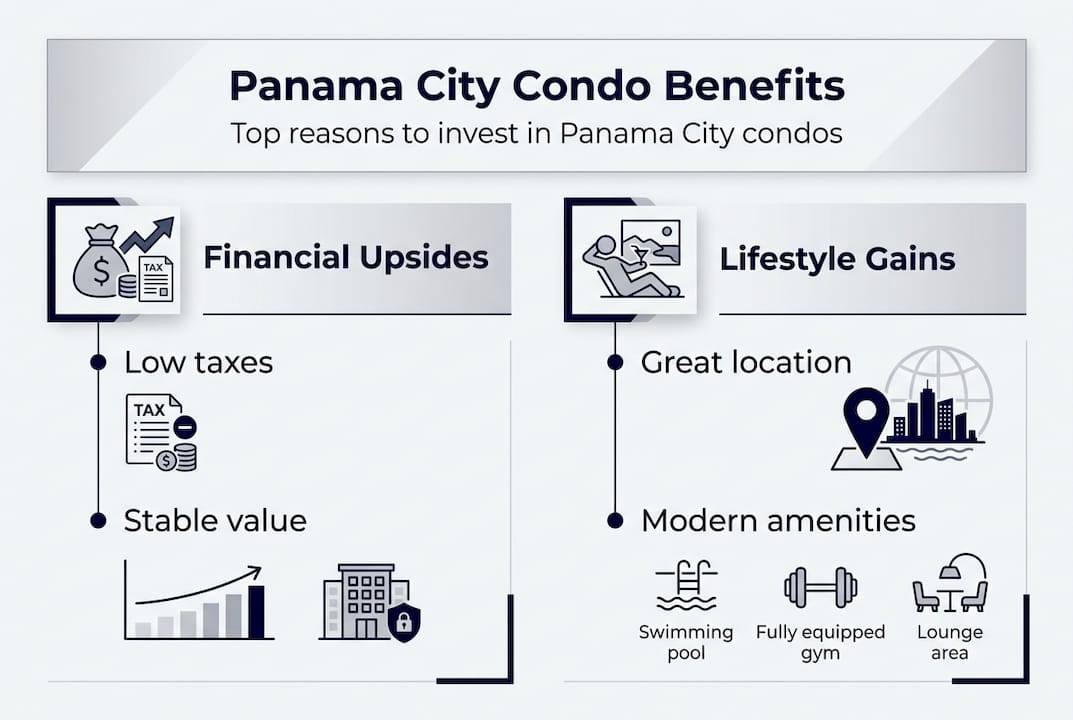
No real estate transfer tax for buyers: Panama charges the transfer tax to sellers, not buyers, which immediately reduces your closing costs
Low or zero annual property taxes: Newly constructed properties often qualify for 20-year property tax exemptions under Panama’s construction incentive laws
Reasonable HOA fees: Monthly fees for most mid-tier condos run between $200 and $500, well below comparable U.S. buildings
Accessible foreign financing: Several Panamanian banks offer mortgages to qualified foreign buyers at competitive rates, typically between 6 and 8 percent annually
Pro Tip: If you plan to finance your purchase, bring a solid credit history from your home country and three years of tax returns. Panamanian lenders respond well to documented income, even foreign income, and some will lend up to 70 percent of the property value to non-residents.
The foreign investor real estate guide covers the full financing process in detail, including which banks are most receptive to international applicants in 2026.
Is rental income or appreciation a better play?
This is the question every condo investor eventually asks. The honest answer is that both strategies work in Panama City, but they favor different buyer profiles.
Panama City sees strong, consistent rental demand thanks to a steady stream of business travelers, staff from international organizations like the United Nations and the Panama Canal Authority, and a growing wave of digital nomads. That demand keeps vacancy rates low and gives landlords pricing power.
Here is a side-by-side breakdown of both strategies:
Strategy | Expected annual yield | Risk level | Best suited for |
Long-term rental | 5% to 7% | Low to medium | Passive income seekers |
Short-term rental (Airbnb style) | 8% to 12% | Medium | Hands-on investors |
Appreciation play | 4% to 6% annual growth | Low | Long-term wealth builders |
Hybrid (rent now, sell later) | Combined upside | Medium | Flexible investors |
The factors that drive rental demand in Panama City are worth knowing in detail:
Multinational employers: Dozens of global companies maintain regional offices here, housing staff in mid-to-high-end condos
Medical tourism: Panama City is a growing destination for medical procedures, bringing patients who stay for weeks
Seasonal expat renters: Retirees from North America frequently rent for three to six months before deciding whether to buy
Embassy and NGO staff: International organizations bring a stable, high-paying tenant pool that prefers furnished condos
Appreciation drivers are equally solid. New infrastructure investment, continued migration from other countries, and limited land supply in key districts like Casco Viejo and Marbella all push values upward over time. You can track current market trends for Panama condos to see how specific neighborhoods are performing right now.
Pro Tip: If you want to maximize short-term rental yields, focus on condos in buildings that explicitly allow Airbnb-style rentals. Some buildings restrict this, so verify the HOA rules before you commit.
Tax benefits, residency, and legal pathways for buyers
This is where Panama City genuinely separates itself from the competition. The combination of low taxes, clear legal protections, and accessible residency programs is rare anywhere in the world.
Foreign investors in Panama City may qualify for significant tax incentives and residency through real estate investment. The process is more straightforward than most investors expect.
Here is how the residency pathway works step by step:
Purchase a property: The minimum investment threshold for the Friendly Nations Visa is currently $200,000 USD in real estate
Obtain a purchase contract and title: Your lawyer registers the deed with the Public Registry, creating a clear ownership record
Apply for provisional residency: Submit your investment documentation, background check, and health certificate to the National Immigration Service
Receive permanent residency: After meeting requirements, permanent residency is granted, giving you the right to live, work, and access public services in Panama
Optional path to citizenship: After five years of permanent residency, you may apply for Panamanian citizenship
“Panama’s tax structure is particularly favorable for new real estate investments,” offering exemptions and incentives that directly increase your net returns from day one. Source: Panama Investors
The Panama real estate tax benefits are structured around several key advantages. New construction properties are exempt from property taxes for up to 20 years. Capital gains tax on property sales is a flat 10 percent of the registered gain, which is low by any international standard. Panama also operates a territorial tax system, meaning income earned outside Panama is never taxed, regardless of your residency status.
For a detailed walkthrough of the visa application process and qualifying investment structures, the Panama residency guide covers every current requirement for 2026.
The overlooked lifestyle and legacy upsides
Numbers matter, but they do not tell the whole story. After years of watching investors buy condos in Panama City, what surprises most of them is not the return on investment. It is how quickly the city becomes a genuine home.
Panama City offers year-round warm weather, a cosmopolitan food scene that reflects its role as a global crossroads, and a quality of life that most buyers did not expect at this price point. World-class private hospitals like Hospital Punta Pacifica, affiliated with Johns Hopkins, provide healthcare standards that rival major Western cities. International schools with IB programs serve the children of expats and Panamanian families alike.
There is also a legacy angle that rarely gets discussed. Panama has no inheritance tax. Condos purchased here can be passed to children or other heirs without the transfer taxes and legal complexity common in North America or Europe. For investors thinking about multigenerational wealth, that is a meaningful advantage that compounds over decades.
Experienced expats will tell you something that does not appear in any investment report: the quality of life in Panama City changes your relationship with the investment. When a property is also a place where you genuinely want to spend time, your decision-making around it improves. You stay informed. You maintain it better. You pick the right neighborhood because you understand it firsthand.
Pro Tip: Prioritize location based on both rental demand and personal enjoyment. A condo you would actually want to live in is almost always the one that attracts the best long-term tenants too.
Ready to invest? How we help you buy the right Panama City condo
Finding the right condo in Panama City is not just about browsing listings. It is about knowing which buildings allow short-term rentals, which developers have a track record of delivering on time, and which neighborhoods are appreciating fastest right now.
The Panama Investors advisory team specializes in exactly this. Luca Piva brings over 12 years of on-the-ground experience in Panama’s real estate market, with direct access to vetted listings and motivated sellers that most buyers never see publicly. We work with international buyers from inquiry through closing, handling due diligence, negotiations, legal referrals, and everything in between. Explore the full picture of Panama market advantages or request a consultation to start a personalized conversation about your investment goals.
Frequently asked questions
Can foreigners buy condos in Panama City with full ownership rights?
Yes, foreigners have equal property rights when buying real estate in Panama, including full titled ownership with no restrictions on nationality.
What are the main taxes on owning a Panama City condo?
Panama’s property and capital gains taxes are especially favorable for international owners, with new builds often exempt from property tax for up to 20 years and a flat 10 percent capital gains rate on resale profits.
How do I qualify for residency by real estate investment in Panama?
Condo buyers may qualify for residency through investment under Panama’s Friendly Nations Visa program by purchasing property at or above the $200,000 USD minimum threshold.
Are rental yields strong for condos in Panama City?
Panama City condos generate strong rental yields due to continuous tenant demand from expats, business travelers, and international organizations, with short-term rentals producing the highest returns in well-located buildings.
Recommended
