
Tocumen’s 11.5 Million-Passenger Surge: Why 76% Transit Traffic Changes the Rental-Demand Math
Tocumen International Airport moved 11,531,295 passengers in the first half of 2026, 15% more than a year earlier. That is an impressive signal for Panama’s connectivity story. It is not, however, a forecast of 11.5 million hotel nights or apartment bookings.
The crucial detail sits deeper in Tocumen’s July report: in June, 76% of passengers were in transit. They changed planes in Panama but did not necessarily enter the country, sleep in the city, or create rental demand. For property investors, that distinction is the difference between using a strong macro indicator intelligently and building an income projection on the wrong denominator.
Here is how to read Panama’s aviation and tourism numbers in 2026—and translate them into a more defensible rental strategy.
The headline is real, but “passenger movements” need context
Tocumen recorded 11.53 million passenger movements between January and June, up 15% year over year. Since January, the airport has also counted infants under two in its official statistical model; including them lifts the first-half total to 11,606,653. The cleanest like-for-like headline in Tocumen’s release remains the 11.53 million figure and its reported 15% growth.
June illustrates the hub effect. Of 1,933,318 passenger movements, 1,467,903 were connecting passengers. Another 236,163 passengers arrived in Panama through Tocumen, while 229,252 began their journey there. The airport served 94 international destinations and one domestic destination during the month.
This is excellent news for the country’s position as the “Hub of the Americas.” It supports airline frequency, business access, trade, tourism marketing and Panama City’s appeal as a regional headquarters. But a connecting traveler who remains airside is not a tenant.
Source: Tocumen International Airport, July 20, 2026 (https://www.tocumenpanama.aero/index.php/nosotros/45-noticias).
The better demand signal: visitors who actually enter Panama
The Panama Tourism Authority provides a more useful second layer. Its preliminary January–May data show international visitor arrivals increased 17.2% from the same period in 2025. Tourism income reached $3,226.1 million, up 15.3%, and monitored hotel occupancy was estimated at about 60.1% in May.
Earlier first-quarter data put international visitors at 999,934, up 17.3%. The authority also reported 86 confirmed and incentivized events for 2026, collectively projected to attract more than 58,000 visitors. Meetings and conventions matter because they create identifiable dates, districts and traveler profiles rather than a vague national “tourism boom.”
These figures are still not a guarantee for any condo. They are preliminary national indicators, and hotel occupancy is not the same as private-rental occupancy. They are nevertheless closer to the demand an accommodation owner can potentially capture.
Sources: Panama Tourism Authority, January–May 2026 market data (https://www.atp.gob.pa/estadisticas-e-informacion-del-mercado-2/) and first-quarter tourism update (https://www.atp.gob.pa/panama-inicia-2026-con-crecimiento-historico-del-turismo-y-se-acerca-al-millon-de-visitantes-internacionales/).
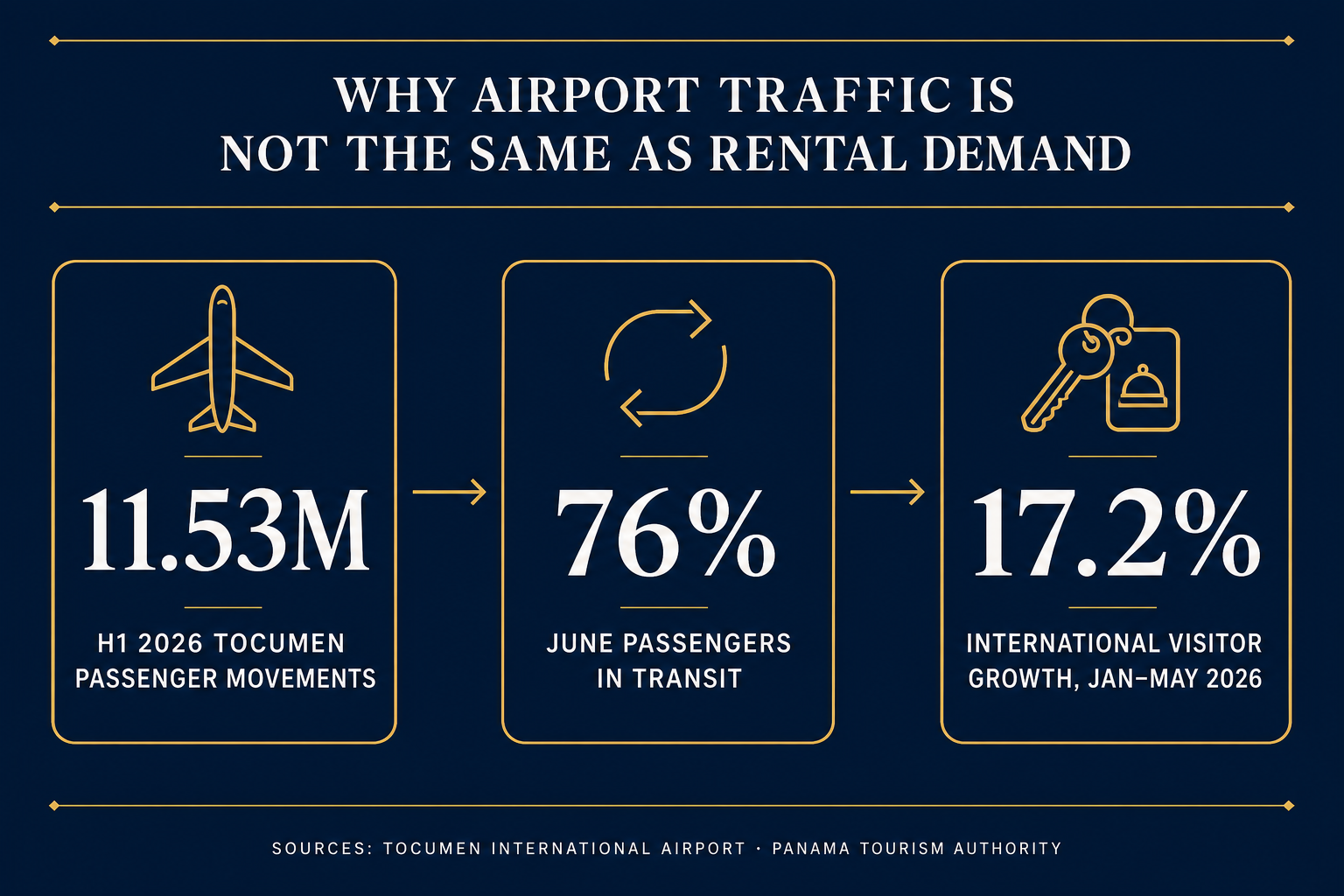
Think of demand as a three-stage funnel
1. Connectivity
More routes and frequencies make Panama easier to reach. That expands the pool of possible visitors, executives, second-home owners and relocating families. Tocumen’s growth is strongest at this level.
2. Entry and purpose of trip
The next question is how many people clear immigration—and why. Leisure visitors, conference delegates, corporate travelers, medical visitors, relocating staff and stopover guests have different budgets and preferred locations.
3. Bookable nights for your exact property
Only a portion of those visitors will choose an apartment rather than a hotel, and only a portion of that group will choose your neighborhood, stay length and price point. Building rules, licensing, furnishings, parking, management quality and review history can narrow the funnel again.
A simple mental test helps: out of every 100 June passenger movements, roughly 76 were transit movements. The other 24 were origin-or-destination movements—not automatically 24 unique overnight visitors. Passenger movements can include departures as well as arrivals, and one traveler may generate more than one movement. Use the number as a connectivity measure, not as an occupancy shortcut.
Which Panama City locations are best positioned?
Obarrio, Marbella and Bella Vista: business and event utility
Central districts with offices, restaurants, hotels and practical access can compete for business travelers and event-related stays. The investment case is strongest when a unit also works for medium-term corporate leases, giving the owner a second demand channel outside event dates.
Amador and Casco Viejo: leisure and convention spillover
Amador’s convention infrastructure and Casco Viejo’s cultural pull create a clearer tourism narrative. The tradeoff is operational: heritage-area inventory, hotel-style products and residential condominiums are not interchangeable. Verify the property’s permitted use and actual rental history before paying a tourism premium.
Costa del Este, Santa María and the airport corridor: access without being “airport rentals”
Eastern Panama City benefits from access to Tocumen, multinational employers and logistics activity. That can support executives, project teams, airline-related personnel and relocating families. A conventional one-year lease may be more defensible here than a model built around one-night airport passengers.
The location lesson is not “buy closest to the runway.” It is “match the property to the traveler who has a reason to leave the airport and remain in Panama.”

A practical underwriting checklist for buyers
Ask for achieved results, not advertised rates. Review at least 12 months of booking or lease records when available, including blocked owner-use dates, cancellations and discounts.
Separate gross revenue from net income. Model platform fees, management, cleaning gaps, utilities, furnishing replacement, insurance, maintenance, property tax where applicable and realistic vacancy.
Check the legal operating framework first. Short-stay activity in Panama City can be restricted by national rules, tourism requirements and the building’s PH regulations. Do not assume an online listing proves permission. Have a qualified Panamanian attorney and the administrator confirm the current rules for the exact unit and intended stay length.
Stress-test the stay profile. Run conservative cases for long-term, medium-term and permitted short-stay use. If the purchase only works under the most aggressive nightly-rate case, the margin of safety is thin.
Verify access at the times guests travel. Airport distance on a brochure is less useful than realistic travel time during weekday peaks, convention arrivals and late-night check-ins.
Match the unit to the tenant. Business travelers value reliable internet and workspace; relocating families may prioritize bedrooms, schools and parking; leisure visitors care more about walkability and experience.
Yield versus appreciation: where airport growth really helps
Connectivity can support both sides of the investment case, but not equally.
For yield, the evidence must be local and operational: permitted use, comparable achieved rents, occupancy, stay length and controllable costs. National passenger growth is supporting context, not the core calculation.
For appreciation, a stronger air hub can be more broadly valuable. It reinforces Panama City’s role as a regional business base, makes second-home ownership easier and improves the city’s international liquidity story. Those benefits may help well-located, high-quality property over time even when the owner uses a traditional lease.
The candid conclusion is that Tocumen’s record half-year makes Panama more investable, but it does not make every tourism-branded condo a good investment.
Five indicators worth tracking next
International visitors who enter Panama, not total airport movements
Average length of stay and visitor spending
Hotel occupancy and room supply by district
Confirmed event calendars and venue locations
Achieved rents, vacancy and new competing inventory in the target building
Read together, these indicators show whether connectivity is converting into paid nights—and whether those nights are reaching the product you plan to own.
The investor takeaway
Panama’s 2026 aviation and tourism momentum is genuine. Tocumen’s 15% first-half growth strengthens the country’s global access, while double-digit visitor growth and a fuller event calendar show that more travelers are also entering and spending in Panama.
The opportunity belongs to investors who keep those numbers in the right order: connectivity first, actual visitors second, and building-level performance last. Buy for a verified tenant or guest profile, not for an airport headline.
If you are comparing Panama City neighborhoods or want help testing a rental projection against real operating constraints, book a free consultation with Luca Piva and the Panama Investors team (https://panamainvestors.com/book-now). The goal is a clear fit between your capital, preferred management intensity and the demand your property can realistically capture.
