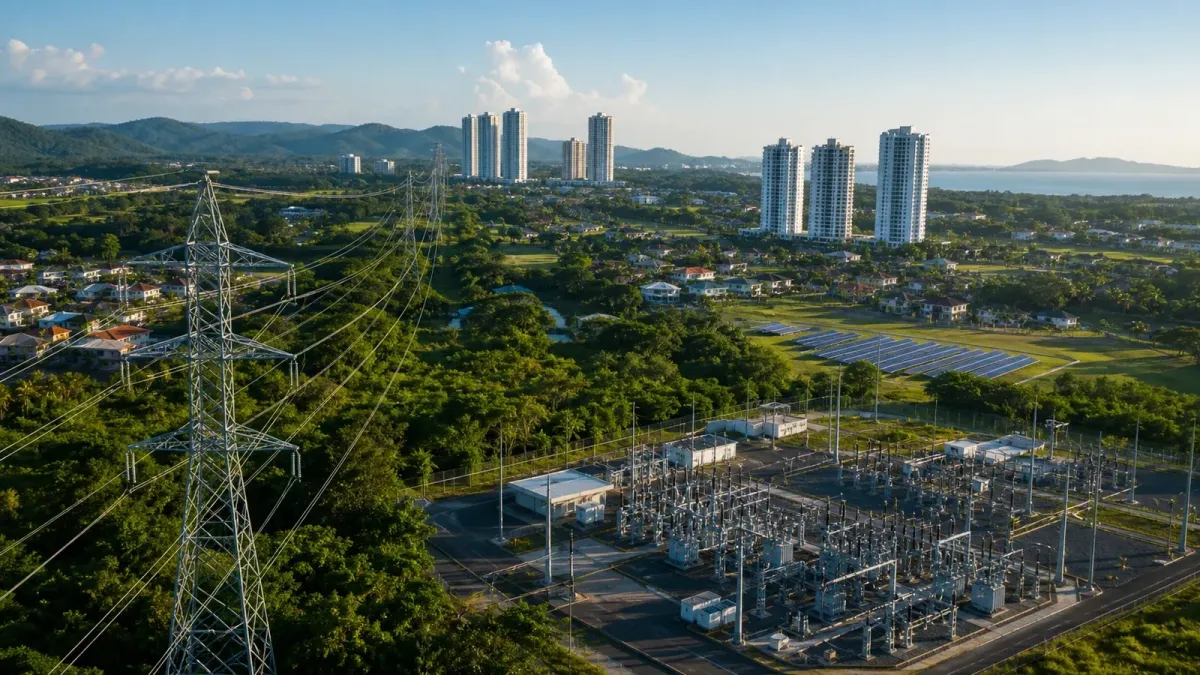
Panama Is Investing $286 Million in Its Power Grid: What Property Buyers Should Check in 2026
Panama has invested $286 million in its electricity-transmission system since 2024 and is preparing the grid to receive roughly 1,000 megawatts of additional renewable generation by 2028, according to a June 2026 report from state transmission company ETESA.
That is a meaningful infrastructure signal for anyone buying property in a fast-growing market. Reliable capacity supports new homes, offices, hotels, logistics facilities, air conditioning, water systems, and increasingly power-intensive digital services.
It is not, however, a guarantee that every condominium, beach house, or new development will deliver reliable electricity.
For property buyers, the useful question is not simply “Is Panama improving the grid?” It is: where does national grid investment end, and where does building-level due diligence begin?
What Panama announced in June 2026
ETESA told Panama’s Cabinet that its $286 million investment programme has strengthened transmission capacity and reliability. The company highlighted two concrete milestones:
The Sabanitas–Panamá III transmission line was reported as 100% complete. It carries power from the Colón side toward the country’s main demand centre.
The GIS substation at Burunga in Panamá Oeste was reported at 91% progress, supporting the repowering of transmission lines in one of the country’s fastest-expanding residential corridors.
ETESA also said the network is being upgraded to accommodate about 1,000 MW of solar and wind generation expected by 2028. Winning energy projects in Coclé, Herrera, and the Penonomé area were associated with an estimated $400 million to $500 million in private investment.
These are transmission and generation investments. They strengthen the system that delivers bulk electricity across the country. They do not tell you whether the generator in a particular building starts when needed, whether a beach development has adequate transformers, or whether a condominium budget can fund electrical maintenance.
ETESA’s June 2026 progress report. National infrastructure is improving, but schedules and project percentages remain subject to execution.
Why the June 30 export suspension also matters
Less than two weeks after the investment update, Panama’s National Dispatch Center temporarily suspended electricity exports to prioritise domestic supply. ETESA said low levels at the Fortuna and Bayano reservoirs followed hydrological conditions associated with El Niño.
The announcement did not say Panama had run out of electricity. It was a precautionary operating decision: keep available power at home while hydroelectric reserves were under pressure.
For investors, the two June announcements belong in the same analysis. Panama is adding transmission capacity and renewable generation, while climate and hydrology can still affect how the system is managed. A diversified grid is valuable precisely because rainfall, heat, and demand do not move in a straight line.
This is also why a property’s own resilience deserves attention. The national system can improve while an individual building remains exposed to a poorly maintained generator, inadequate fuel storage, ageing switchgear, weak water pumping, or an underfunded condominium association.
The four layers of electricity risk in a property purchase
1. Generation: is enough electricity available?
Power can come from hydro, thermal, solar, wind, and other sources. ETESA’s 1,000 MW objective is about integrating more renewable production into the system by 2028. For buyers, greater diversity can improve long-term resilience, but the capacity is planned rather than fully operating today.
2. Transmission: can bulk power reach the demand centre?
This is ETESA’s core role. High-voltage lines and substations move electricity across Panama. Projects such as Sabanitas–Panamá III and Burunga matter because bottlenecks can limit how efficiently growing regions are supplied.
The Burunga upgrade is particularly relevant to Panamá Oeste, where new communities and transport infrastructure are expanding the load. Investors should view it as a positive capacity signal—not a promise of appreciation for every nearby property.
3. Distribution: can electricity reach the building consistently?
Local distribution companies take power from the transmission network to homes and businesses. Reliability can vary by feeder, neighbourhood, vegetation exposure, storm conditions, and the age of local equipment.
A national progress report cannot answer this part of the property question. Neighbours, building managers, utility records, and an independent technical inspection are more useful.
4. The property itself: what happens when supply is interrupted?
This is the layer buyers control most directly. A well-run building may have a tested generator, automatic transfer equipment, fuel-management procedures, surge protection, water reserves, and a realistic maintenance budget. A poorly run building may own impressive equipment that has not been properly serviced.
The difference shows up in tenant comfort, elevator access, refrigeration, internet connectivity, water pressure, security systems, and reviews.
What different buyers should inspect
Condo investors in Panama City
Ask exactly what the backup generator serves. In some buildings it powers elevators, pumps, emergency lights, and common areas but not air conditioning or receptacles inside each apartment. In others, selected in-unit circuits may be covered.
Request service records, the last load-test date, fuel-storage arrangements, and recent condominium minutes. Confirm whether major generator or electrical work is already being discussed and whether reserves are sufficient.
For a rental property, disclose backup-power limits accurately. “Building has a generator” can mean very different things to a tenant working remotely.
Buyers in Panamá Oeste
The Burunga substation update is encouraging for regional capacity. Buyers should still investigate the last kilometre: the development’s distribution connection, transformer capacity, road access for repair crews, water pumping, and generator coverage.
Fast growth can create both opportunity and load. A project surrounded by new construction needs evidence that utility infrastructure and building systems were sized for actual occupancy—not only the first phase shown in a sales presentation.
Beach and interior-property buyers
In secondary and coastal markets, brief interruptions can have outsized effects if the property relies on electric pumps, gates, well systems, septic equipment, refrigeration, or remote internet hardware.
Solar and battery systems may add resilience, but buyers should confirm ownership, permits, warranties, installer support, battery condition, and whether the system is designed for backup or merely bill reduction. An engineer or qualified electrician should inspect the installation.
Pre-construction buyers
Do not accept “full backup” without a written load schedule. Ask what the generator will power, how long fuel can support that load, who maintains the system, and whether the developer has secured required utility approvals.
Also ask about transformer responsibility, surge protection, water-pump redundancy, electric-vehicle charging capacity, and the condominium budget assumed at handover. These questions are easier to resolve before signing than after delivery.
A generator is only as useful as its coverage, fuel, transfer equipment, testing, and maintenance. Buyers should request records and obtain independent technical advice. Illustrative editorial image.
The rental-return calculation: resilience has a price
Backup systems are not free. Generators consume fuel, require preventive service, and eventually need major repairs or replacement. Batteries degrade. Pumps and transfer switches fail. Condominium fees must reflect those costs.
The mistake is to treat resilience as either pure upside or pure expense.
For a long-term rental, dependable elevators, water, access control, and internet can reduce tenant frustration and turnover. For a short-term rental, a well-managed interruption can protect reviews. But an unusually high condominium fee can erase that operating advantage if the unit’s rent does not support it.
Compare properties on net operating income after realistic infrastructure costs, not on the presence of a generator icon in a brochure.
A practical electricity due-diligence checklist
Before closing, request or verify:
Recent utility bills and any available outage or incident log.
The circuits and equipment covered by backup power.
Generator age, capacity, fuel type, fuel storage, service contract, and load-test history.
Automatic transfer-switch and electrical-panel maintenance records.
Whether elevators, domestic-water pumps, fire systems, gates, security, and internet equipment remain operational.
Condominium reserves, pending assessments, and minutes discussing electrical work.
Transformer capacity and utility approvals for new or phased developments.
Solar-panel and battery ownership, warranties, permits, installer support, and remaining useful life.
An independent inspection by a qualified Panamanian engineer or electrician.
For income property, add a stress test: calculate the return with higher condominium fees, one special assessment, and a realistic vacancy allowance. If the deal fails under modest maintenance pressure, the purchase price is too high or the yield thesis is too weak.
What the $286 million programme means for investors
Panama’s transmission investment is positive. Completed and nearly completed projects show that grid capacity is being expanded, and the plan to integrate more renewable generation responds to future demand rather than only today’s load.
The June export suspension adds a useful dose of realism. Electricity systems remain exposed to weather, water, equipment, fuel, and execution risk. National investment reduces some risks; it does not remove them.
The best property decision therefore combines two views:
Macro: Is the country investing in the capacity needed for growth?
Micro: Can this specific property keep its essential systems working, and is the cost reflected honestly in the return?
Panama’s macro answer is moving in the right direction. The micro answer still has to be proven building by building.
If you are comparing a condominium, pre-construction project, or rental property in Panama, book a free consultation with Luca Piva and the Panama Investors team. We can help you evaluate the location, operating costs, building systems, and investment tradeoffs before you commit.
This article provides general market information, not engineering, legal, tax, or investment advice. Energy projects, progress percentages, operating measures, and schedules may change. Use qualified local professionals to inspect the property and verify current utility and building information.


