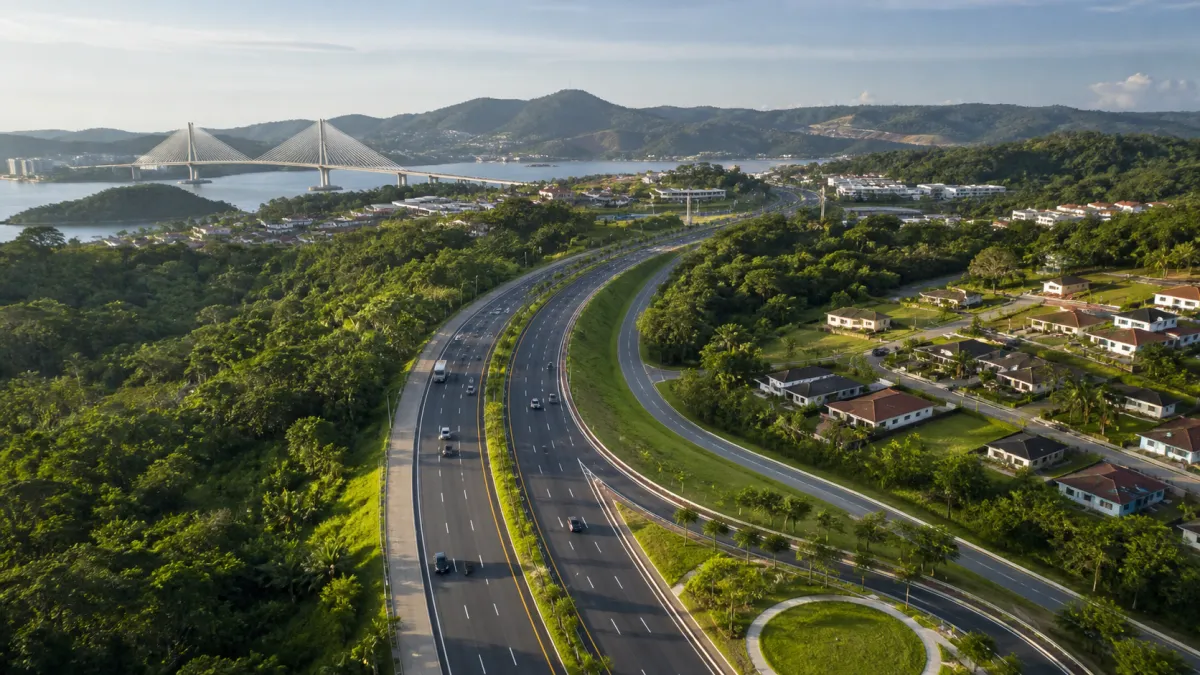
Panama’s B/.606.5 Million Centenario Highway PPP: Where Property Investors Should—and Shouldn’t—Look
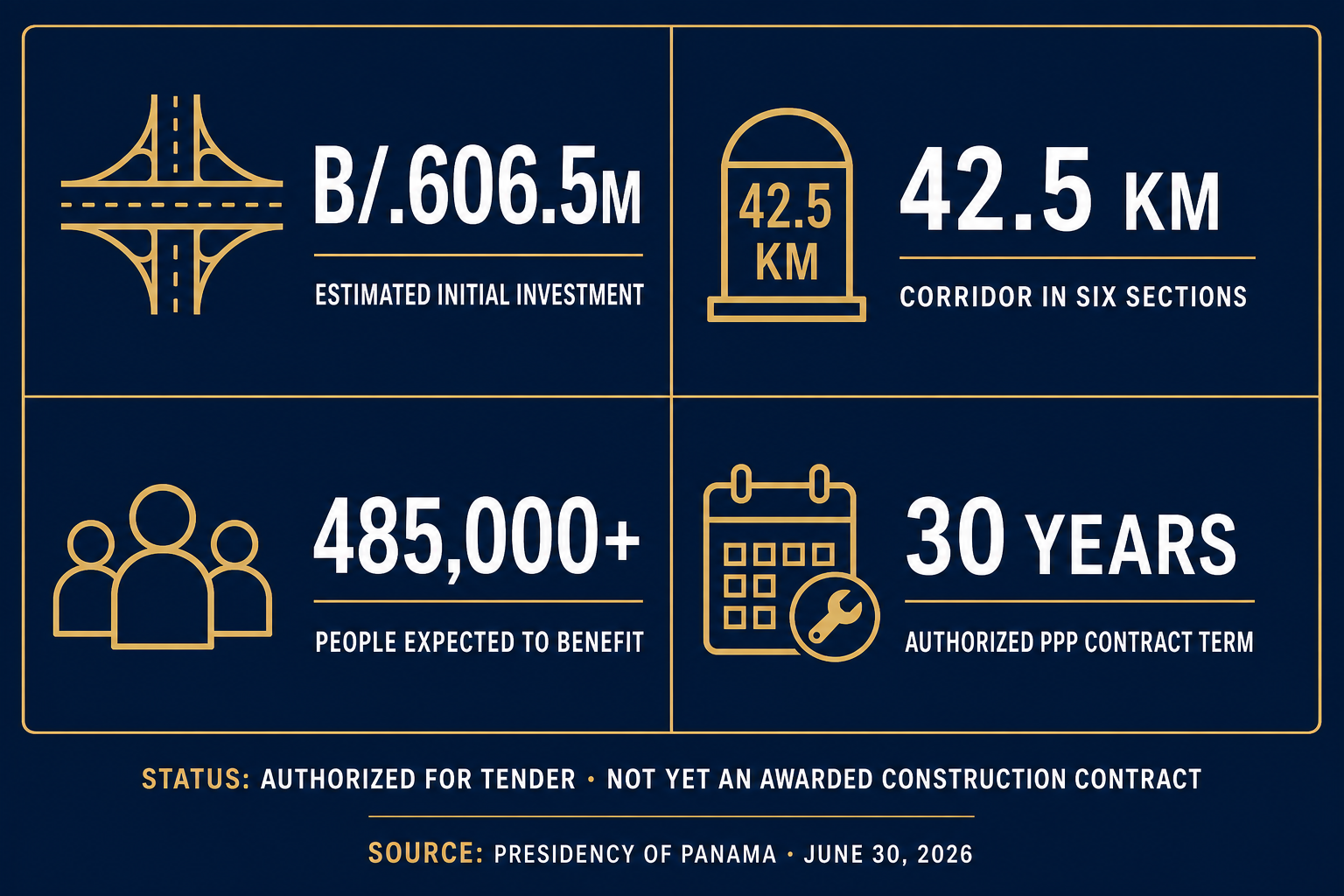
Panama has authorized the tender for a B/.606.5 million public-private partnership to rehabilitate, improve and maintain 42.5 kilometers of the Vía Centenario and the Arraiján–La Chorrera highway. The government says the six-section corridor is expected to benefit more than 485,000 people and support more than 12,000 direct and indirect jobs.
For Panama real-estate investors, this is a meaningful mobility signal. It is not yet a construction-start notice—and it is certainly not permission to add a speculative “highway premium” to every property west of the Canal.
The useful question is narrower: which locations and property types could benefit if the project moves from tender to award, construction and performance-based operation, and how should a buyer price that possibility today?
What Panama approved—and what it did not
On June 30, 2026, Panama’s PPP governing body approved the definitive technical report, tender specifications, proposed PPP contract and annexes for the Centenario project. That completed the feasibility stage and authorized the tender to begin.
The latest official announcement describes an estimated initial investment of B/.606.5 million, 42.5 kilometers divided into six sections, intelligent transport systems for traffic and incident management, and a 30-year contract intended to keep the corridor maintained to measurable performance standards.
That distinction matters. Authorization to tender is not the same as an awarded contract. Panama’s official PPP process still includes tender activity, award, contract signature and Comptroller General review before execution. Contractor proposals, financing, design details and timing can change along the way.
An earlier Ministry of Public Works concept described capacity improvements including widening sections of Vía Centenario and the Arraiján–La Chorrera highway. Investors should treat the final tender documents and eventual signed contract—not an older concept presentation—as the controlling scope.
Sources: Presidency of Panama, June 30, 2026 (https://www.presidencia.gob.pa/publicacion/autorizan-licitacion-de-proyecto-app-para-modernizar-la-autopista-centenario-inversion-de-b-606-5-millones-que-generara-mas-de-12-mil-empleos); National PPP Secretariat process guide (https://snapp.gob.pa/proceso-app/).
Why this corridor matters to housing demand
Road infrastructure does not create property demand by itself. It changes the friction between a home and the jobs, schools, hospitals and services that make people willing to live there.
That friction is already visible west of the Canal. In an October 2025 project briefing, the Ministry of Public Works said more than 100,000 people use the corridor daily and cited a traffic forecast rising from about 41,000 vehicles per day in 2022 to more than 112,000 by 2040. Forecasts are not guarantees, but the direction explains why long-term maintenance and capacity are economically important.
For a family deciding between a smaller home in central Panama City and more space in Arraiján or La Chorrera, the commute is often the decisive tradeoff. A corridor that becomes safer and more reliable can widen the buyer and tenant pool. A corridor that remains unpredictable limits how much affordability converts into demand.
Source: Ministry of Public Works project briefing, October 13, 2025 (https://www.mop.gob.pa/index.php/prensa/sala-de-prensa/item/5637-gobierno-avanza-en-proyectos-app-con-la-aprobacion-del-plan-para-la-via-centenario-y-autopista-arraijan-la-chorrera).
Where investors should watch
Arraiján and Burunga: connectivity is valuable, but feeder roads decide the outcome
Arraiján sits closest to the metropolitan side of the western growth corridor. Communities near dependable access points may gain from better regional circulation, especially when Metro Line 3 and wider road investments are considered together.
The caveat is local access. A faster highway does not help a development trapped behind a narrow feeder road, an unsafe intersection or a flood-prone entrance. Inspect the final kilometers between the interchange and the property during weekday peaks, not on a quiet Sunday showing.
La Chorrera: the strongest case is self-sufficient urban demand
La Chorrera is not only a bedroom community. Its retail, education, healthcare and employment base gives it demand that does not depend entirely on commuting into Panama City. Better corridor performance would strengthen that position, but investors should favor neighborhoods with nearby daily services and proven long-term rents.
This is generally a family-housing and long-hold appreciation thesis, not a short-stay tourism thesis. Two- and three-bedroom units, parking, water reliability and school access can matter more than resort-style amenities.
Canal Area and western Panama City: reliability can protect established demand
Clayton, Albrook, Condado del Rey and communities around the Canal Area already attract professionals, families, students and institutional tenants. Their investment case does not require the Centenario project, but improved western connectivity can make cross-Canal employment and family networks easier to serve.
Do not confuse separate projects. Improvements to the Omar Torrijos corridor, access to Ciudad de la Salud and Merca Panamá, Metro Line 3, the Fourth Bridge and the Centenario PPP have different scopes and timelines. A property brochure that bundles them into one guaranteed mobility story is overselling.

Three property strategies that fit the corridor
1. Family-oriented resale
Owner-occupiers usually value predictable travel more than a theoretical yield calculation. Secure communities with practical floor plans, two parking spaces where the market expects them, backup water and access to schools are better positioned than projects built around a distant infrastructure promise.
2. Long-term rentals near jobs and services
Long-term rental demand can benefit when commuting becomes more reliable, but today’s rent must still support the purchase. Ask for signed lease evidence and vacancy history from the same development. Do not substitute asking rents from a portal for achieved results.
3. Selective land or commercial exposure
Road upgrades can improve logistics and neighborhood retail, yet land speculation carries the widest outcome range. Zoning, utilities, access rights, environmental constraints and the exact interchange design matter more than straight-line distance to the highway. This is where legal and engineering due diligence becomes non-negotiable.
The risks investors should price in now
Execution risk. The project is authorized for tender, not awarded. Procurement, financing, approvals or design revisions can affect timing and scope.
Construction disruption. Even a successful project can create years of detours, noise and unpredictable travel before benefits arrive.
Bottleneck migration. More highway capacity can move congestion to local exits, bridges and feeder streets rather than eliminate it.
Pricing risk. Sellers may capitalize the full future story before a buyer receives any practical benefit.
Operating-cost uncertainty. Do not assume a future toll structure, user charge or access arrangement until the final contract and operating rules are public.
Service risk. Water, drainage, power, internet and property management can still dominate livability even when the regional road improves.
The government’s performance-based maintenance model is a positive structural feature because it is designed around service standards over decades. But investors should still separate the public project’s risk allocation from the private risk of owning a specific home, condo or parcel.
A better way to underwrite the infrastructure upside
Use a base case that works with today’s road, today’s rent and today’s travel time. Treat the PPP as option value rather than required value.
Stage 1: tender
Track the published scope, bidder requirements and environmental or social obligations. This is when older presentations should be replaced with current documentation.
Stage 2: award, signature and review
Confirm the winning proposal, contract term, financing, performance standards and the milestones that trigger obligations. An announcement of a preferred bidder is still not the same as a fully effective contract.
Stage 3: construction and operation
Only after work progresses should an investor begin using observable changes—safer access, more reliable trip times, new employer activity or stronger achieved rents—to justify higher assumptions.
This staged approach prevents a common mistake: paying today for benefits that may arrive later, arrive differently, or already be reflected in the asking price.
Yield versus appreciation: the honest split
For yield investors, the Centenario PPP should have almost no weight in the current income calculation. Net yield comes from the signed rent, realistic vacancy, management, maintenance, insurance, taxes where applicable and the development’s actual operating quality.
For appreciation investors, the project is more relevant. Durable mobility improvements can deepen the resale market and make western communities more practical for households priced out of central districts. The best appreciation candidates, however, will usually combine infrastructure exposure with fundamentals that already work.
The disciplined position is simple: buy a sound property first and accept the highway improvement as upside. Do not buy a weak property and ask the highway to rescue it.
Due diligence before you buy near the corridor
Map the property to a verified interchange and drive the feeder route at morning and evening peaks.
Review current achieved sale and rental comparables inside the same development.
Check title, zoning, easements, access rights and any road-reserve impact with a qualified Panamanian attorney.
Inspect drainage, flood exposure, water storage, power reliability and internet service.
Ask the administrator about occupancy, delinquency, maintenance reserves and planned assessments.
Model a hold period long enough to absorb procurement and construction uncertainty.
Infrastructure can expand opportunity, but it does not replace property-level diligence.
The investor takeaway
Panama’s B/.606.5 million Centenario highway PPP is one of the clearest 2026 signals that mobility between Panama City and Panama Oeste is moving up the national investment agenda. The authorized 42.5-kilometer, performance-based program could support safer travel, stronger regional integration and a deeper housing market over time.
The immediate opportunity is not to chase every listing near the road. It is to identify properties that perform under current conditions and have credible exposure to future improvements without requiring them.
If you are comparing Arraiján, La Chorrera, the Canal Area or other western corridors, book a free consultation with Luca Piva and the Panama Investors team (https://panamainvestors.com/book-now). We can help you test the property, access and hold-period assumptions before you commit capital.
